

Bitcoin prices this week have fully retraced their gains, falling to a critical support level. This downturn follows a higher-than-expected Producer Price Index (PPI) report and remarks from Federal Reserve Chair Jerome Powell, both of which have dampened hopes for interest rate cuts this year.
Stronger PPI data typically signals that inflation at the wholesale level is cooling slower than anticipated, potentially leading to higher consumer prices.
Investors were already cautious prior to Powell's speech, and the unexpected strength in inflation data further impacted market sentiment. Expectations for rate cuts have significantly diminished, with futures markets now largely pricing in a pause in rate hikes before the Federal Open Market Committee (FOMC) meeting.
Despite widespread expectations of a pause, the recent string of hawkish signals has unsettled investors, raising concerns about further delays in monetary easing.
Can Bitcoin Price Find a Bottom?
Bitcoin's price is now approaching the crucial $70,000 support level, a point considered a significant psychological and technical barrier by analysts.
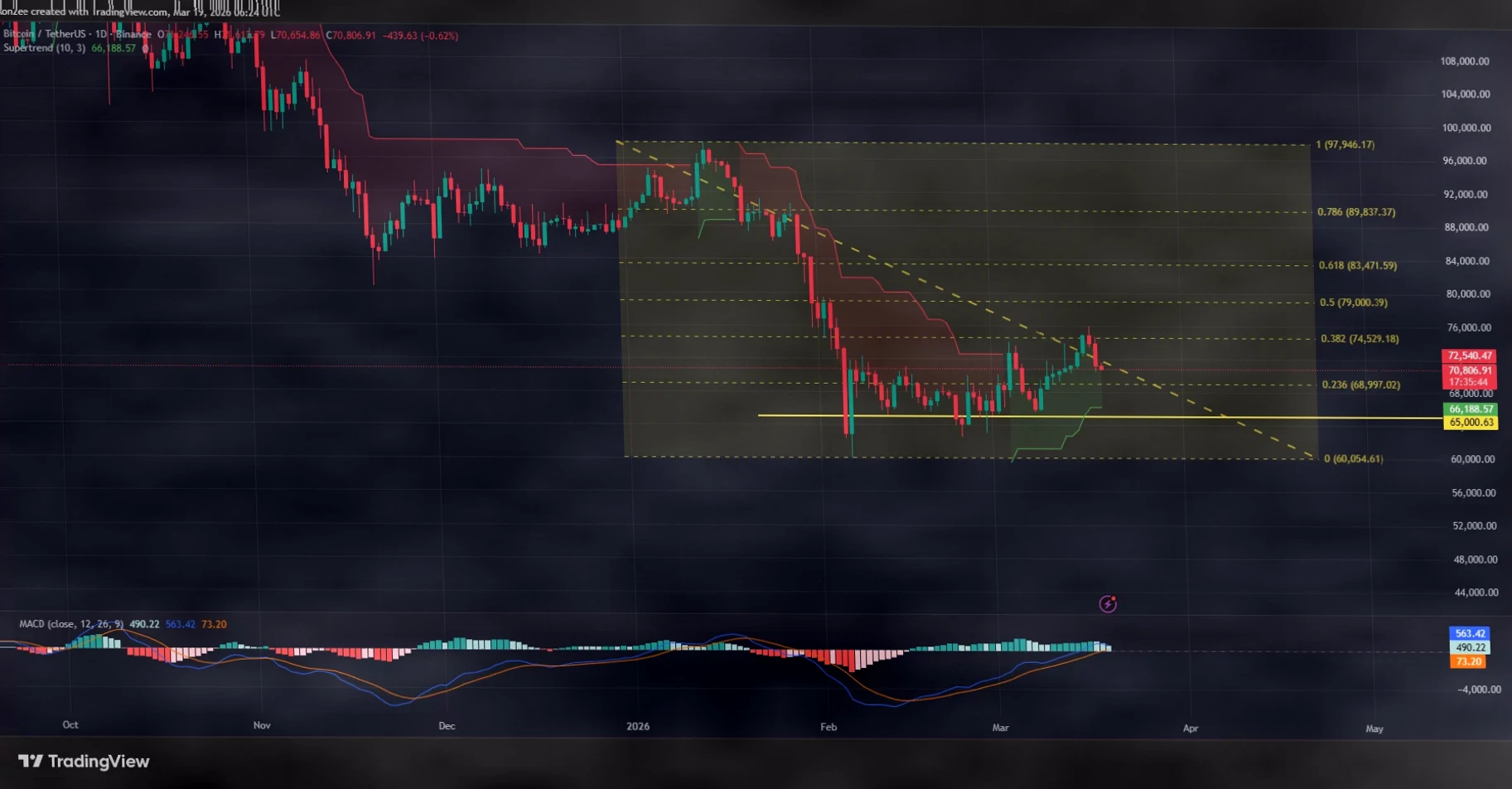
Technical indicators are showing some positive signs that could foreshadow a potential rebound. Notably, the Supertrend indicator has flashed a green signal. When this indicator turns green, it typically signifies a shift in the overall trend from bearish to bullish, often acting as a buy signal for momentum traders.
Concurrently, the MACD indicator, which measures the relationship between two moving averages of a security's price, is trending upwards. This suggests that downward pressure is easing, and a bullish crossover may be imminent.
Currently, immediate resistance in the short term lies at $72,540, the upper band of the Supertrend. A break above this level could propel Bitcoin towards the $74,500 mark, aligning with the 38.2% Fibonacci retracement level.
Conversely, a decisive break below the $70,000 support could lead to a retest of $65,000, or even a further decline to $60,000, representing the next major liquidity zones.