

Recently, a California court dismissed a summons request from a Coinbase user attempting to prevent the Internal Revenue Service (IRS) from accessing their financial records. This marks the second similar case in the past year that failed to reach the trial stage.
The user, Roger Metz, and his attorneys argued that the IRS summons infringed upon his privacy rights, was overly broad, and failed to meet basic administrative requirements. Metz's lawyers also contended that by the time the IRS issued the summons in 2024, he had already self-identified and corrected errors, filed amended tax returns, and paid any outstanding taxes.
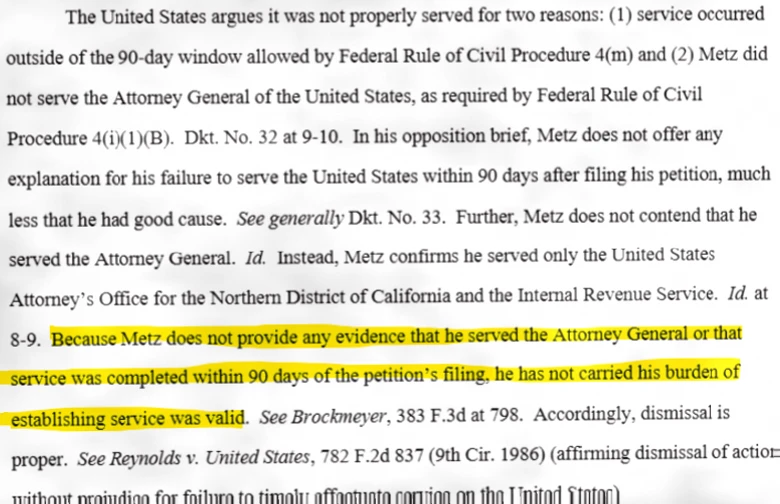
The judge dismissed Roger Metz's lawsuit due to his failure to follow necessary procedures.
However, U.S. District Judge Araceli Martínez-Olguín dismissed Metz's lawsuit in a ruling on Wednesday. The judge determined that Metz failed to notify the relevant government officials of the lawsuit within the statutory 90-day period, leading to the case's dismissal on procedural grounds.
Case Dismissed for 'Improper Service'
According to court documents, Metz admitted to serving the summons on the U.S. Attorney's Office for the Northern District of California and the IRS, but acknowledged failing to notify the Attorney General of the United States in Washington within the 90-day deadline. Government lawyers argued this was sufficient grounds for dismissal.
Judge Martínez-Olguín stated in her ruling: "In his opposition, Metz has offered no explanation, let alone a justification, for his failure to serve the United States within 90 days of filing his petition."
She added, "Dismissal is appropriate when service of process is improper."
The dismissal was "without prejudice," meaning Metz can refile the same lawsuit at a later date.
Cryptocurrency Exchanges Must Provide User Data to Tax Authorities
Tax authorities can also issue "John Doe Summons" to identify a broad group of unknown taxpayers. Through this mechanism, tax authorities can legally compel cryptocurrency exchanges to provide transaction records for customers within a specified range, such as those with transaction volumes of $20,000 or more between 2016 and 2020.