

Dogecoin (DOGE) is currently consolidating around the $0.10 mark, forming a converging pattern that has caught the attention of market participants. Although historical data suggests that such patterns often precede significant price movements, the short-term outlook remains unclear.
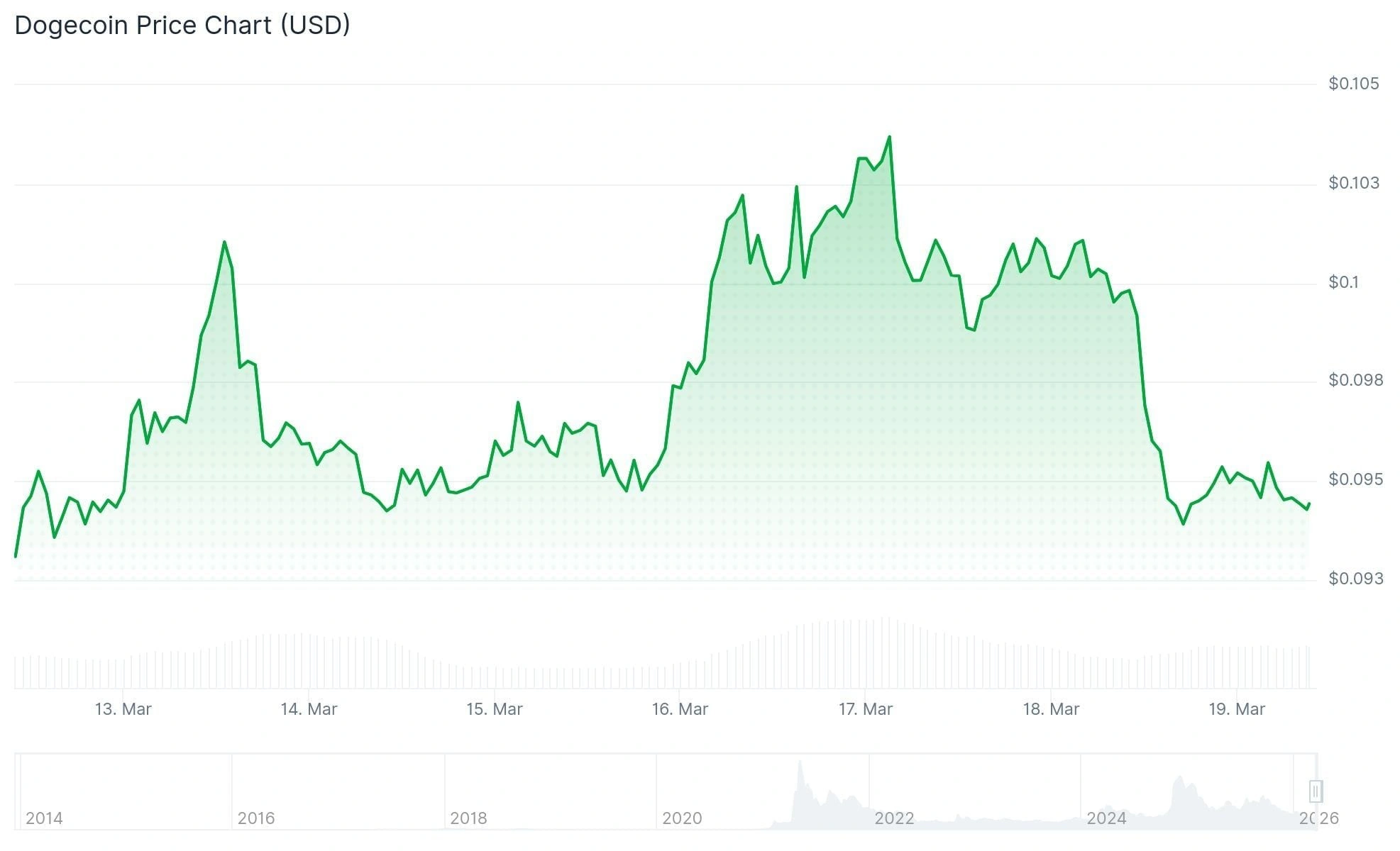
Analysis of the daily chart shows that DOGE is forming a typical descending wedge pattern. This technical formation is characterized by a series of lower highs while the lows converge upwards during a downtrend. As the price channel narrows, it typically leads to a directional breakout. Long-term holders are hoping for a price rebound during this period.
This price compression phase follows a strong performance by DOGE that has since retraced. During this process, Dogecoin has shown a consistent decline in its high points, but the intensity of selling pressure has weakened, which may indicate that bearish market participants are losing momentum.
Resistance Remains Above
Any meaningful rebound will face initial resistance in the $0.105 to $0.11 range. This area aligns precisely with the 0.5 to 0.618 Fibonacci retracement levels calculated from the recent downtrend. Additionally, this zone intersects with a dense area of short-term exponential moving averages, forming a concentrated resistance barrier.
Over the past year, Dogecoin has attempted multiple breakouts above the $0.10 level. However, each time the price has risen above this level, selling pressure has re-emerged, causing the price to retreat. Technical analysts note that this repeated rejection has diminished the credibility of $0.10 as a reliable support level.
If a decisive breakout above $0.11 occurs, it could pave the way for a price increase to $0.116 and potentially reach the next target of $0.136. However, the current price remains below the 50-day, 100-day, and 200-day moving average indicators, maintaining an overall bearish structure.
As of March 18, Dogecoin's trading price is approximately $0.094, down 4.84% on the day.
Regaining the 50-Day EMA is Key
Historically, successfully reclaiming the 50-day exponential moving average (EMA) has been the first reliable signal of a trend reversal for DOGE. In the absence of this technical confirmation, market observers will view any rise above $0.10 as a temporary respite rather than a meaningful reversal.
The Relative Strength Index (RSI) has rebounded from the oversold territory and is currently hovering near the neutral zone, showing mild bullish characteristics. The MACD indicator is also preparing for a potential bullish crossover, suggesting that downward pressure may be easing.
Current market data shows that DOGE is maintaining above a longer-term support base at $0.086, which is the most recent local low prior to the current stabilization attempt.