

RAK Bank in the UAE has recently issued an important notice to its customers, announcing that it will set specific limits on transactions involving the purchase of cryptocurrencies using bank accounts. This new regulation is expected to take effect in the second quarter of 2026, no later than June 2026.
RAK Bank stated that this move aims to help customers feel more confident when engaging in cryptocurrency transactions while ensuring the safety and controllability of their investments. The bank has established different cryptocurrency investment and daily trading limits based on customer segmentation.
Specifically, the trading limit for regular retail customers is set at 240,000 dirhams (approximately $65,000). The limit for RAK Bank Select customers is 576,000 dirhams (approximately $157,000), while RAK Bank Elite customers can have a limit of up to 6 million dirhams (approximately $1.6 million).
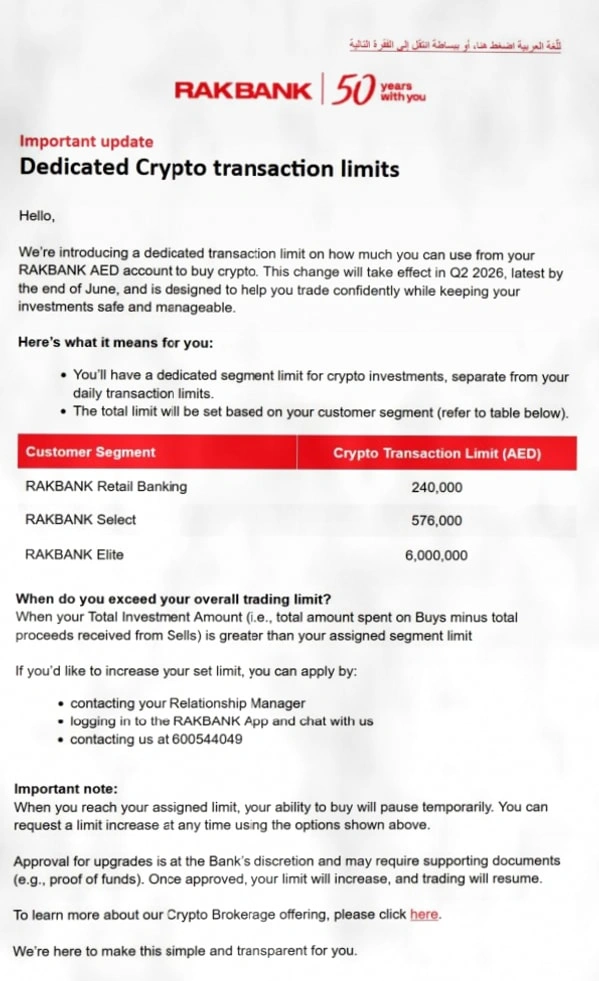
RAK Bank also noted that customers can apply for an increase in their trading limits, but this requires bank approval and may necessitate the provision of supporting documents such as proof of funds.
It is worth mentioning that not all banks in the UAE offering cryptocurrency trading services have implemented similar limit measures. Reports indicate that Zand Bank has not yet set any cryptocurrency trading limits. Previously, Liv Bank was the first to offer cryptocurrency trading services through AquaNow.
RAK Bank became the first bank to launch cryptocurrency brokerage services through its mobile application in 2025, in collaboration with BitPanda.
According to S&P data, the bank currently holds approximately $312 billion in cash or deposits at the central bank, sufficient to handle such capital outflows. Additionally, about $630 billion in buffer funds can be obtained through a discounted investment portfolio.
In the same week that RAK Bank announced its new regulations, the Central Bank of the UAE announced a series of measures to support bank liquidity, including increasing the utilization rate of reserve balances to a maximum of 30%.