

As of noon on March 19, ASTER was trading at $0.684 on Binance, a significant drop from its recent high of nearly $0.780 two days prior, following a sharp multi-day sell-off that saw the price fall below the 50-day moving average. Analysts believe that further downside risks may still lie ahead.
1-Hour Chart Analysis
The chart displays the ASTER/USDT trading pair from the evening of March 17 to the afternoon of March 19, using a 1-hour timeframe, showing a clear downward trend.
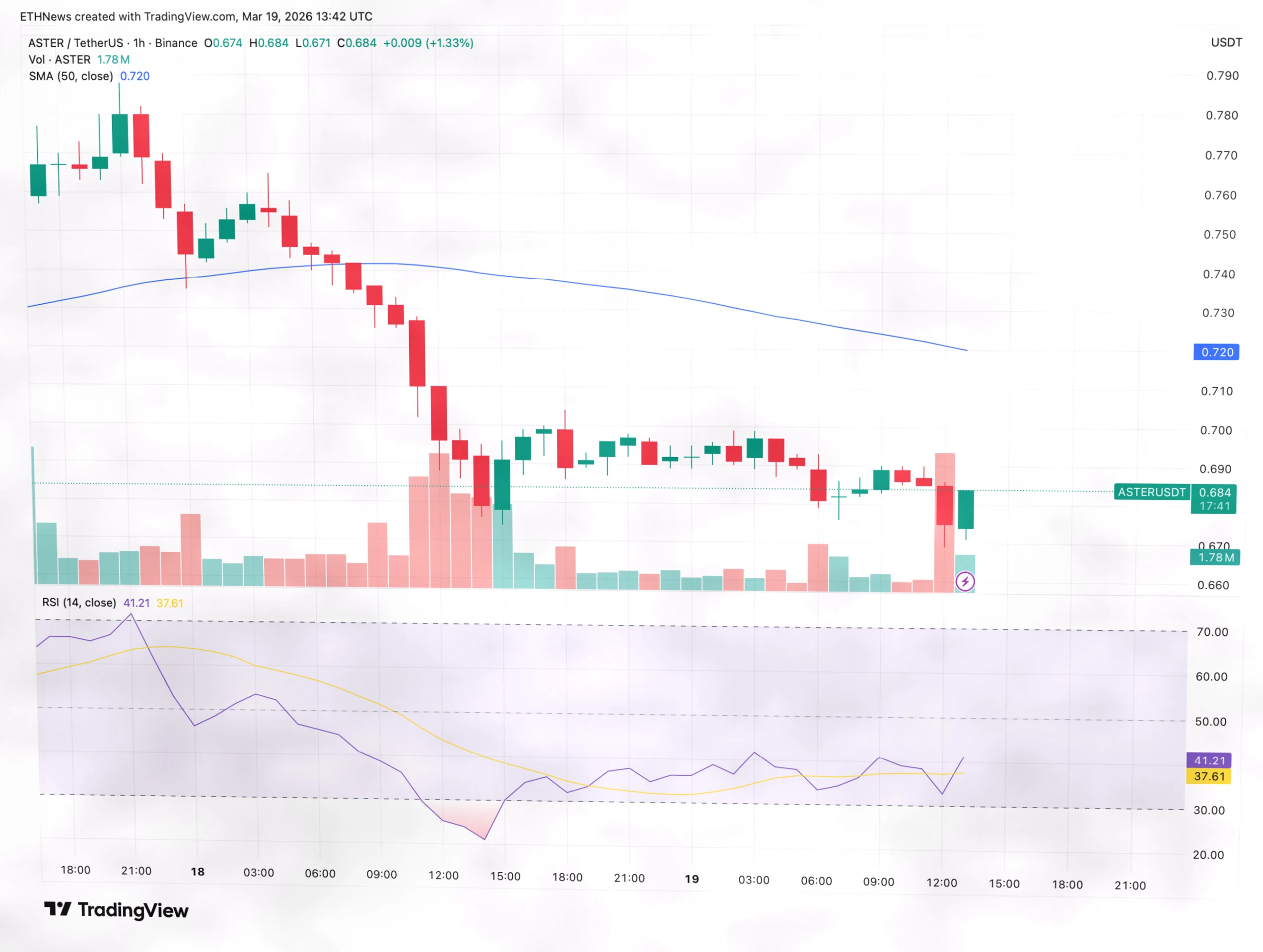
ASTER opened at around $0.765 on the evening of March 17 and briefly rose to $0.780 on the morning of March 18, marking the highest point during the visible period on the chart. At that time, the 50-day moving average was rising near $0.740, with the price consistently above it.
The decline began on the morning of March 18, with a series of large red candles pushing the price down from $0.780 to $0.750, and then further to $0.720, until it briefly touched $0.700 by noon. The volume panel indicated that the most significant pink histogram bars were concentrated during this period, confirming that the price movement was driven by substantial selling pressure rather than low-volume drift. Subsequently, the price stabilized briefly between $0.688 and $0.695 in the afternoon and evening of March 18, attempting a slight recovery overnight.
However, this recovery was halted near $0.693 on the morning of March 19, and the price slid again, reaching a low of $0.671, before the most recent candle slightly rebounded to $0.684. The current 50-day moving average is at $0.720, sloping downwards, significantly above the current price, with a gap of about 5.3%. Since the drop on March 18, the price has not interacted with the moving average.
RSI Bounce Does Not Indicate Trend Reversal
The RSI panel shows the fast purple line at 41.21 and the slow yellow line at 37.61. The purple line has been rising since its visible low point on the chart (around noon on March 18, dropping to 25), which was the most oversold moment on the chart.
The divergence between the two lines, with the purple line above the yellow line, reflects a short-term momentum recovery after the oversold washout, but does not indicate a trend reversal. Both signals remain below the midpoint of 50, and the yellow line has yet to respond to the purple line's rebound, suggesting that long-term momentum has not confirmed a change in direction.
False Breakout in Long-Term Chart
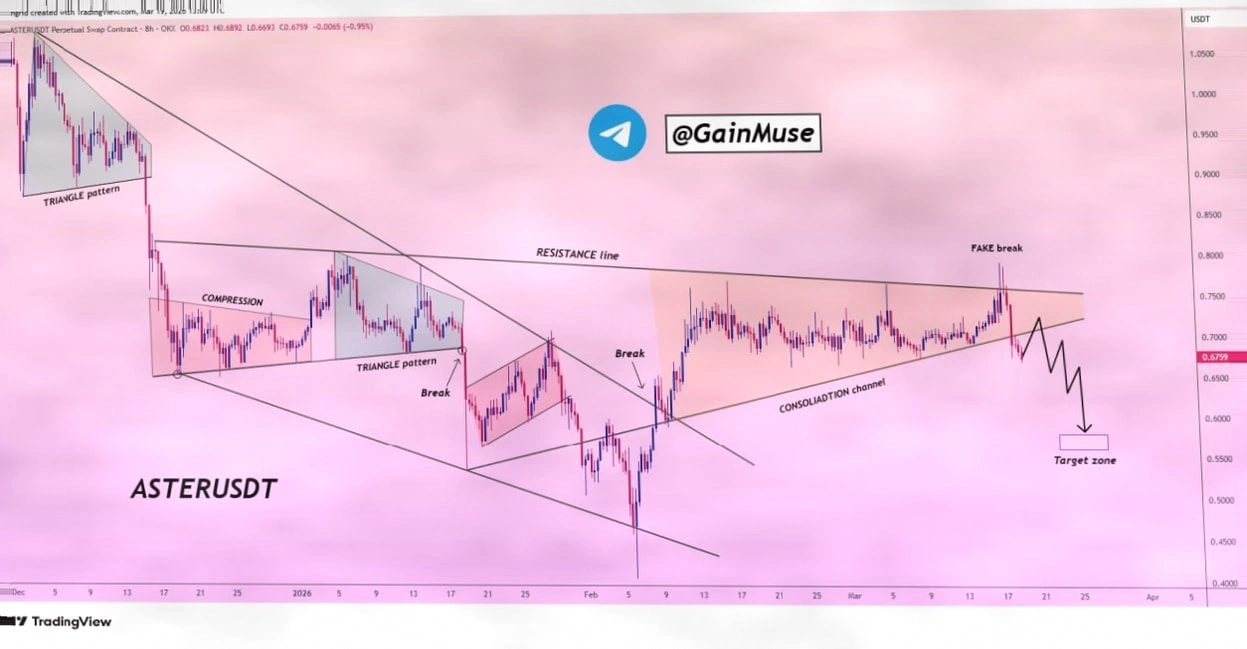
A key observation is a false breakout. ASTER attempted to break through the downward resistance line of the consolidation channel but quickly reversed. This pattern typically indicates a brief breakout above resistance followed by a pullback, often trapping buyers who entered on the breakout signal. Trapped buyers become sellers when the price reverses, further increasing downward pressure.
GainMuse has identified a target area.