

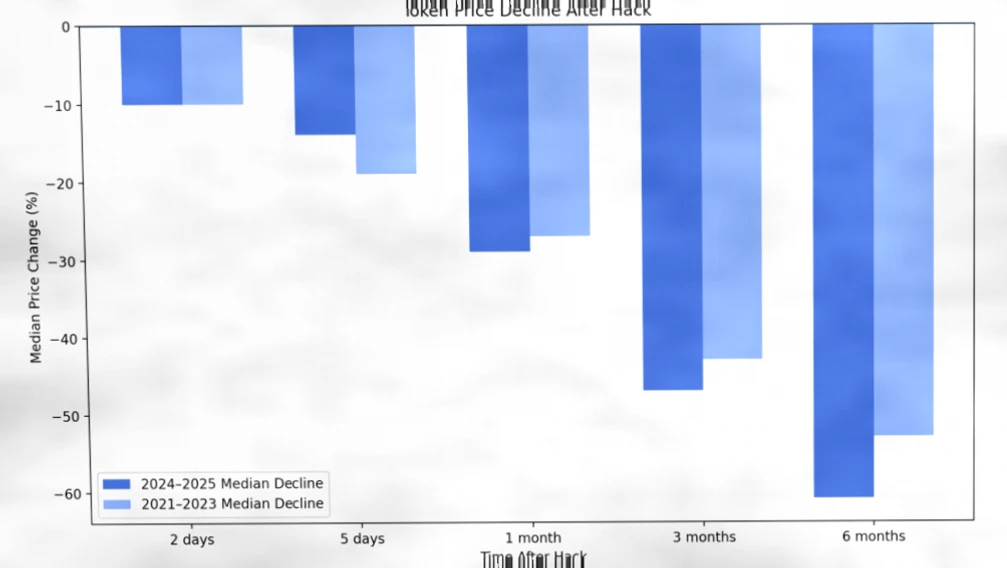
Victims of cryptocurrency theft face losses far beyond the immediate digital figures. According to a recent report by Immunefi, affected tokens experience an average decline of 61% within six months and rarely recover to pre-theft levels. This stark reality is reshaping perceptions of risk within the crypto space.
The Market's Instant Sanction on Crypto Theft Incidents
This phenomenon reflects a profound shift in market perception. Immunefi CEO Mitchell Amador points out that the market has become "less forgiving." Security breaches are no longer viewed as mere technical accidents but as indicators of deeper issues such as structural flaws, poor governance, inadequate code audits, and a lack of risk management.
This erosion of trust is often irreparable in today's market, dominated by demanding institutional investors, with impacts extending far beyond the initial financial losses.
DeFi News and Capital Concentration Amplify Systemic Risk
Another significant lesson revealed by the report concerns the market's own structure. Losses are not evenly distributed but are concentrated in a few large-scale theft incidents. Of the $4.67 billion lost between 2024 and 2025, just five attacks accounted for 62% of the total losses.
Centralized platforms exemplify this paradox. Despite being attacked less frequently, they hold vast amounts of capital. Approximately twenty attacks resulted in over half of the total losses, indicating that the scale of targeted assets is as important as the frequency of attacks.
However, the most severe threats emanate from Decentralized Finance (DeFi News). Its networked architecture acts as a crisis amplifier: an isolated incident can rapidly cascade through lending, liquidity, or collateral protocols that are not directly affected.
The collapse of Elixir's deUSD stablecoin at the end of 2025 serves as a prime example. Elixir had deposited approximately 65% of its collateral with Stream Finance. When the latter disclosed a $93 million loss due to an external manager, the chain reaction was devastating. Stream's xUSD stablecoin plummeted by 77%, deUSD redemptions were immediately halted, and panic selling swept through Curve pools, ultimately leading to deUSD losing over 97% of its value.
A single failure within a partner agreement was enough to trigger the collapse of an entire ecosystem.