

According to cryptocurrency analyst Merlijn The Trader, Ethereum (ETH) has exhibited the "three-step bull trap" pattern twice within four months. This structure is relatively simple: three consecutive rebounds, each accompanied by a peak confirmation from the Stochastic RSI, followed by a pullback and sharp sell-off. The price action in November last year perfectly matched this pattern. Now, a similar Stoch RSI configuration has reappeared in March, with prices hovering above $2,000 — analysts believe this is the last line of defense.
The unresolved question on the chart is clear.
The analyst's perspective presents a binary characteristic: if it maintains above $2,000, the trap will be invalidated, and the bulls will regain control; if it falls below this level, history will repeat for the third time.
Glamsterdam: Ethereum's Most Ambitious Hard Fork Yet
The main feature of this hard fork is EIP-7928, which introduces block-level access lists to enable parallel transaction processing. This change shifts Ethereum from sequential execution to a multi-lane model, aiming to process 10,000 transactions per second — a significant improvement over current capabilities.
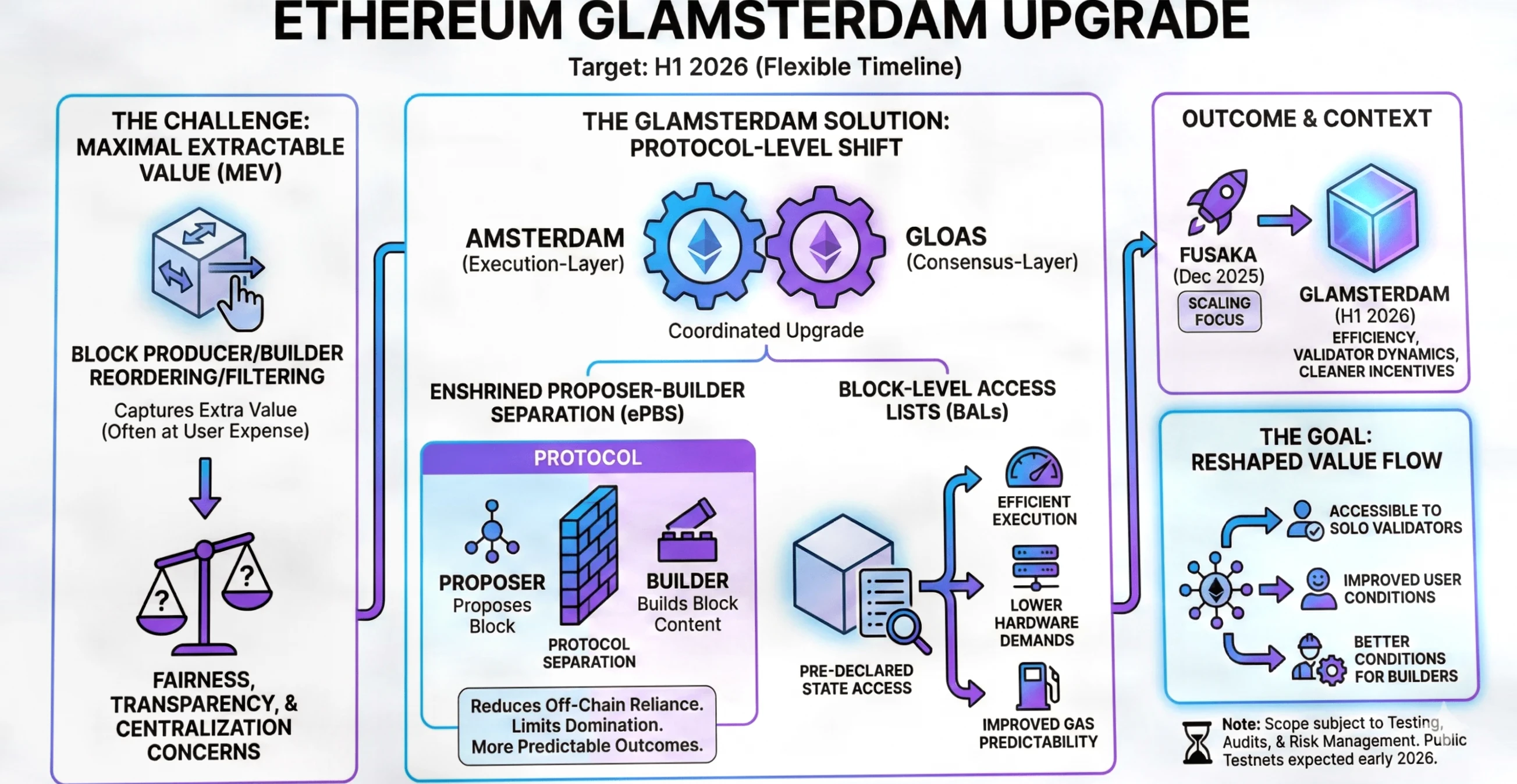
EIP-7732 addresses another issue: by implementing proposer-builder separation on-chain, it eliminates reliance on third-party relay infrastructure (like Flashbots). Developers estimate this could reduce the proportion of high-frequency trading profits (MEV) extraction by up to 70%, which is significant for regular users who currently bear these costs silently.
Regarding gas fees, EIP-7904 readjusts fees based on modern hardware benchmarks, with expectations of a 78.6% reduction in costs for simple transfers and complex smart contract interactions. Combined with plans to raise the block gas limit from 60 million to 200 million, Glamsterdam undoubtedly represents a true leap in scalability rather than a mere patch.
BlackRock Enters Ethereum Staking Market
The fund's staking ratio for its Ethereum holdings ranges between 70% and 95%, distributing approximately 82% of total staking rewards to investors on a monthly basis, with the current annual yield around 3.1%. BlackRock charges a 0.25% management fee, which will be discounted to 0.12% for the first year or until fund assets exceed $2.5 billion.

Bitcoin Holds Steady at $70,000 Amid $1.7 Billion Options Expiry and Geopolitical Pressures
BitMine Continues Accumulation
Currently, over 3 million of the tokens are staked, generating an annual income of approximately $180 million. BitMine's accumulation strategy is similar to MicroStrategy's approach with Bitcoin: treating the asset as a long-term treasury position and actively accumulating during volatility.
The correctness of this belief largely depends on the support at $2,000. Technical charts suggest caution, while institutional schedules show momentum. Ethereum is facing dual pressures.
Outlook for Ethereum in 2026
The remaining time in 2026 will become a decisive turning point.