

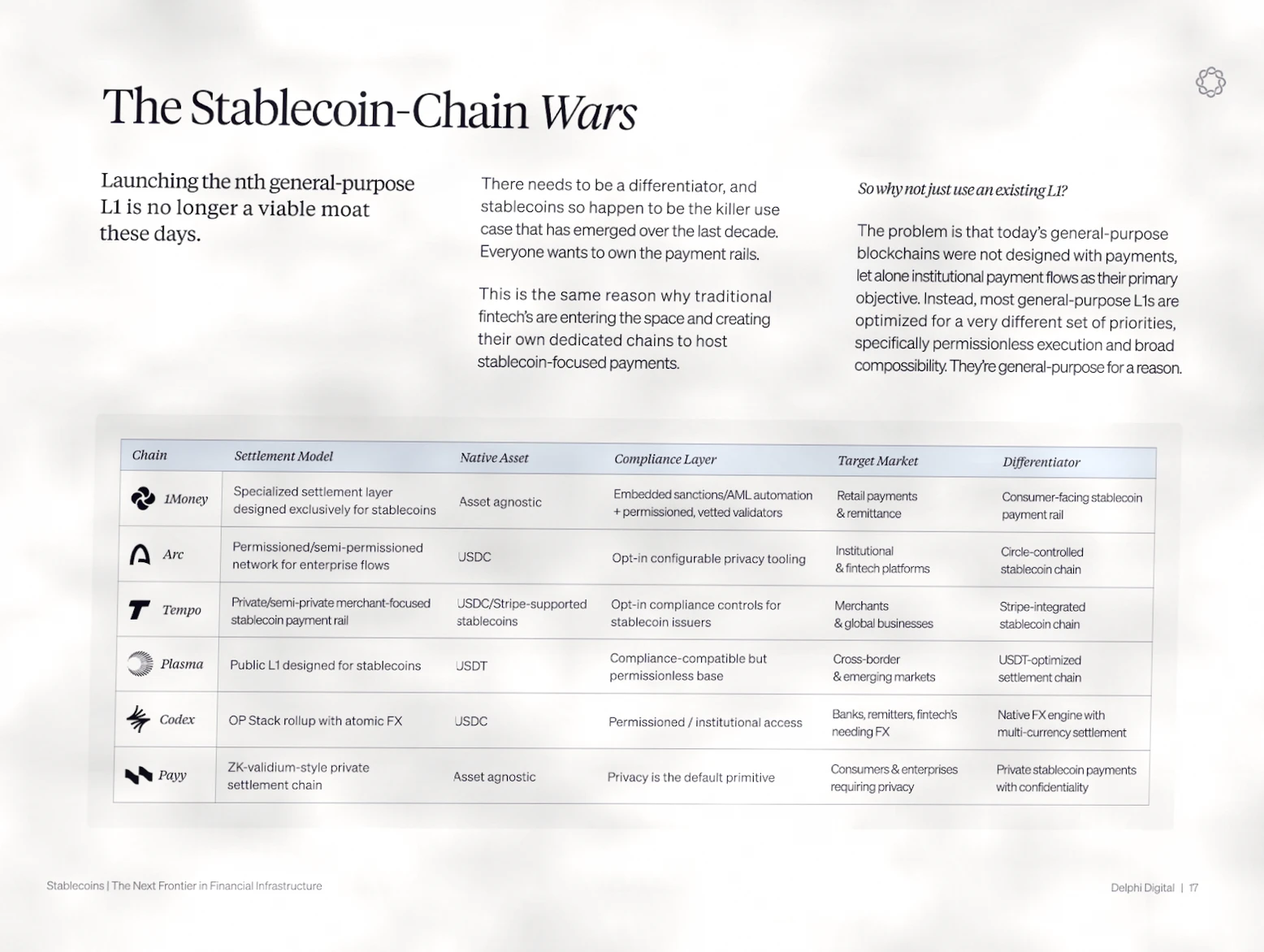
Stablecoin issuers and their associated fintech enterprises are actively launching blockchain networks focused on payments, vying for control over the settlement infrastructure behind U.S. digital dollar transactions.
These developments signal a structural shift in the industry, moving from general-purpose blockchain infrastructure towards payment-centric networks. In this context, companies are competing for the payment networks that underpin stablecoin settlements, with the practical application of stablecoins being identified by Delphi Digital as one of the clearest opportunities in the cryptocurrency space.
Fintech companies are also joining the wave of payment infrastructure development, aiming to secure a position in the growing stablecoin payments market.
Ran Goldi, Senior Vice President of Payments and Networks at digital asset custody platform Fireblocks, highlighted that owning a payment network is "strategically significant." He added that for payment companies, controlling the underlying network means avoiding additional costs associated with stablecoin minting and burning operations.
Fintech companies are also entering the stablecoin competition.

Research from Delphi Digital indicates that through relevant partnerships, Stripe has gained greater control over the issuance, wallet, and billing aspects of stablecoin payments, as well as the settlement infrastructure.
Alvin Kan, COO of Bitget Wallet, believes that stablecoin payment infrastructure is increasingly being viewed as a new "yield layer." Entities capable of controlling the end-to-end payment process will have the opportunity to capture fees from every transaction.
He further explained, "As settlement costs at the protocol layer continue to decrease, value capture is shifting towards the organizational layer surrounding payment networks: including compliance, foreign exchange, wallet infrastructure, on-ramps and off-ramps, local payment connections, and merchant integrations."
Irina Chuchkina, Chief Growth Officer at Wallet in Telegram, stated that controlling the settlement infrastructure behind stablecoins has become the next battleground for cryptocurrency and fintech companies. She predicts that companies building settlement networks interoperable with agentic AI will be able to "capture the vast majority of value flowing through these networks."