

Key Takeaways
U.S. stock markets faced renewed selling pressure on Friday, March 20th, with major indices registering their fourth consecutive week of negative returns. This weakness was primarily attributed to elevated crude oil prices and persistent concerns over escalating tensions in Iran.
The Dow Jones Industrial Average shed approximately 300 points, or about 0.7%, during Friday's trading session. The S&P 500 index declined by roughly 1%, while the tech-heavy Nasdaq Composite saw a steeper drop of approximately 1.3%.
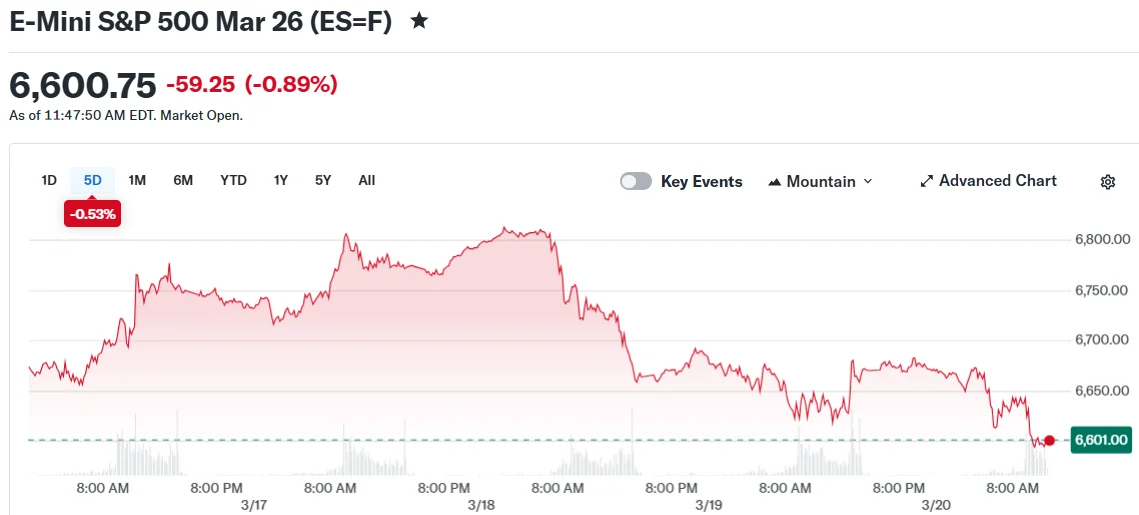
If the Dow Jones finishes the week in negative territory, it would mark its longest losing streak since the four-week period ending February 24, 2023. The S&P 500's most recent four-week slide occurred in March 2025.
The Nasdaq, which experienced a five-week losing streak earlier this year, is now approaching correction territory, mirroring the Dow Jones' situation.
Investor anxiety has been on the rise since late February, following coordinated military actions by the U.S. and Israel against Iranian targets on February 28th. Throughout this period, oil prices have remained elevated, adding pressure to market sentiment.
Market uncertainty intensified on Friday with an Axios report indicating that the Trump administration is evaluating strategies such as occupying or establishing a maritime blockade around Kharg Island, a key Iranian oil export facility near the Strait of Hormuz, to pressure Tehran into reopening maritime traffic.
Iran continued its attacks on neighboring Gulf states on Friday. Market observers warn that damage to infrastructure will exert upward pressure on oil prices in the long term.
Oil Prices Dominate Market Direction
Paul Hickey, co-founder of Bespoke Investment Group, noted that Friday's trading direction was "almost entirely dictated by oil prices." With a lack of significant data releases or corporate earnings on the economic calendar, geopolitical developments emerged as the primary market driver.
Friday's trading coincided with Quadruple Witching Day, the simultaneous expiration of stock options, stock index futures, and stock index options contracts. These quarterly events typically lead to heightened trading volatility.
David Lout, Chief Investment Officer at Kerux Financial, stated that the dynamics of Quadruple Witching could exacerbate volatility, given the market's already fragile state entering the session.
The S&P 500 broke below its 200-day moving average during Thursday's trading, a technical threshold closely watched by technical analysts. Frank Cappelleri of CappThesis pointed out that while a single breach of this level does not necessarily confirm future weakness, it does represent a significant turning point.