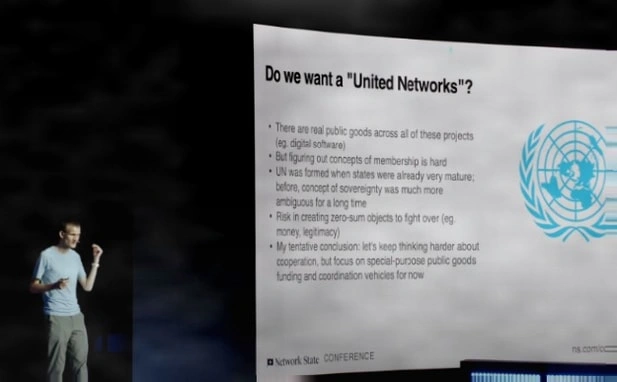
Network states are decentralized social structures proposed by the crypto community, using blockchain for global distributed governance. This article analyzes real-world experiments like Liberland and Zazulu, discussing their feasibility and controversies.
The cryptocurrency community has long been exploring the construction of a new type of social structure – the ‘Network State.’ This concept proposes that, without relying on traditional geographical boundaries, like-minded individuals can be connected into a distributed political entity through blockchain technology and cryptocurrencies. Its core idea, proposed by crypto thinker Balaji Srinivasan, advocates using shared values as a bond and leveraging digital tools to achieve the decentralization of governance and identity.
Although this vision has not yet been implemented on a large scale in reality, several experimental projects have attempted to turn it into reality. In 2023, approximately 200 supporters gathered in Montenegro to establish an experimental community called Zazulu, with the support of Ethereum co-founder Vitalik Buterin. Participants live and work together, practicing healthy eating, cold water bathing, and meditation, aiming to explore the operational challenges of a network state in daily life.
An earlier attempt can be traced back to 2015 when Czech libertarian Vit Jedlicka declared the establishment of ‘Liberland’ on a piece of unclaimed land on the Danube River. This land was neglected by both Croatia and Serbia due to river channel changes in the 19th century. Today, Liberland has developed an active online community and issued a governance token called ‘Liberland Merit’ and an official currency called ‘Liberland Dollar,’ attempting to achieve digital sovereignty through blockchain.
In Norway, a group of tech geeks also launched the ‘Liberstad’ community, attempting to manage resources and decisions through decentralized protocols. Although these projects are limited in scale, they reflect a deep reflection on governance models in the digital age.
However, the concept of a network state has also sparked widespread skepticism. Critics point out that its ‘single core principle’ is difficult to maintain in practice and is prone to evolving into a digital oligarchy dominated by technical elites. Historical experience shows that autonomous experiments that deviate from social contracts and legal frameworks are often difficult to sustain and may even replicate old power structures.
Nevertheless, supporters believe that its value lies not in whether it is ‘feasible’ but in stimulating a rethinking of the essence of the state. As encryption technology increasingly penetrates public life, the network state is no longer just a utopian fantasy but an unavoidable social experiment.
Currently, El Salvador's ‘Bitcoin City’ plan, although endorsed by the government, is more regarded as a symbolic move and has not yet formed a true distributed governance structure. In contrast, grassroots projects such as Zazulu and Liberland are closer to the ideal model of a network state, although they are still in their early stages.
In the future, can the network state break through the tech bubble and build a sustainable digital civil society? The answer remains to be seen. But what is certain is that it has profoundly influenced the global discussion on sovereignty, identity, and collaboration.
0 comment A文章作者M管理员
No Comments Yet. Be the first to share what you think
❯
Profile
Search
Checking in, please wait...
Click for today's check-in bonus!
You have earned {{mission.data.mission.credit}} points today