

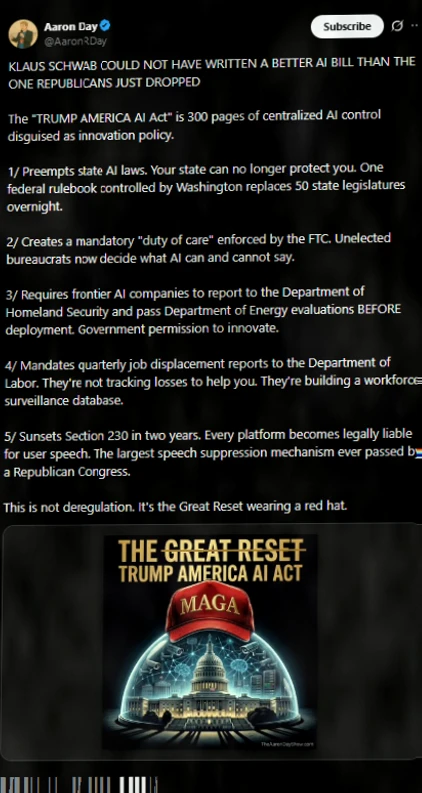
The Trump administration unveiled a sweeping legislative proposal on Friday aimed at establishing unified national standards for artificial intelligence (AI), stripping states of the power to enact their own AI laws while setting safety rules for the rapidly evolving technology.
The White House stated the move is intended to protect children and prevent high energy bills from the growth of AI infrastructure from impacting communities.
During a signing ceremony earlier this month, Trump made his position clear. "We want a central approval agency, and we have strong Republican support," Trump said. "I think we might get Democratic support too, because it's common sense. Every time you make a change, even a very reasonable change, if you have to go to 50 states, you can't get it approved. This centralizes the approval process."
AI has become a significant profit driver in the tech industry in recent years.
The White House plans to work with Congress to transform this new framework into actual law.
Six Areas, One Goal
Regarding child safety, the proposal would grant parents direct control over their children's accounts and devices to protect their privacy and increase tools to combat online exploitation and self-harm risks.
Additionally, the plan calls for strengthening government tools to combat AI-driven cyber fraud and national security threats.
On intellectual property, the White House stated it wants an approach that allows AI companies to thrive while protecting the rights and identities of American creators and publishers.
Free speech is also addressed. The proposal includes measures to prevent AI systems from being used to suppress or silence legitimate political viewpoints or public dissent.
To maintain America's lead in the global AI race, the framework aims to remove barriers to building advanced AI systems.
International companies like China's Alibaba are also vying for dominance in the AI space.
Finally, the administration wants Congress to invest in job training programs so that American workers can benefit from the economic gains AI is expected to bring.
States Push Back
"We need a national AI framework, not a fragmented system of 50 states," he said.
Achieving this goal will not be easy. Several states, including New York and California, have already begun crafting their own AI rules amid growing concerns about the technology's broader impact.
New York Attorney General Letitia James opposes federal efforts to limit state-level authority. "Throughout history, it has been the collaboration, not the conflict, between state legislatures and Congress that has led to some of the most critical federal legislation in our nation's history," James said at a press briefing with reporters.