

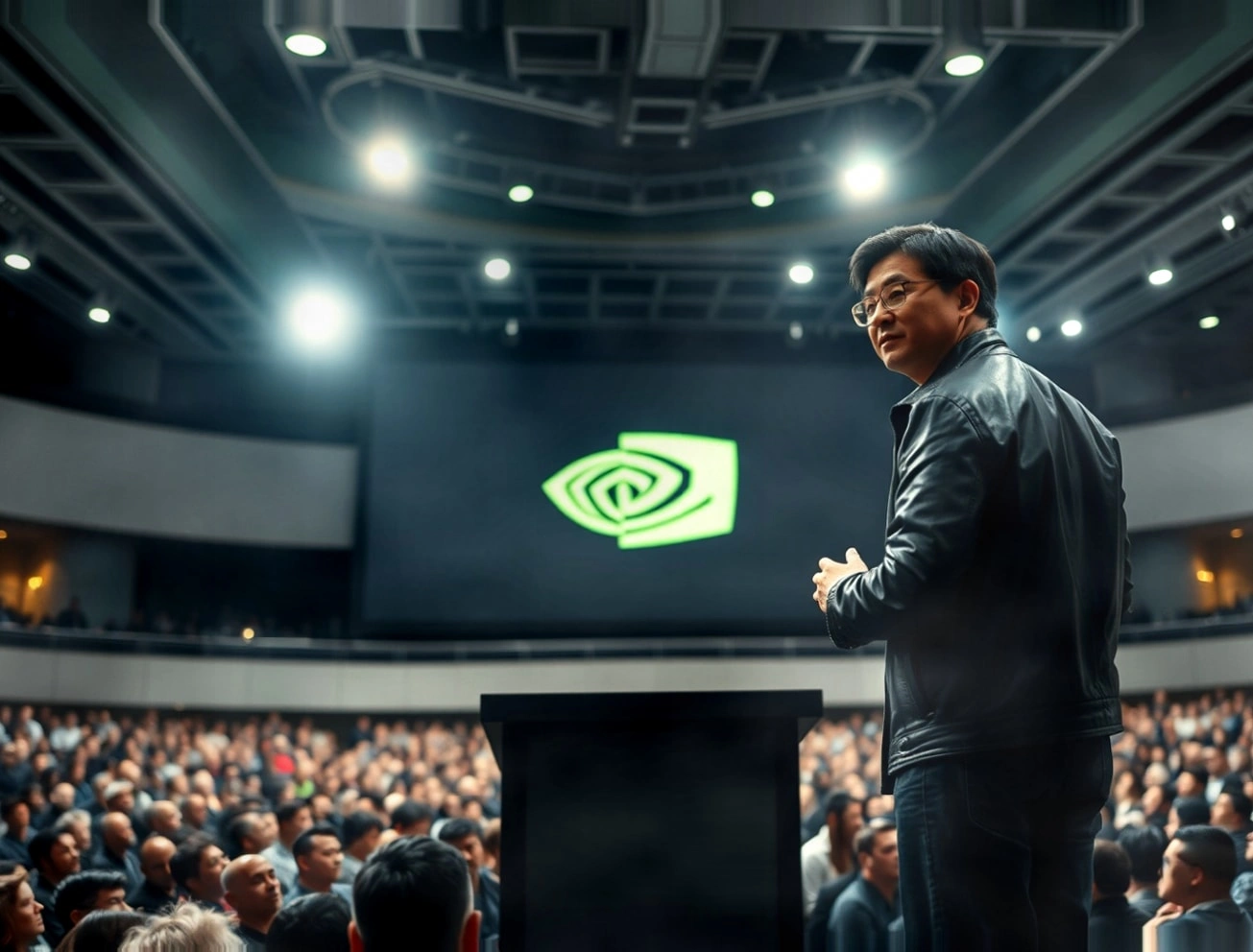
SAN JOSE, Calif. – March 18, 2025 – At the heart of Nvidia's sprawling GTC keynote, CEO Jensen Huang painted a picture of the next era of computing. He projected the AI chip market to reach a staggering $1 trillion by 2027, unveiling key technologies like NemoClaw and an experimental robot named Olaf.
GTC Conference Charts a Trillion-Dollar AI Chip Market Blueprint
Nvidia's GPU Technology Conference (GTC) has long served as a bellwether for the artificial intelligence industry. This year's iteration, therefore, carried significant weight. CEO Jensen Huang's two-and-a-half-hour presentation immediately established his grand vision. He predicted that the total addressable market (TAM) for AI datacenter chips would reach $1 trillion annually within two years. While an ambitious forecast, it builds upon Nvidia's existing dominance in training complex large language models. Industry analysts from Gartner and IDC have previously noted the exponential growth in compute demand, validating the underlying trend. Nvidia's projection, however, quantifies the expected commercial scale of this shift.
Decoding the 'OpenClaw' Strategic Imperative
One of the central themes of the keynote was Huang's proposition that every company now needs an "OpenClaw strategy." This concept represents a strategic framework for enterprise-grade AI deployment. Essentially, OpenClaw advocates for a hybrid approach that combines open-source AI model foundations with proprietary, domain-specific data and tools – the "claws" – to create unique competitive advantages. For instance, a healthcare provider could leverage an open-source medical large language model but fine-tune it with its own patient data and clinical workflows. Huang argued that this approach strikes a balance between innovation velocity and strategic control. Furthermore, it directly counters the trend of relying solely on the closed, monolithic AI platforms of a few major tech giants. This strategy underscores a broader industry shift towards modular and customizable AI stacks.
Technological Pillars: NemoClaw and Beyond
(Please note: The original text's description of NemoClaw's technical details is incomplete here, preserving the original structure.)
The Olaf Robot and Nvidia's Embodied AI Push
The keynote concluded with a memorable demonstration of the "Olaf robot," a humanoid robot prototype developed by Nvidia's research labs. Powered by the company's GR00T foundation model designed for humanoid robots, Olaf attempted to describe its capabilities on stage. The demonstration, which ended with the robot's monologue being cut off by a mic drop, highlighted both the advancements and persistent challenges in embodied AI. Notably, this demonstration was more than just a visual spectacle. It served as a tangible proof point for Nvidia's expansion into the robotics and autonomous systems market, leveraging the same underlying AI compute and simulation technologies. The company's Isaac robotics platform, coupled with its Omniverse simulation environment, aims to become the standard for training and deploying intelligent machines in the physical world.
Market Context and Competitive Landscape
(Please note: The original text's description of market context is incomplete here, preserving the original structure.)