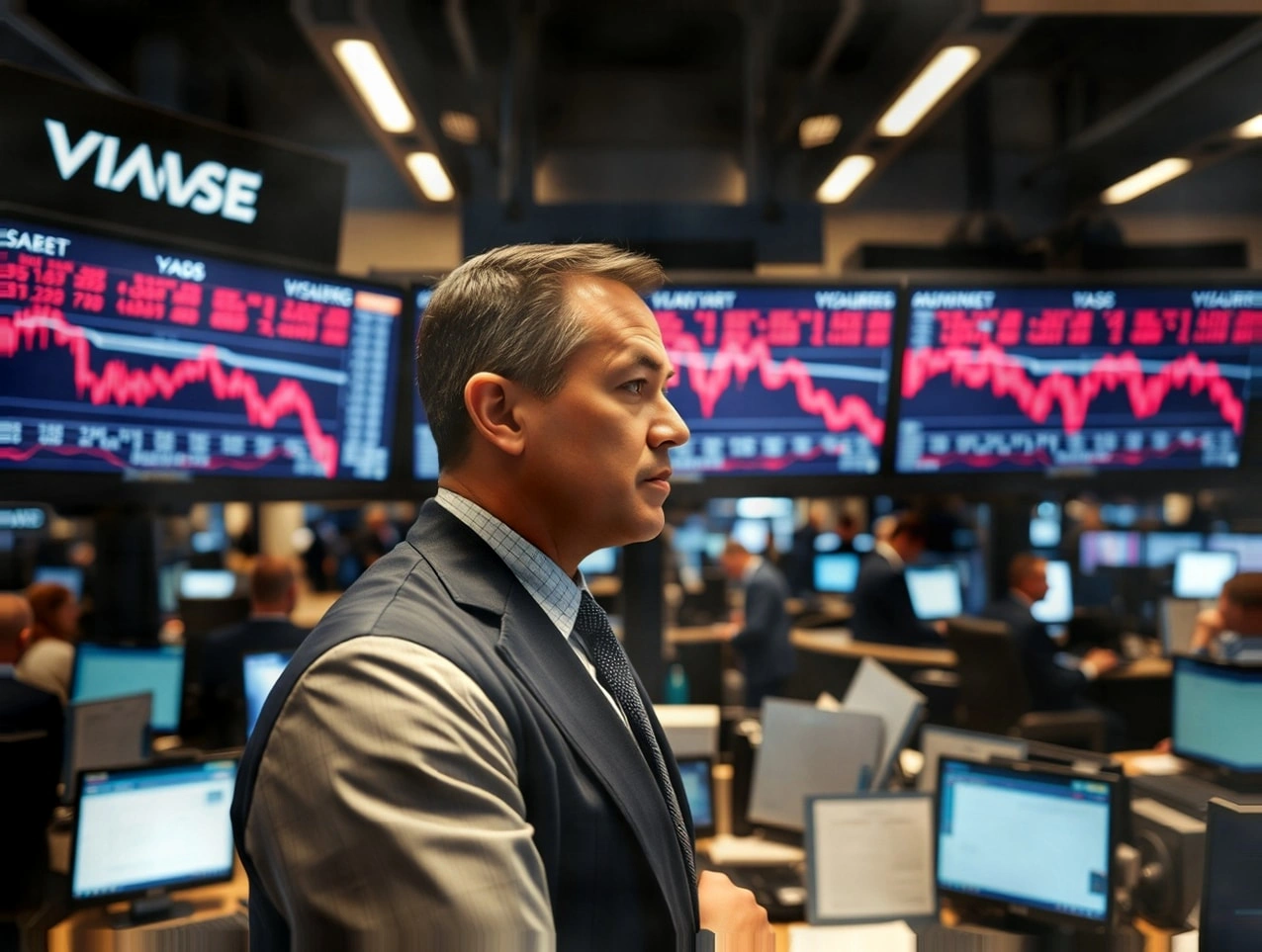
US stocks experienced a significant sell-off on Tuesday, with the S&P 500, Nasdaq, and Dow Jones all closing lower due to stronger-than-expected economic data, hawkish Fed commentary, and geopolitical risks. Tech stocks led the decline, while defensive sectors showed resilience, signaling reduced investor risk appetite.
Major US stock indices concluded Tuesday's trading session with significant declines, prompting a deeper analysis of underlying economic pressures. The S&P 500, Nasdaq Composite, and Dow Jones Industrial Average all finished in negative territory, marking one of the quarter's more pronounced single-day sell-offs. This downturn reflects heightened investor caution amidst a complex macroeconomic landscape.
**US Equities Weaken Across the Board, Market Under Pressure**
The trading day on Wall Street was characterized by broad weakness across the three benchmark indices. Specifically, the S&P 500 fell by 1.51%, retreating notably from its recent highs. The Nasdaq Composite, which has a higher concentration of technology stocks, experienced a more substantial drop of 2.01%. Meanwhile, the Dow Jones Industrial Average also registered a decline, closing down 0.97%. These synchronized movements suggest a widespread reassessment of risk within the market, rather than isolated sector concerns.
Market analysts were quick to point to a confluence of factors driving the sell-off. Firstly, economic data that exceeded expectations reignited concerns about persistent inflationary pressures. Secondly, commentary from Federal Reserve officials further solidified their cautious stance on interest rate cuts. Lastly, ongoing geopolitical tensions continued to weigh on global risk appetite. The combination of these elements prompted a shift in capital away from growth-oriented equities towards more defensive assets.
**Decoding Key Market Drivers**
A series of interconnected factors contributed to the day's market downturn. One primary catalyst was the latest economic data for the services sector, which indicated robust expansion. This resilience in the economy could imply that the Federal Reserve may maintain higher interest rates for a longer period. Typically, higher rates increase borrowing costs and make fixed-income investments like bonds more attractive relative to stocks, thereby pressuring equity valuations.
Furthermore, with the corporate earnings season entering a quieter phase, the market lacked sufficient positive catalysts to offset macroeconomic concerns. Investors are now closely scrutinizing companies' forward guidance for signs of slowing economic demand or margin compression. The table below summarizes the performance of major indices on the day:
Sector performance also exhibited clear patterns. Technology and consumer discretionary stocks, which are highly sensitive to interest rate expectations, led the declines. In contrast, defensive sectors such as utilities and consumer staples demonstrated relative resilience. This rotation of capital is a hallmark of risk-averse investor behavior.
**Expert Perspectives: Interpreting Market Volatility**
Financial strategists emphasized that cyclical pullbacks are a normal part of a healthy market. "Today's volatility serves as a reminder that the path to lower inflation and stable growth is not always linear," commented the Chief Investment Officer at a major asset management firm. Historical data indicates that intraday drops of 5%-10% are common, even in years with strong overall stock market performance. The key question for investors is whether this is merely a short-term correction or the beginning of a deeper downturn.
0 comment A文章作者M管理员
No Comments Yet. Be the first to share what you think
❯
Profile
Search
Checking in, please wait...
Click for today's check-in bonus!
You have earned {{mission.data.mission.credit}} points today