

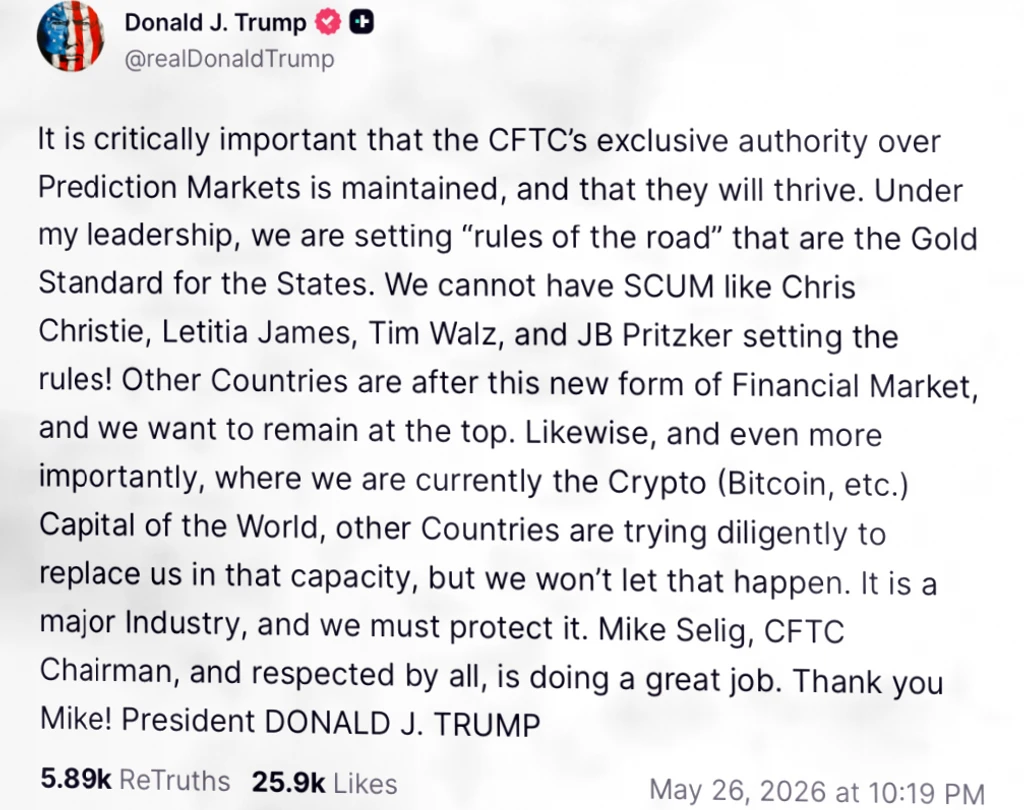
Trump's Remarks and Their Significance
The article praises the new CFTC Chairman Michael Selig, the only sitting commissioner among the five-member panel. Selig was appointed last December and has filed lawsuits against several states in recent months. The piece clearly indicates that President Trump is empowering Selig to push federal priorities as forcefully as possible.
State Lawsuits and the Counterattack from 38 Attorneys General
Since April, the CFTC has filed lawsuits against Arizona, Connecticut, Illinois, New York, and Wisconsin, arguing that event contracts traded on the design contract market are protected under the Commodity Exchange Act, and state governments cannot enforce gambling laws against them. Arizona's criminal case against Kalshi has been paused by a judge, who believes the argument for federal priority is likely to prevail. The lawsuit from Wisconsin targets Kalshi, Polymarket, Crypto.com, Robinhood, and Coinbase, accusing them of violating state gambling laws.
The response from state governments has been equally vigorous. Nevada Attorney General Aaron Ford and Ohio Attorney General Dave Yost co-authored an amicus brief supporting Massachusetts in its battle with Kalshi over sports contracts. The coalition pointed out that between January and June 2025, Kalshi's sports betting volume exceeded $1 billion, with a total of 3.4 million bets, approximately 90% of which were related to sports outcomes. Their argument is straightforward: Congress has not explicitly overturned state gambling rights, and the CFTC cannot create such an overturn based on a law that does not even mention gambling.
What Happens Next
Court observers expect this case to reach the Supreme Court within the next 12 to 18 months. Until then, prediction market platforms will continue to operate under federal protection in most areas, while Minnesota is actively classifying it as a criminal offense. Congressional pressure is also mounting, with the House Oversight Committee launching an investigation into Kalshi and Polymarket regarding insider trading issues. Trump's support makes the federal position politically harder to reverse, but it does not resolve the underlying legal issues.