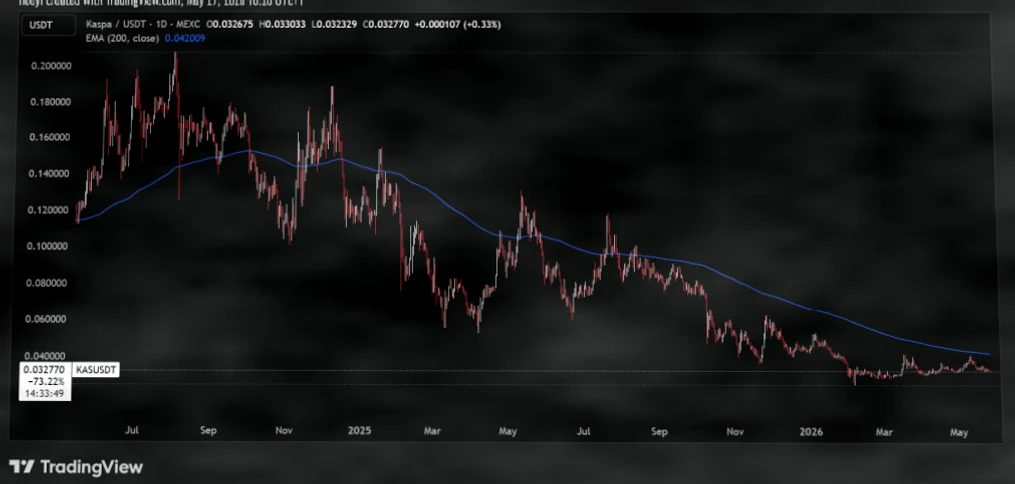
The upcoming Toccata upgrade in June poses a critical question for the market: can it truly change KAS's market performance, or will it merely be another technical improvement that fails to drive price increases?
While the Crescendo upgrade improved network performance, it did not lead to a price increase for KAS, primarily due to three reasons. First, investors took profits. Many buyers accumulated KAS before the hard fork and chose to sell after the upgrade. Second, there was underutilized network capacity. Despite the speed improvements, the lack of smart contracts, decentralized applications (dApps), stablecoins, or tokens meant that this additional capacity did not generate immediate demand. Lastly, insufficient liquidity was a key issue. Major upgrades require new capital inflows to support price growth, but during this period, inflows into other altcoins were weak, leaving Kaspa's advanced technology without market support.
The Toccata upgrade is expected to introduce smart contracts, tokens, and real applications to Kaspa. This will broaden the use cases for the KAS token, as users may need KAS to interact with applications, deploy contracts, mint tokens, and pay network fees, making it more practical than mere holding or transferring.
Additionally, the upgrade may also benefit miners. Kaspa's mining rewards decrease each month, with approximately 95.55% of KAS already mined. More applications could lead to increased network fees, which may help support miners as the generation of new coins approaches zero.
However, the Toccata upgrade might initially see a price decline. Although smart contracts can be launched quickly, developers will still need time to build real products. This means that while Kaspa may become technically stronger, the market may not immediately reflect this until activity levels increase.
Stronger market demand may emerge later. If applications, tokens, and stablecoins begin to appear post-upgrade, the KAS price could slowly recover as demand improves.
The current KAS price level is crucial for the outlook on Kaspa and price predictions following the Toccata upgrade, as KAS does not need to return to historical highs to achieve significant percentage gains. An increase from $0.032 to $0.064 would already represent a doubling, even though Kaspa's price remains far below its peak in 2024.
If the price moves towards $0.08 to $0.10, it would signify a stronger recovery, but KAS would still be about 50% below its historical high. The real test will come in the $0.15 to $0.20 range, where investors who bought at high prices may choose to exit.
We asked ChatGPT how KAS's price might change if Toccata succeeds, disappoints, or transforms Kaspa into a stronger Layer 1 ecosystem.
In a pessimistic “sell the news” scenario, assuming Toccata launches successfully but the market reacts similarly to after Crescendo, profit-taking could begin post-launch, with slow developer progress and limited early dApp activity. In this case, KAS price might drop to $0.025 to $0.028, then stabilize between $0.03 and $0.045. This would mean Toccata technically succeeds but fails to change market sentiment.