

Recently, the Bitcoin ecosystem has faced not only price pressure but also a significant decline in a key network component—mining difficulty adjustment, which has recorded the second largest single drop in nearly a year. Meanwhile, the Bitcoin network has seen its hashrate plummet by about 20% in less than a month, indicating that miners are gradually shutting down their equipment.
Significant Drop in Mining Difficulty
The designer of the Bitcoin network, Satoshi Nakamoto, embedded an important adaptive mechanism at its inception. This mechanism aims to maintain the block time of Bitcoin at a constant level of approximately 10 minutes, regardless of changes in the number of miners in the network. This adjustment occurs approximately every 2016 blocks (about two weeks); when the number of miners increases, mining difficulty rises, and conversely, it decreases. This process ensures the predictability of new Bitcoin issuance.
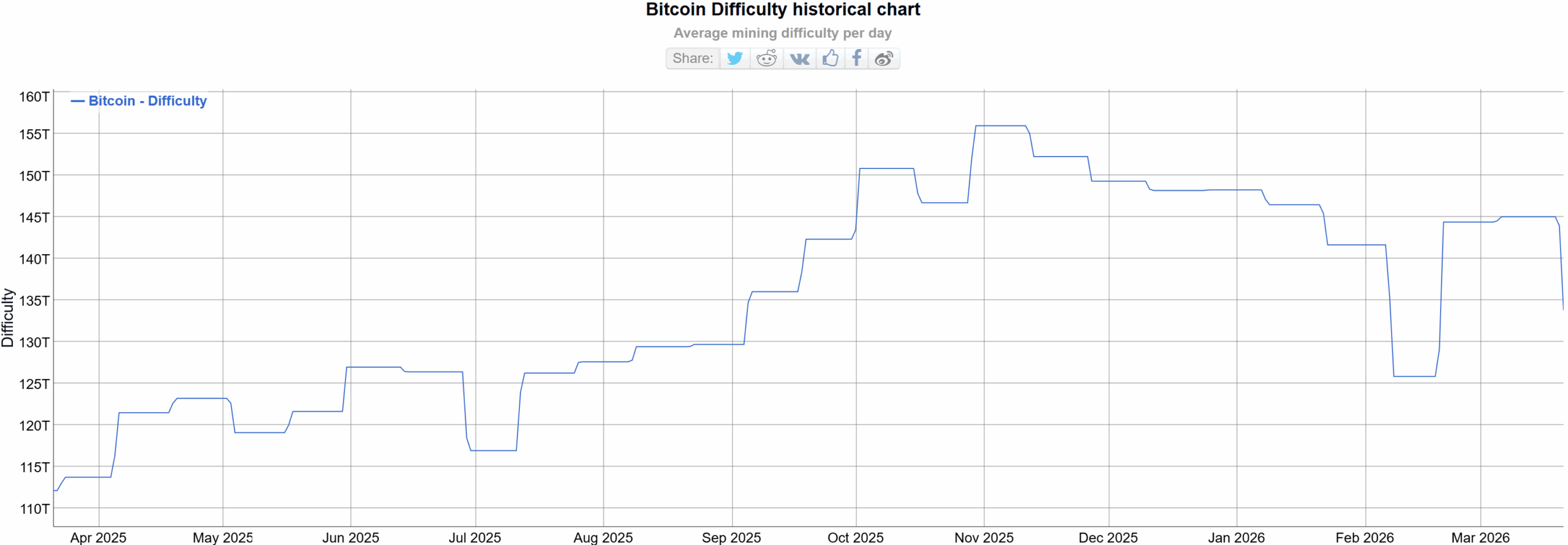
The most recent difficulty adjustment occurred over the weekend, reducing the mining difficulty by 7.76%. This marks the second largest single drop for this metric in nearly a year. More notably, seven out of the last ten adjustments have shown negative growth. Of the three positive adjustments, two had increases of less than 1%. The only significant increase occurred on February 19, 2025, when the metric surged by 14.73%.
On-chain data indicates that the next difficulty adjustment is expected to take place on April 3. Current predictions suggest that mining difficulty will slightly rebound from the current 133.79T to nearly 135T. For reference, mining difficulty peaked at 155T in late October 2025, meaning the current difficulty has decreased by over 13% from that peak.
Hashrate Falls Below 1 ZH/s
Hashrate is another core indicator of the health of the Bitcoin network. It is an estimate used to measure the hashing power generated by miners competing for the right to record the current block or any given block, measured in hashes per second (H/s).
In simple terms, a higher hashrate means more miners are active in the network, which enhances network security. Data from Coinwarz shows that this metric peaked at over 1.28 ZH/s in late September last year, before dropping to a range of 1.2 ZH/s to 900 EH/s. In late January last year, severe weather in North America briefly caused the hashrate to drop to 700 EH/s, but it quickly rebounded.
However, the current Bitcoin network hashrate remains below 1 ZH/s, down about 22% from its peak in 2025.
