

Bitcoin's price remained in a state of consolidation on Thursday, with market focus squarely on the upcoming US Non-Farm Payroll (NFP) data. Scheduled for release on Friday, the data is considered a crucial indicator influencing the Federal Reserve's monetary policy direction.
According to a Reuters survey of economists, the market widely anticipates approximately 70,000 new jobs were added in the US in February, significantly lower than the 110,000 in January. The unemployment rate is expected to remain unchanged at 4.3%. This data will provide a key reference for the Federal Reserve's interest rate meeting on March 17-18, where the market generally expects the Fed to maintain interest rates in the 3.50% to 3.75% range.
Historical data shows that when the Federal Reserve signals easing or initiates a rate cut cycle, cryptocurrencies like Bitcoin tend to gain increased market attention and capital inflows.
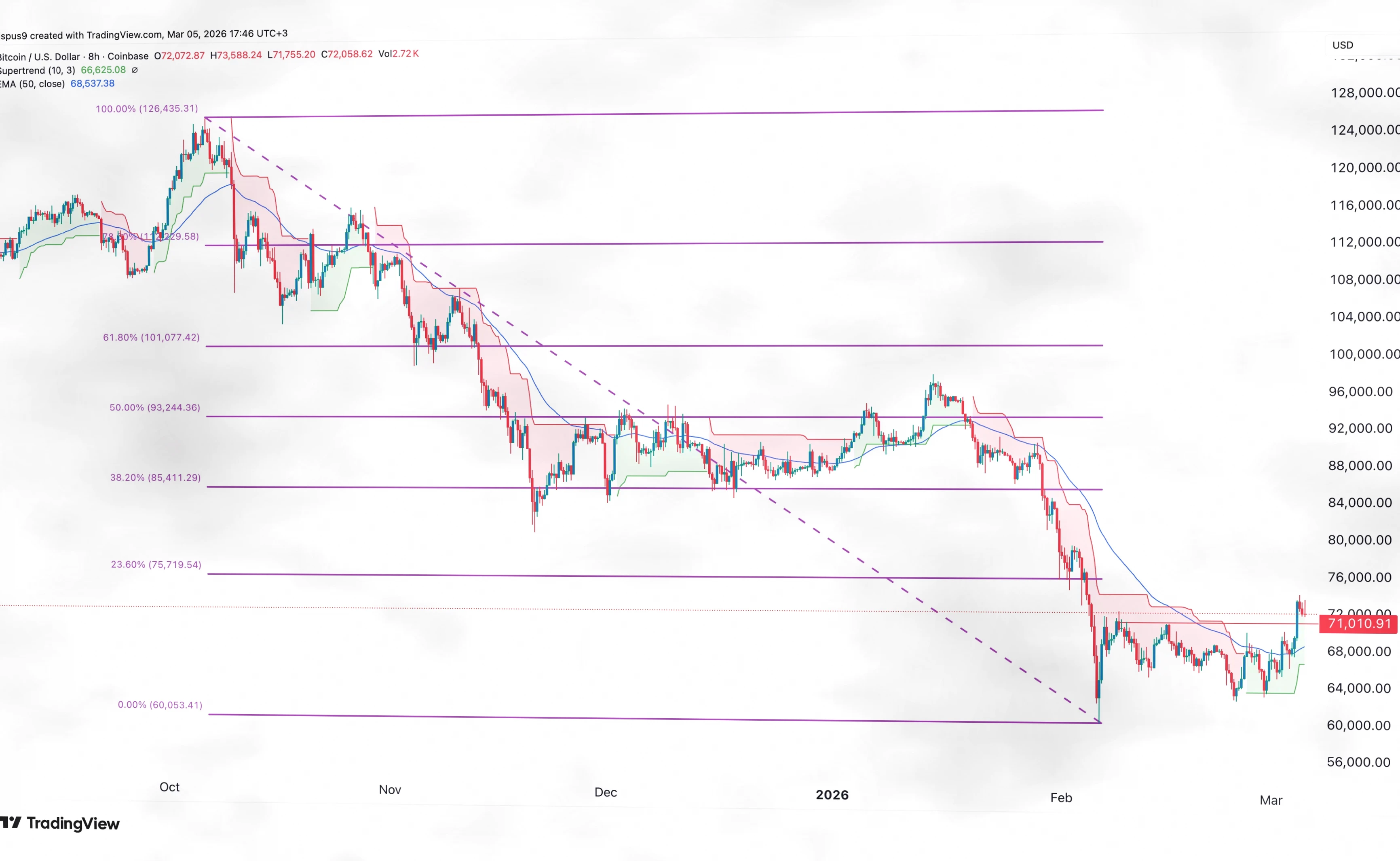
From a technical perspective, Bitcoin has shown a clear rebound recently, with the price rising from a year-to-date low of $60,000 to $72,700, successfully breaking through the key resistance level of $71,000 – a level that also represents the interim high on February 15 and the neckline of an inverse head and shoulders pattern.
Currently, BTC's Supertrend indicator has turned from red to green, and the price has also risen above the 50-day exponential moving average, indicating strengthening technical signals. Simultaneously, the price is fluctuating around the 23.6% Fibonacci retracement level for the year, connecting the all-time high with this year's low, becoming a significant watershed for bulls and bears.
Overall, the short-term trend leans bullish, with the next major target being the psychological barrier of $80,000. If the price effectively breaks through this level, it will further open up upward space. Conversely, if it falls below the key support level of $70,000, the current rebound pattern may face a reversal risk.