

As of February 11, 2026, Solana network's total payment volume has surged by 755% year-on-year, according to Messari data. This growth is not driven by retail speculation but stems from a wave of global mainstream financial institutions integrating Solana as the underlying clearing system into their payment architecture.
The Solana payment ecosystem map released by Messari divides the network's infrastructure into six major sectors, showcasing remarkable depth and breadth. The infrastructure layer includes prominent names such as Visa, Stripe, Worldpay, Bridge, MoonPay, Zero Hash, and Huma Finance. These are not emerging crypto startups but traditional payment giants processing hundreds of billions of dollars in transactions annually. Their choice of Solana is based on its real advantages of low fees and high throughput.
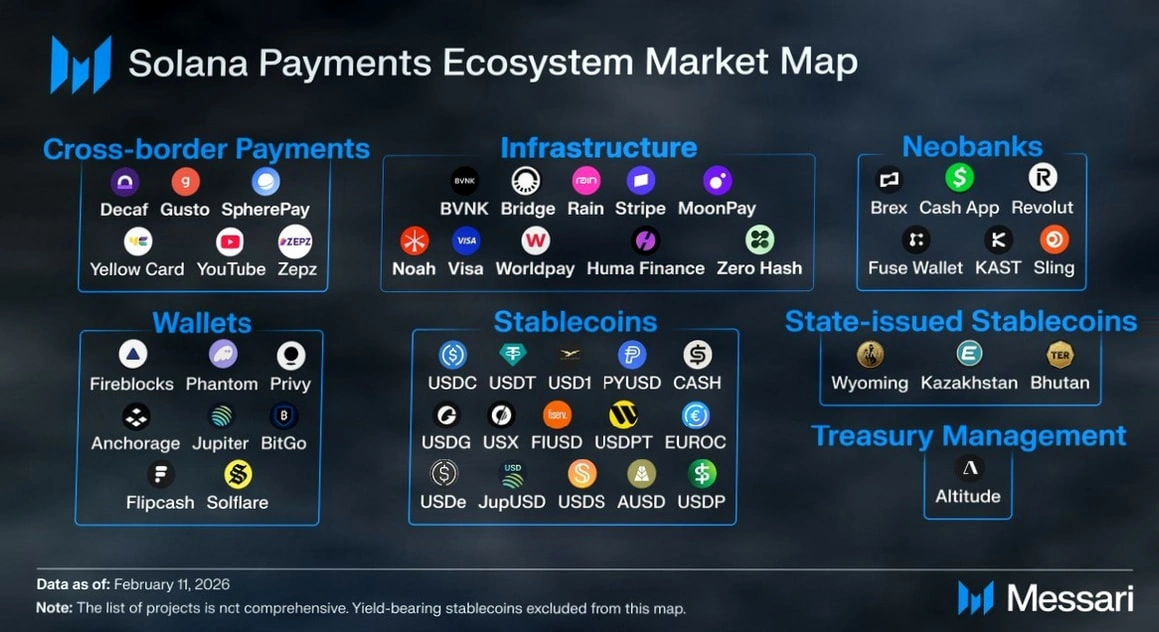
In the digital banking sector, Revolut, Brex, and Cash App, three leading global digital finance platforms in terms of user base, have all integrated Solana. Revolut officially submitted its U.S. banking license application this week. Cash App has been supporting Bitcoin transactions for years, while Brex focuses on providing financial solutions for corporate clients. Their inclusion signifies that mainstream financial services are moving closer to blockchain infrastructure.
In terms of cross-border payments, Yellow Card, which focuses on remittances to Africa, as well as platforms like SpherePay and Zepz, have also been incorporated into the ecosystem. The stablecoin layer covers fifteen mainstream assets such as USDC, USDT, PYUSD, and EUROC. Notably, sovereign-level stablecoins from Wyoming, Kazakhstan, and Bhutan are also listed separately, indicating initial synergy between national governments and the Solana network.
Unlike the “boom from a very low base” phenomenon common in crypto projects, this 755% growth stems from real, verifiable institutional capital flows. Western Union recently launched the USDPT stablecoin on Solana, Stripe acquired Bridge and built its stablecoin clearing system, and Zero Hash applied for a federal banking license in early March and provides underlying support for Morgan Stanley, Interactive Brokers, and others. These actions are not isolated events but organic components of the same institutional adoption trend.
In fact, Visa already processes 72% of global cryptocurrency card transactions, and its gap with Mastercard continues to widen. This trend echoes the data released by Grayscale this week: in February 2026 alone, Solana's adjusted stablecoin transaction volume reached $650 billion, second only to Ethereum globally. Behind these numbers, it's not retail investors brushing the chain, but the global financial system re-selecting its clearing path—Solana is becoming the new infrastructure for institutional-grade payments.