Coinbase executives secretly met with the White House to push for the passage of crypto regulatory bills, triggering a strong market reaction. This article provides an in-depth analysis of the stablecoin yield dispute, the political lobbying network, and the power dynamics behind the policy game.
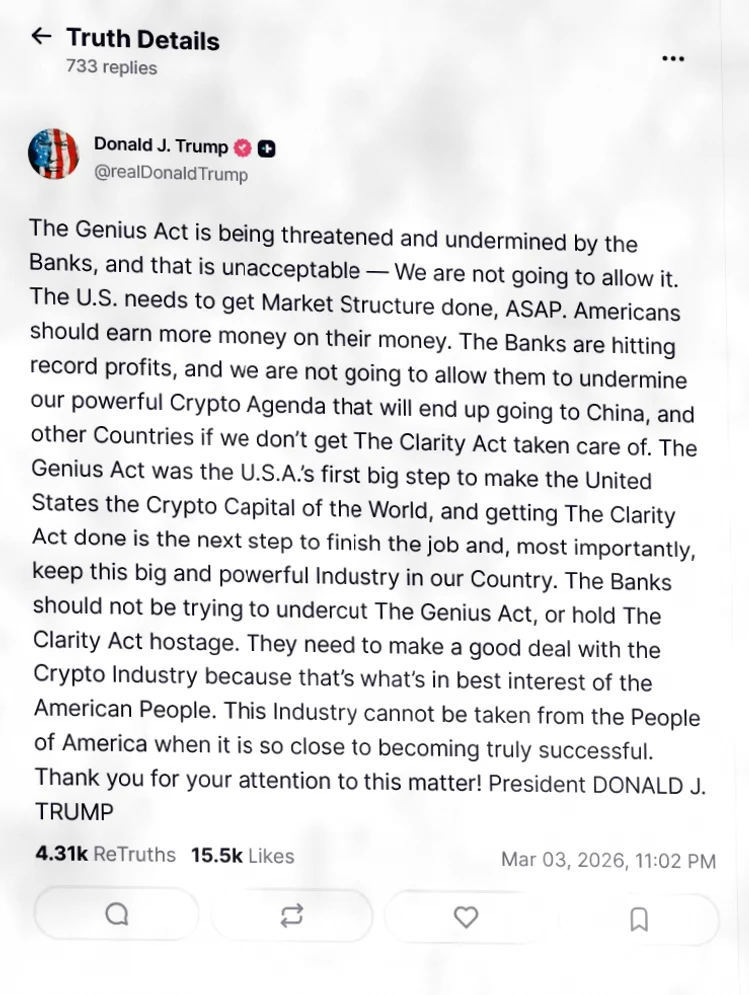
On March 3rd, a high-level Coinbase team, including CEO Brian Armstrong, secretly visited the White House to engage in closed-door consultations with government officials on cryptocurrency regulatory issues. This move was first disclosed by journalist Eleanor Terrett on March 4th, citing three sources familiar with the matter. Although neither Coinbase nor the White House issued an official statement regarding the meeting, President Trump's subsequent post on Truth Social inadvertently revealed the core issues at stake.
In his post, Trump harshly criticized the traditional American banking system, claiming it was “threatening and weakening” the advancement of the GENIUS Act, and pointed out that if the CLARITY Act could not be passed, the crypto industry might flow to China and other countries. He explicitly demanded that banks must reach a “favorable agreement” with the crypto industry. These remarks are highly consistent with Coinbase's long-standing public position. Armstrong has consistently emphasized for months that stablecoin yield mechanisms are at the core of industry innovation and competitiveness, while banks are attempting to prohibit third-party platforms from paying interest to stablecoin holders through legislation, arguing that this would drain bank deposits and weaken credit capacity.
Currently, the legislative stalemate surrounding stablecoin yields is at a critical juncture. Although the White House has organized multiple mediation meetings, led by crypto advisor Patrick Witt, major banks, including JPMorgan Chase, have refused to accept the latest compromise proposal. The original negotiation deadline of March 1st has passed, and the relevant bill remains stalled.
This high-level meeting was not accidental but rather the result of Coinbase's years of political maneuvering. Through its Super PAC, Fairshake, the company has committed over $190 million to the 2026 midterm elections. In addition, Coinbase donated to Trump's inaugural committee and participated in the White House renovation project. Armstrong himself attended the presidential inauguration in January 2025 and was invited to speak at a crypto summit held at Mar-a-Lago in February 2026, sharing the stage with Senator Bernie Moreno.
At the government level, the Trump administration has signed the GENIUS Act, ending SEC enforcement actions against several crypto companies. Since December 2024, former Silicon Valley investor David Sacks has served as the White House's head of Artificial Intelligence and Crypto Affairs, becoming an important advocate for the industry within the government – although he liquidated his personal holdings of Coinbase shares before taking office.
A private meeting with the current president is far beyond the reach of ordinary corporate lobbying. This level of political engagement can often directly influence the legislative process. After the news broke, Coinbase's stock price surged by more than 15%, regaining the $200 level and achieving its best performance since late January, with the market responding to this deep interaction between power and capital with real money.
0 comment A文章作者M管理员
No Comments Yet. Be the first to share what you think
❯
Profile
Search
Checking in, please wait...
Click for today's check-in bonus!
You have earned {{mission.data.mission.credit}} points today