

As Bitcoin's price approaches the $100,000 mark, market attention is focused on its spillover effect on altcoins. Kaspa (KAS), known for its high volatility, has historically shown a strong correlation with Bitcoin's price movements, but with more dramatic swings. This characteristic gives it the potential for outsized gains in a bull market, but also means that the risk is amplified during corrections.
Looking back at the price trajectory from March 2025 to March 2026, Kaspa mostly moved in the same direction as Bitcoin, but its gains were often 1.5 to 2 times that of BTC, demonstrating a clear high-beta characteristic. It is worth noting that Kaspa does not always linearly follow BTC – after an initial rapid rise, it sometimes experiences a decline in momentum, leading to subsequent lagging gains.
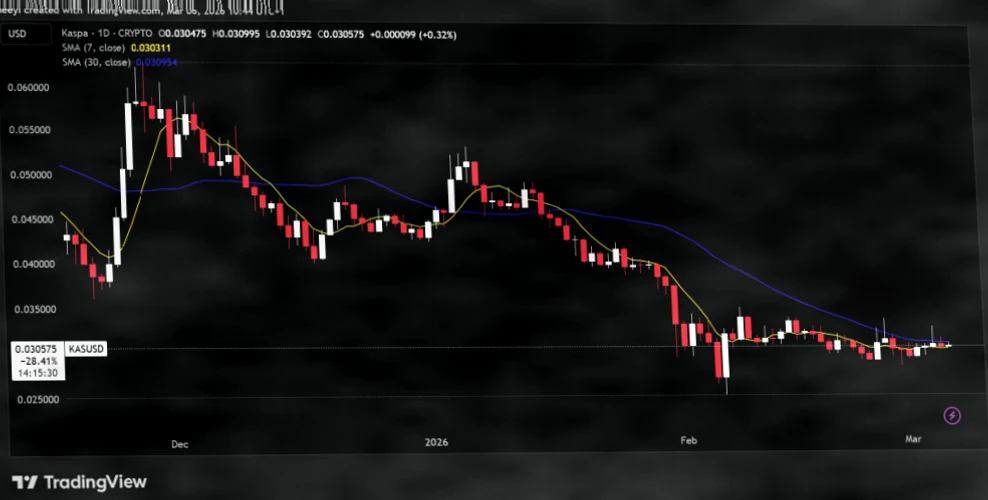
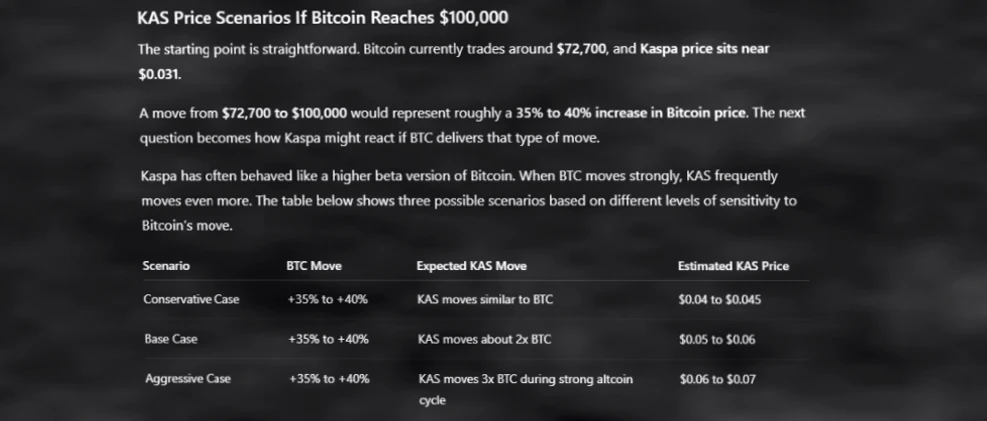
Currently, Bitcoin is priced around $72,700, and Kaspa is trading near $0.031. If Bitcoin rises 35% to 40% to $100,000, Kaspa's potential path can be divided into three scenarios:
Conservative Scenario: Kaspa's gains match Bitcoin's, with an expected price range of $0.04 to $0.045. This scenario assumes stable market sentiment, with Kaspa acting only as a follower asset.
Baseline Scenario: Referring to Kaspa's strong upward cycle in 2025, its gains could reach 1.8 to 2 times that of Bitcoin. If BTC rises 40%, Kaspa is expected to achieve a 70% to 80% gain, with a target price in the $0.05 to $0.06 range.
Aggressive Scenario: If the market enters a full-blown altcoin frenzy, coupled with Kaspa ecosystem upgrades, increased exchange liquidity, and enhanced miner activity, its gains may exceed 100% to 120%, and the price may touch $0.06 to $0.07.
It should be noted that Kaspa's final performance is affected by multiple factors, including macro liquidity, on-chain activity, exchange listing dynamics, and changes in market sentiment. If Bitcoin's rise is driven by strong macro factors, Kaspa is more likely to achieve high growth; conversely, if the rally is short-lived and accompanied by policy tightening or increased risk aversion, high-beta assets are highly susceptible to rapid declines.
Based on historical data and market mechanism analysis, if Bitcoin breaks through $100,000 in April, Kaspa's price will likely trade between $0.05 and $0.07, with $0.04 as a lower limit reference in a weaker market environment. Investors should focus on its ecosystem progress and market capital flows, rather than simply relying on BTC correlation expectations.