

According to data released by Chainalysis, the total volume of illegal cryptocurrency transactions reached $154 billion in 2025, nearly doubling from $59 billion in 2024. This surge is not merely driven by market expansion but is a result of a structural transformation in criminal activities.
From 2020 to 2025, the total amount of crypto assets received by illegal addresses steadily rose from $11 billion to $59 billion, while the $154 billion in 2025 represents a dramatic leap, far exceeding any previous year.
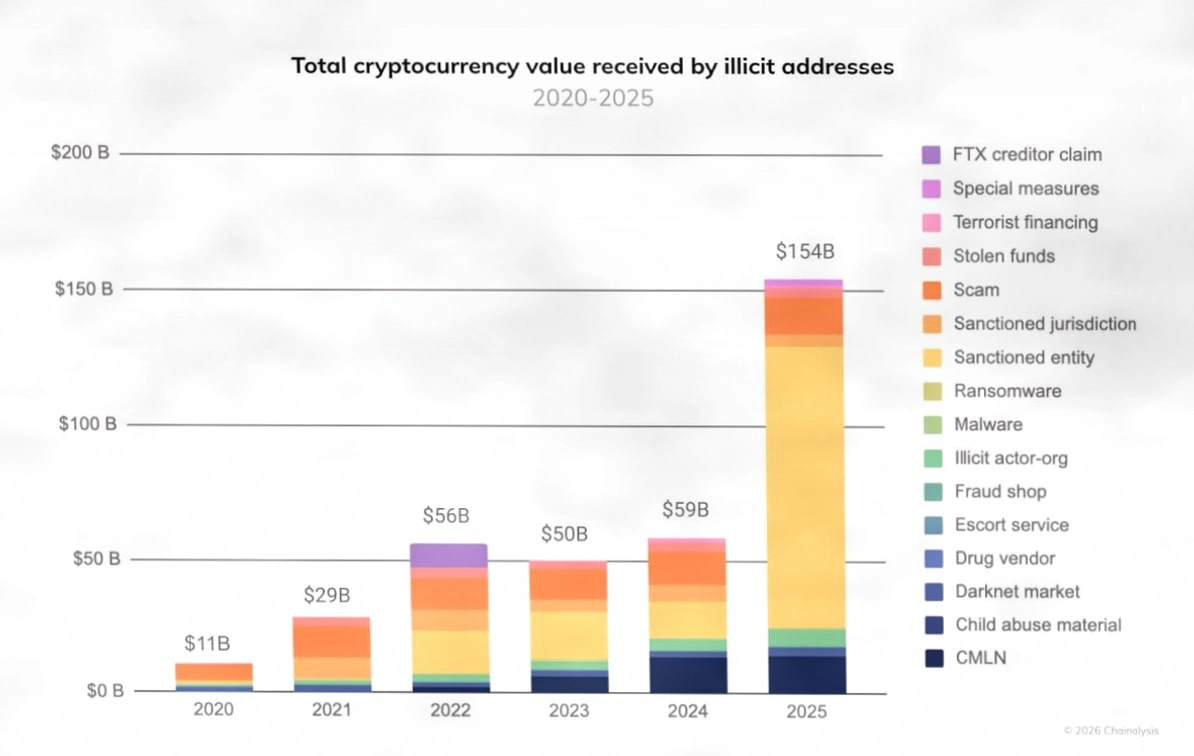
This massive sum encompasses various types of crime: transactions involving sanctioned entities accounted for the largest share with a staggering annual growth rate of 694%; hacker thefts exceeded $2 billion; additionally, online scams, ransomware, dark web markets, drug trafficking, terrorist financing, and the distribution of illegal content involving children also contribute to the criminal ecosystem.
Among these, the surge in sanctioned entities is particularly critical. These are not isolated criminals but state actors, organized groups, or institutions listed internationally, systematically exploiting the crypto network to bypass traditional financial sanctions. Such a steep increase indicates that crypto assets are being integrated into the toolkit of geopolitical maneuvering.
Chainalysis defines this trend as “industrialization” — crypto crime has evolved from individual opportunistic acts to a black market industry with organizational structures, specialized divisions, and scaled operations. Scam rings have customer service systems and money laundering channels, ransomware organizations are equipped with human resources and distribution networks, and dark web platforms have even established dispute resolution mechanisms. These are no longer temporary crimes but highly mature business models.
Notably, the Solana network has surpassed other blockchains to become the largest platform for stablecoin transactions, reflecting the rising role of new public chains in the flow of illegal funds.
Although the $154 billion in illegal activity is alarming, it still represents a very small portion compared to the trillions of dollars in legitimate crypto transactions expected in 2025, even falling below the estimated proportion of illegal funds in traditional banking systems. This does not mean the risks can be underestimated — the systemic infiltration by sanctioned entities and the frequency of hacker attacks pose severe challenges to the compliance outlook of the crypto ecosystem, prompting global regulators to accelerate the development of targeted frameworks.