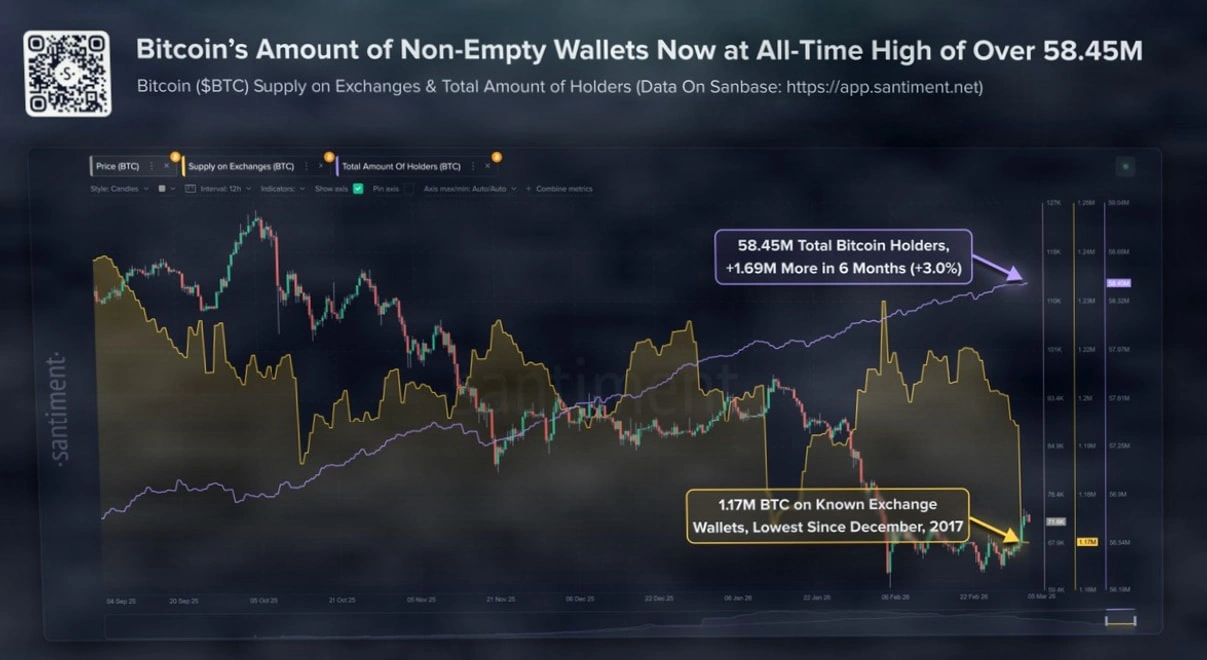
Bitcoin non-empty wallets surpass 58.45 million, exchange holdings drop to an eight-year low, reflecting continued optimization of the holding structure, increased individual holders, reduced market available supply, and a significant long-term holding trend.
The number of non-empty Bitcoin wallets has surged to a record high of 58.45 million, while the total amount of Bitcoin held in wallets on major exchanges has fallen to 1.17 million BTC, the lowest level since December 2017. The simultaneous movement of these two metrics reflects a profound shift in market structure and is no coincidence.
The growth in the number of non-empty wallets signifies that over 58 million addresses hold at least one Bitcoin and have not been emptied. This figure has increased by 1.69 million in the past six months, a significant rise since September 2025. As a fundamental indicator of network adoption, this data suggests that the number of individual Bitcoin holders currently surpasses any period in history, including the bull market peaks of 2021 and 2025.
Source: https://x.com/santimentfeed/status/2029697093271503161
Meanwhile, the decrease in Bitcoin held on exchanges implies that the supply available for immediate sale in the market is shrinking. The last time exchange supply was at such a low level was in December 2017, just before Bitcoin's price approached its all-time high of $20,000. While this data alone cannot directly predict price movements, it reveals a shift in holder behavior: more and more users are transferring Bitcoin from exchanges to cold wallets controlled by private keys, reducing liquidity and reinforcing long-term holding intentions.
The simultaneous change in these two indicators constitutes a structural trend – the continuous entry of new users coupled with the concentrated accumulation by existing holders, jointly compressing the market's available circulating supply. Even during the market correction in February, when Bitcoin's price fell by 14.94% in a single month, holders did not exhibit panic selling or a return to exchanges. Instead, they continued to move assets off centralized platforms. This steadfast behavior in a bear market is more significant than hoarding in a bull market.
The net outflow of 11,700 Bitcoin on Wednesday (March 4th) is just a microcosm of this long-term trend. Single-day fluctuations are noise, while the continuously declining exchange supply over the past eight months is a clear trend line.
It should be noted that the combination of low exchange supply and a high number of wallets has historically occurred in both bull and bear markets. The data reflects the holding structure and behavioral tendencies of market participants, rather than the inevitable direction of prices. However, it is clear that there are no signs of "Bitcoin adoption stagnation" or "holders about to sell off on a large scale." On the contrary, we are seeing a larger and more determined network of holders, and the least amount of Bitcoin available for trading in nearly eight years.
0 comment A文章作者M管理员
No Comments Yet. Be the first to share what you think
❯
Profile
Search
Checking in, please wait...
Click for today's check-in bonus!
You have earned {{mission.data.mission.credit}} points today