

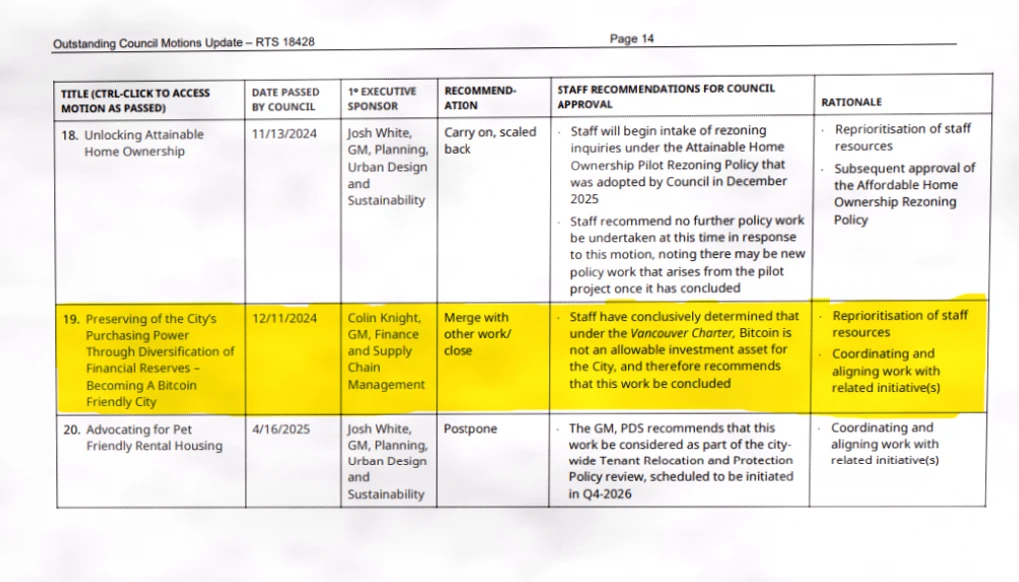
Vancouver city officials have formally recommended terminating the previously proposed Bitcoin reserve plan, citing that Bitcoin does not fall under the legal asset classes that municipal funds can invest in, according to the Vancouver Charter. The charter clearly defines the scope of the city's financial management and the types of assets it is allowed to hold, and cryptocurrencies are not included.
This decision was made during a systematic review of 181 municipal proposals put forward between 2018 and 2025. Currently, 103 plans have been successfully completed, and the remaining 78 are under evaluation, including the proposal to hedge against inflation and enhance the purchasing power of fiscal reserves by holding Bitcoin. Due to legal obstacles, municipal staff recommended halting related work and prioritizing the allocation of limited resources to more pressing public projects.
The Bitcoin reserve plan was initially proposed by Vancouver Mayor Ken Sim in November 2024, under the title 'Securing City Purchasing Power Through Financial Reserve Diversification – Creating a Bitcoin-Friendly City.' In December of the same year, the City Council formally passed the proposal and requested staff to submit a progress report in early 2025. However, the evaluation results were only publicly disclosed for the first time this week.
Notably, the plan was proposed when Bitcoin prices had just broken the $100,000 mark, and market sentiment was high. However, as regulatory scrutiny deepened and price volatility risks increased, the municipal team ultimately concluded that investing public funds in highly volatile assets was not in line with the principles of fiscal prudence.
Vancouver Ends Bitcoin Reserve Plan, Citing Legal Restrictions on Investment
The City of Vancouver has officially terminated its Bitcoin reserve plan due to restrictions in the Vancouver Charter, deeming it not a legally permissible investment, highlighting the cautious regulatory approach of local governments towards crypto assets.