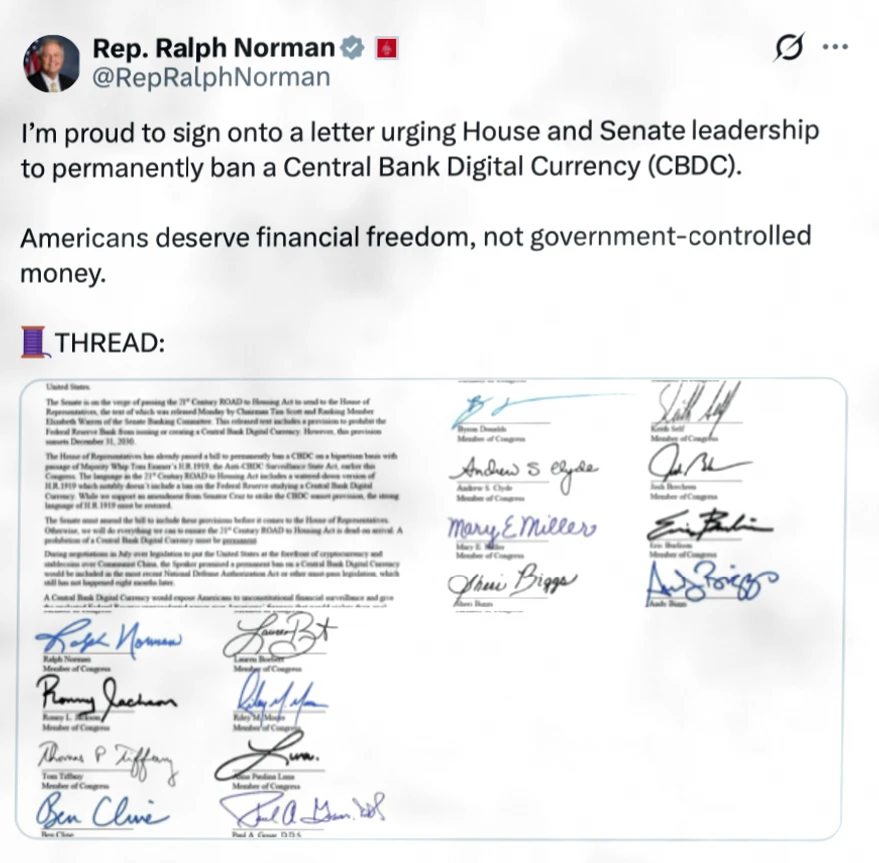
US lawmakers urge a permanent ban on central bank digital currencies, warning of potential financial surveillance and power imbalances. They criticize existing bills for only temporarily suspending rather than eliminating risks, and call for the restoration of strict legislative clauses.
A group of U.S. lawmakers have jointly called for a complete block on the Federal Reserve's ability to issue a central bank digital currency (CBDC), arguing that current proposals only delay the ban until 2031, which is insufficient to protect citizens' rights.
In an open letter to Congress, the lawmakers emphasized that any temporary restrictions on CBDCs contain significant loopholes, and only permanent legislation can truly prevent potential systemic risks. They pointed out that CBDCs could subject Americans to an unconstitutionally authorized financial surveillance system and grant the Federal Reserve enormous unelected financial control, seriously threatening individual privacy and economic freedom.
The letter further criticized the revised version of the existing bill for still allowing the Federal Reserve to continue researching CBDCs, calling for the restoration of the stricter language in H.R.1919, which would completely shut down research and pilot programs. The lawmakers stated that this issue concerns national financial sovereignty and civil liberties, and decisive action must be taken before the technological path solidifies to avoid future irreversible regulatory dilemmas.
Currently, the relevant bill has passed the House of Representatives but has not yet received final approval from the Senate, and the legislative process remains at a critical stage.
0 comment A文章作者M管理员
No Comments Yet. Be the first to share what you think
❯
Profile
Search
Checking in, please wait...
Click for today's check-in bonus!
You have earned {{mission.data.mission.credit}} points today