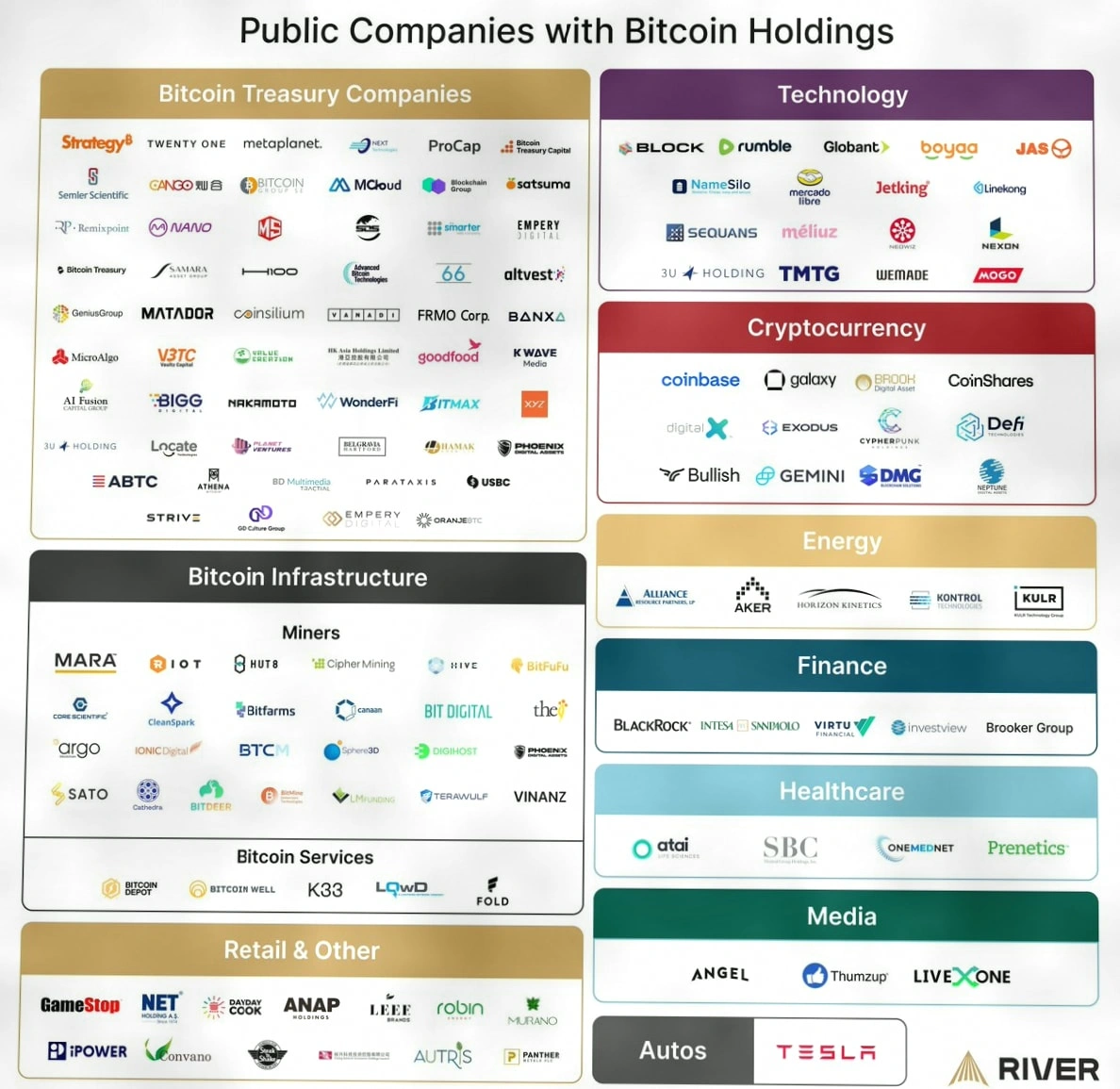
In the past year, 116 publicly listed companies have increased their Bitcoin holdings, covering multiple traditional industries such as technology, finance, healthcare, and media, marking Bitcoin's transformation from a crypto-native asset to a global enterprise-level reserve asset, highlighting its increasing long-term strategic significance.
Over the past 12 months, a total of 116 publicly listed companies have added Bitcoin to their balance sheets, according to data released by digital asset service provider River. Notably, this phenomenon is no longer limited to early crypto-native businesses or isolated cases, but has evolved into a systematic asset allocation behavior across multiple traditional industries.
River's classification map divides companies holding Bitcoin into eight industry categories: Bitcoin Treasury Companies, Infrastructure, Retail & Other, Technology, Cryptocurrency, Energy, Finance, Healthcare & Media. Among them, the Bitcoin Treasury Companies category has the largest number, led by Strategy and Metaplanet, and also includes dozens of small and medium-sized companies such as Semler Scientific, Remixpoint, Genius Group, and MicroAlgo. The core strategy of these companies has shifted from traditional financial management models to using Bitcoin as a long-term store of value.
The technology sector is also active, with companies such as Block, Mercado Libre, Nexon, and Jetking allocating Bitcoin as a cash equivalent, even though their primary business is not crypto-related. In particular, the participation of Latin American e-commerce giant Mercado Libre highlights the actual penetration of Bitcoin in payment and capital management in emerging markets.
The financial industry represents the formal acceptance of crypto assets by traditional institutions. Large financial institutions such as BlackRock, Intesa Sanpaolo, Virtu Financial, and Brooker Group appear on the list. Of particular note is BlackRock's direct holding of Bitcoin as a listed company, rather than indirect participation through its ETF products, which conveys a deeper level of institutional recognition.
The most groundbreaking changes have occurred in the healthcare and media sectors. Healthcare companies such as Atai Life Sciences, SBC Medical, OneMedNet, and Prenetics, as well as media platforms such as Angel, Thumzup, and LiveXOne, have quietly held Bitcoin. These industries, which had little interaction with digital assets in the past, are now participating in the new trend, reflecting the rapidly spreading acceptance of decentralized assets by companies.
It is worth mentioning that Tesla is currently the only player in the automotive sector, and its early decision is still of symbolic significance.
In a market environment where the price of Bitcoin has fallen nearly 50% from its high of $126,000 in October 2025 to approximately $68,000, companies continue to increase their holdings, indicating that their behavior is more based on long-term asset allocation logic rather than short-term speculation. However, if the market falls further by more than 30%, some companies relying on debt financing may face liquidity pressure, leading to passive selling, which may bring new downside risks to the market. 116 companies have taken the first step, but how many can survive the next bear market cycle remains unknown.
0 comment A文章作者M管理员
No Comments Yet. Be the first to share what you think
❯
Profile
Search
Checking in, please wait...
Click for today's check-in bonus!
You have earned {{mission.data.mission.credit}} points today