

On Monday, Bitcoin rose 2.8% to $68,150, coinciding with NATO's defense system shooting down a second Iranian ballistic missile in Turkish airspace, escalating tensions in the Middle East and increasing volatility in global financial markets. In this context, traditional stocks and safe-haven assets faced pressure, while Bitcoin emerged as the strongest mainstream asset class.
NATO spokesperson Allison Hart stated that the alliance "firmly supports all member countries, including Turkey," emphasizing its "deterrence and defense capabilities remain robust across all domains." Iran, on the other hand, denied launching missiles and reiterated respect for Turkey's sovereignty.
Ethereum also saw gains, rising 2.88% within 24 hours to $2,002. Privacy-focused tokens like Monero, Dash, and Zcash surged even higher, with increases ranging from 3.8% to 5.2%, as the market interpreted this as investors seeking censorship-resistant, decentralized digital assets amid rising geopolitical risks.
In the commodities sector, oil prices soared to $115 per barrel, the highest since June 2022, as concerns grew over shipping safety in the Strait of Hormuz. The dollar index surpassed 99, and the yield on the U.S. ten-year Treasury note rose from 4% to 4.2%.
Despite the gloomy market sentiment, cryptocurrencies continued to attract significant inflows. Daily net inflows into crypto funds reached $619 million, with Bitcoin contributing $521 million. BlackRock's iShares Bitcoin Trust (IBIT) led with a net inflow of $808 million, while Fidelity recorded an outflow of $359 million. U.S. investors dominated the inflows, contributing a total of $646 million, while the European market saw a net outflow of $23.8 million.
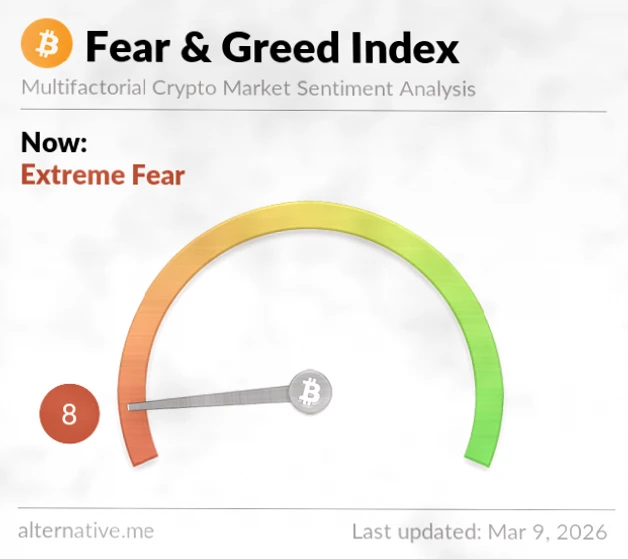
The current Crypto Fear and Greed Index stands at 8, remaining in the "extreme fear" zone for a month. Historical data shows that such extreme sentiments often signal potential buying opportunities, but the current complex geopolitical backdrop challenges the applicability of this trend.
Industry analysis firm QCP Capital noted that while Bitcoin has not yet fully established its status as "digital gold," its practical value as a "digital escape route" is increasingly evident, especially as Gulf countries face currency volatility and political uncertainty.
Notably, Iran is reportedly attempting to use cryptocurrency for military procurement transactions. According to the Mindex platform, in response to the Iranian government's policy direction to evade sanctions, "there are no obstacles to contract execution." Chainalysis data indicates that Iran's crypto ecosystem is projected to exceed $7.78 billion in total transaction volume by 2025, with addresses related to the Iranian Revolutionary Guard accounting for 50% of on-chain activity in the country. Approximately 5 million Iranians are active in crypto trading, with withdrawal volumes nearing $2 million per hour during the escalation of conflict in early March.
U.S. Secretary of Defense Peter Hegseth stated that the missile interception incident "will not trigger NATO's Article 5," but the situation remains highly sensitive, with markets closely monitoring subsequent developments.