

XRP price is currently stable above the key support level of $1.30, but market order flow data indicates that selling forces still dominate, significantly suppressing short-term upside potential.
Over the past seven days, the price of XRP has fluctuated between $1.34 and $1.46. Despite the recent sideways trend, it is still down approximately 62% from its all-time high of $3.65 set in July 2025, and has not yet returned to its previous strong range.
Trading activity has rebounded, with 24-hour trading volume climbing to $2.55 billion, a 67.5% increase from the previous day, reflecting renewed market attention. However, buying sentiment remains weak.
The current buy-to-sell liquidity ratio is approximately 0.912, indicating that the number of sell orders in the market continues to exceed buy orders. This means that most traders prefer to sell using market orders rather than actively buying. XRP's recent price has mostly fluctuated around $1.34, lacking significant upward momentum. When this ratio is below 1, market buying pressure struggles to push the price higher.
Although buyers are still present, their behavior is mainly limited to limit orders, providing liquidity rather than actively driving up prices. Conversely, sellers are constantly absorbing liquidity through market orders, creating continuous selling pressure. If this structure persists, the price will continue to face downward pressure in the short term.
From a technical perspective, 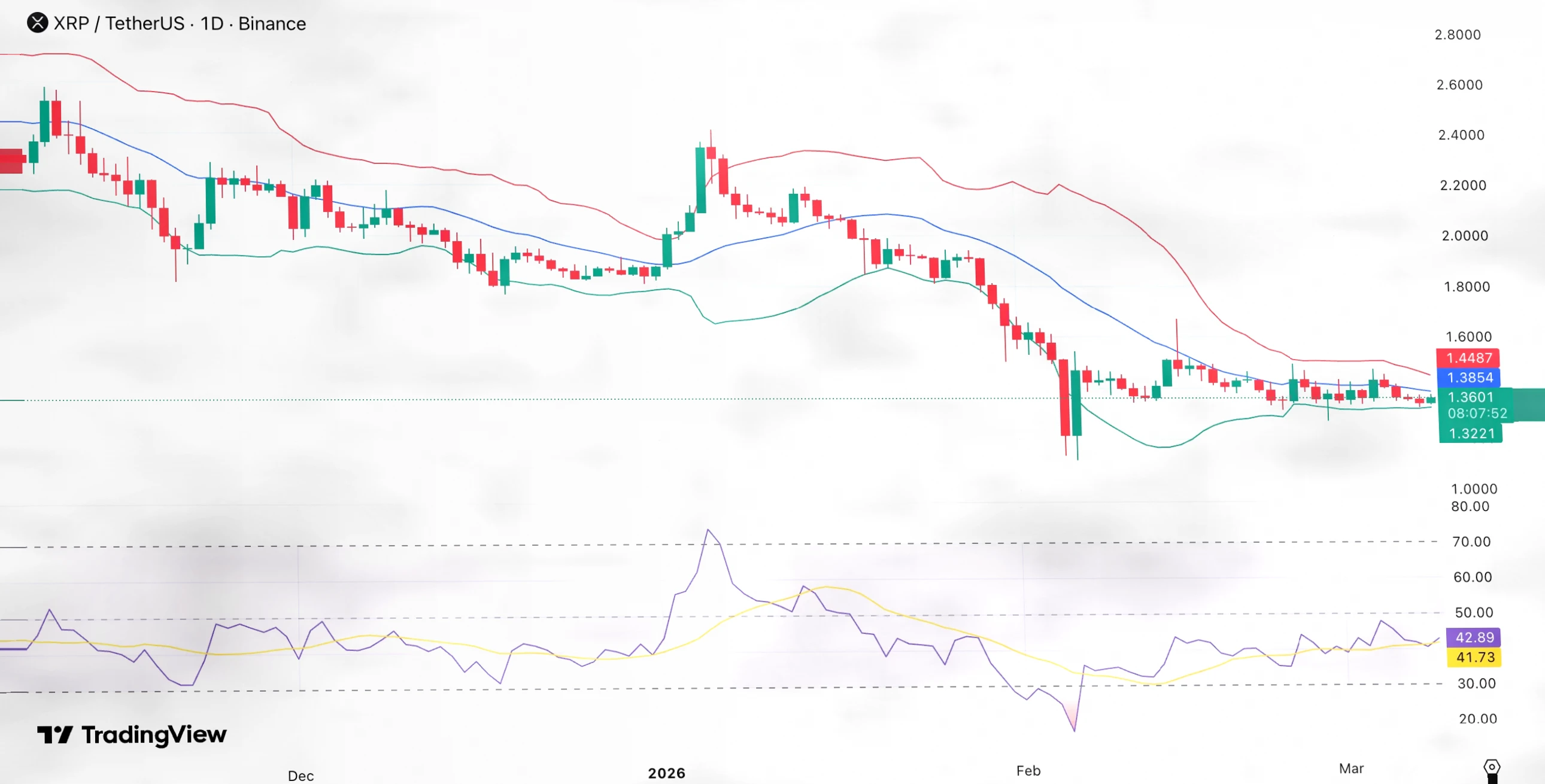
XRP's current price is below the middle band of the Bollinger Bands, coinciding with the 20-day moving average. This position is typically seen as a signal of short-term weakness. In early February, XRP touched the lower band of the Bollinger Bands and rebounded, but since then, volatility has gradually narrowed, and the price has entered a range-bound trading pattern.
The momentum indicator RSI hovers between 42 and 43, still below the neutral level of 50. Although it has rebounded from the oversold area in early February, buying momentum remains insufficient. From a longer-term perspective, since January of this year, the price structure has shown a series of lower highs, indicating that the overall downward trend has not yet reversed. The current consolidation is more likely a temporary pause in the trend.
If the price can effectively break through the upper edge of the current trading range and the RSI rises above 50, the short-term trend is expected to strengthen. Conversely, if the $1.30 support fails, the price may further decline to around $1.20. With the RSI consistently below the neutral line, the market remains in a bearish structure.