

The potential returns in the 2026 cryptocurrency market often depend not on the hype surrounding a project, but on its underlying value, the team's ability to build continuously, and the gap between current prices and the next wave of mainstream capital inflow. Projects with true long-term potential are often those that quietly iterate and accumulate users and ecosystems even during market lows.
1. BlockDAG: From Prediction to Reality, the $0.20 Target is Within Reach
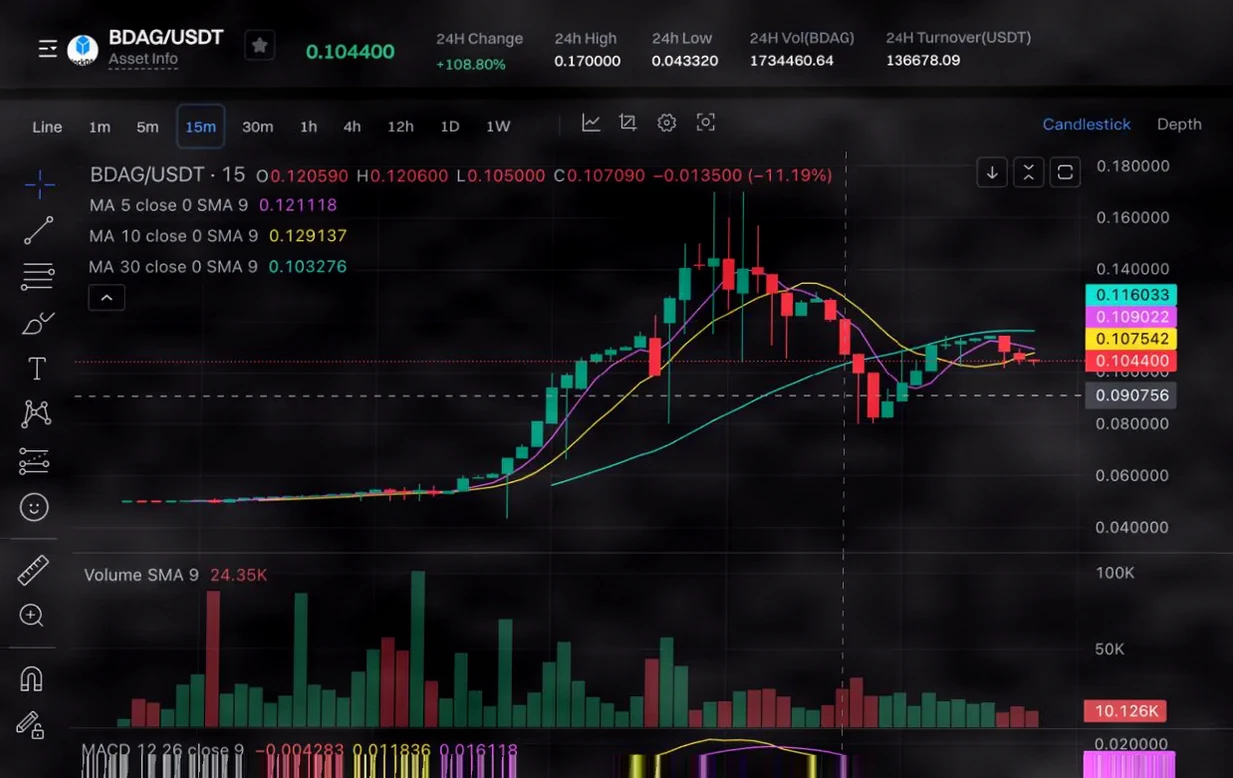
Experts had predicted that BlockDAG (BDAG) would reach $0.20 in the short term, a target initially seen as a bold assumption. However, on its first day of trading on Coinstore, the BDAG price quickly surged to $0.18, validating the market's high recognition of its technical architecture and circulation mechanism. Currently, BlockDAG has been listed on four major exchanges and supports direct exchange functionality, making it one of the most smoothly launched crypto projects recently. With LBank opening trading at 8 PM Pacific Time, expectations for a new influx of capital are strong, turning the $0.20 target from speculation into a quantifiable trend. The current price is just two cents away, and with two new exchanges about to launch, a price acceleration is highly likely. For investors, the opportunity is no longer a future concept but a reality unfolding now.
2. Render: Driven by AI Computing Demand, Deflationary Model Accelerates Value Accumulation
As of early March 2026, Render (RENDER) is priced at $1.40, down 89% from its historical high of $13.53, but its weekly chart shows sustained buying support. During the general market pullback in February 2026, the Render network maintained high activity levels, adding multiple AI task nodes, demonstrating strong resilience.
The Dispersed protocol launched at the end of 2025 is optimized for AI tasks like machine learning, further solidifying its position in the decentralized computing market. The upcoming RNP-021 plan will introduce high-performance GPUs like NVIDIA H200, making Render a core infrastructure for large-scale AI training. More importantly, Render employs a dynamic burn mechanism: for every computing transaction completed, the system will burn an equivalent value of RENDER tokens based on USD value, naturally contracting supply with usage. Recently, large holders have concentrated their purchases of 680,000 RENDER, reflecting institutional confidence in its long-term value.
3. BONK: The Community Choice of the Solana Ecosystem, Growth Potential Ready to Unleash
BONK, as a flagship community token within the Solana ecosystem, currently has a stable trading price and increasing trading activity. Although it was initially regarded as a “meme coin,” with the accelerated expansion of the Solana ecosystem in DeFi News, NFTs, and payment scenarios, BONK is gradually transforming into a utility token within the ecosystem. Recently, several Solana chain projects have partnered with BONK, promoting its practical applications in payments, incentives, and community governance. On-chain data shows that the number of addresses holding BONK continues to grow, and the frequency of large transfers is rising, reflecting a clear trend of transition from speculation to utility. As the overall Solana ecosystem warms up, BONK is expected to become one of the most representative community-driven growth assets.
4. SEI: The Computing Revolution of High-Performance Public Chains, Ecological Expansion Enters the Fast Lane
The SEI network has achieved significant TPS improvements and reduced transaction costs from early 2025 to early 2026, thanks to its unique parallel trading architecture, making it a favored underlying platform for many dApp developers. Currently, over 50 decentralized applications have been deployed within the SEI ecosystem, covering DeFi News, derivatives, social, and gaming sectors. Its native token SEI continues to attract liquidity through staking incentives and gas fee refunds. In the first quarter of 2026, SEI's on-chain TVL grew by over 300%, and the mainnet upgrade plan has clearly indicated the introduction of cross-chain bridging and ZK verification layers, further enhancing its scalability and security. As mainstream exchanges gradually launch SEI spot and futures trading, the dual increase in market attention and liquidity is laying a solid foundation for price breakthroughs in 2026.