

BSCNews recently pointed out that the Bollinger Bands on the 3-day chart have contracted, a classic signal that typically appears before significant price movements. Currently, there is heavy derivative leverage accumulation at the $8 support and $10 resistance levels, indicating that the market is about to choose a direction.
What the Current 4-Hour Chart Shows
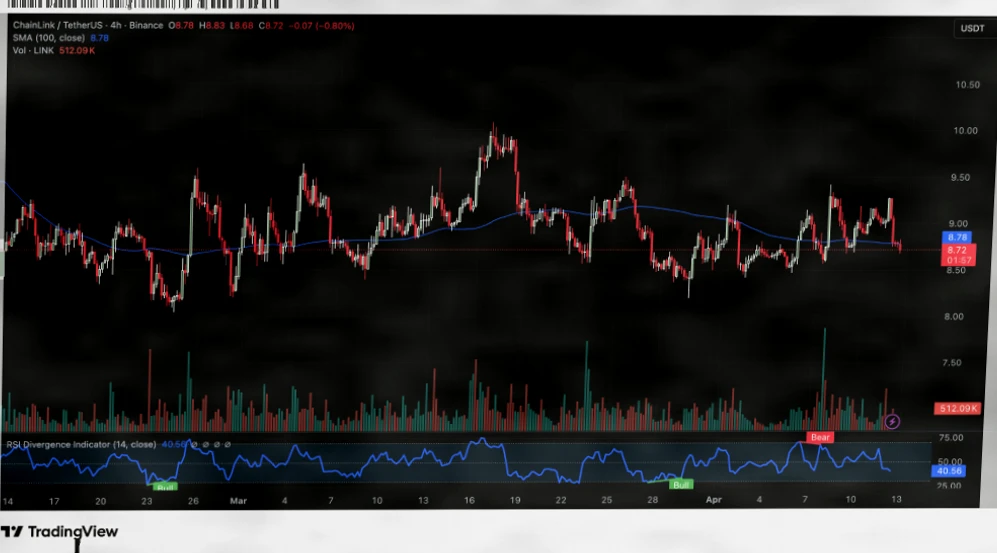
We examined LINK's chart, and the situation is quite tight. The current price of LINK is $8.72, down 0.80% from the previous trading day, with a high of $8.83 and a low of $8.68. The 100-period Simple Moving Average (SMA) is positioned at $8.78, slightly above the current price.
Source: TradingView
The Relative Strength Index (RSI) on the 4-hour chart is at 40.56, indicating a neutral to slightly bearish state, but it is not oversold. This indicator shows a bearish structure in the short term, but the long-term outlook is different. LINK has respected the $8.20 support area over the past few months.
Each time this level is tested, it is accompanied by an influx of buying. Meanwhile, the $9.55 resistance level remains strong. The contraction of the Bollinger Bands on the 3-day chart is an important signal. After months of sideways consolidation, a tightening Bollinger Band typically indicates an impending breakout.
Two Paths for LINK Price
If the price breaks above $10, everything will change. A significant amount of derivative leverage has accumulated at this level, with shorts positioned here. If LINK breaks above $10, shorts will be forced to cover, and the price could accelerate rapidly upward.
The target range after a breakout is between $12 and $14, which implies a 40% to 60% increase from the current level. While the 4-hour chart does not show these levels, the structure of the 3-day chart points to this potential movement.
Fundamental Background is Building
While technical conditions are important, the fundamentals are also performing well. JPMorgan and UBS are piloting real-time settlements on Chainlink's infrastructure, which is not just a test network but involves real banks investing real funds.
Chainlink's Cross-Chain Interoperability Protocol (CCIP) processes cross-chain transaction volumes of $18 billion monthly. This figure is not to be underestimated. Additionally, the Bitwise LINK ETF now allows 401(k) accounts to invest in LINK, enabling retail retirement funds to flow into Chainlink.
Whale accumulation is also ongoing. The number of wallets holding over 1 million LINK tokens has increased by 25% year-over-year, with a total of 125 such wallets. This indicates that a significant amount of supply is being absorbed in the market. LINK is currently in a consolidation range, with large players accumulating tokens while banks pilot the technology. When the breakout comes, there will be real momentum to support it.
Read more: How Cardano (ADA) Price May Move This Week
Future Trends for LINK Price