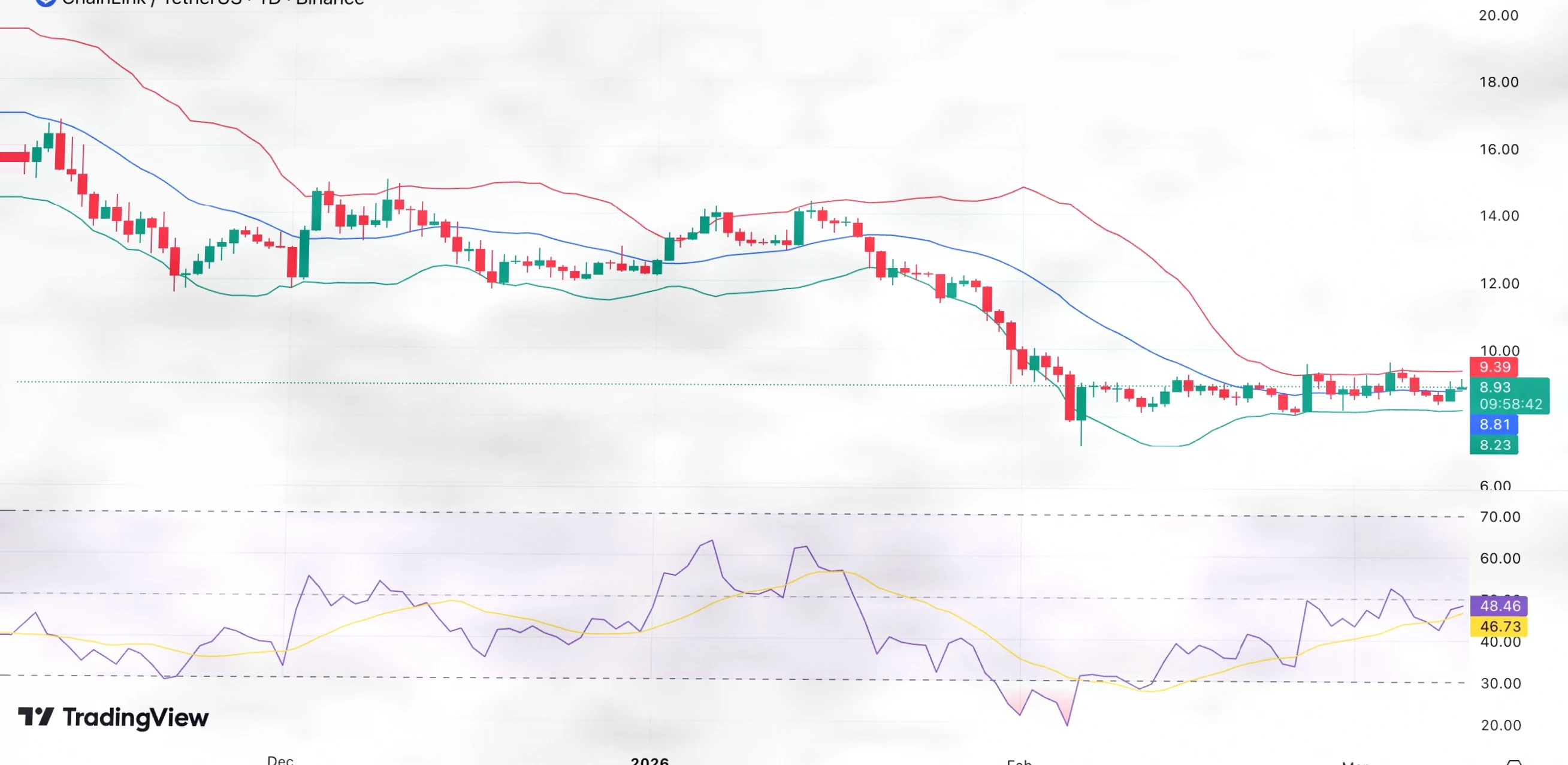
Chainlink (LINK) price has recently entered a low-volatility range around $9, with the market closely watching whether it can break through the key $10 resistance level. Despite a cumulative drop of approximately 42% over the past year, the recent stabilization and rebound have narrowed the monthly decline to around 0.8%, indicating a gradual recovery in short-term sentiment.
On the infrastructure front, Chainlink continues to expand its cross-chain ecosystem. Its Cross-Chain Interoperability Protocol (CCIP) now connects over 75 blockchains and continues to integrate new chains, including projects like Injective EVM, Monad, and Perennial. Recently, 11 new chains, including ADI Chain, Arc, and Base, have also been added to the network, further strengthening its core position in cross-chain asset and data transfer.
Trust in Chainlink is also growing in the traditional financial sector. Institutions such as SWIFT, UBS, and the Bank of England have participated in tokenization pilot projects based on the Canton Network, targeting up to $8 trillion in real-world assets. Chainlink currently holds approximately 64% of the oracle market share, securing over $41 billion in asset value, and has processed nearly $27.3 trillion in total on-chain transaction value as of the end of 2025.
To enhance token utility, the project is advancing a $644 million token buyback program and collaborating with S&P Global to assess the compliance and stability of on-chain stablecoins. Additionally, Chainlink has obtained both SOC 2 and ISO 27001 international security certifications, laying a compliant foundation for institutional-grade access.
From a technical perspective, LINK is experiencing a typical "volatility compression" phase – Bollinger Bands are continuously narrowing, and the price is oscillating around the middle band, indicating that the market is accumulating energy, awaiting a directional breakout. Currently, $10 is a resistance level that has been tested multiple times recently without a breakthrough. If a daily close above this level can be achieved, it may transform into a new support level and open up space to move towards $11 to $12.
The downside support range is between $8.8 and $9.0. If $8.8 is broken, it may test the $8.2 to $8.0 area. In terms of momentum indicators, the RSI remains between 45-50, indicating that selling pressure has eased, but buyers have not yet dominated the market, and a clear trend has not yet formed.
If $10 is broken, potential targets are $10.8, $11.5, and $12; if it fails to break through, the price may continue to consolidate within the $8.5 to $10 range.