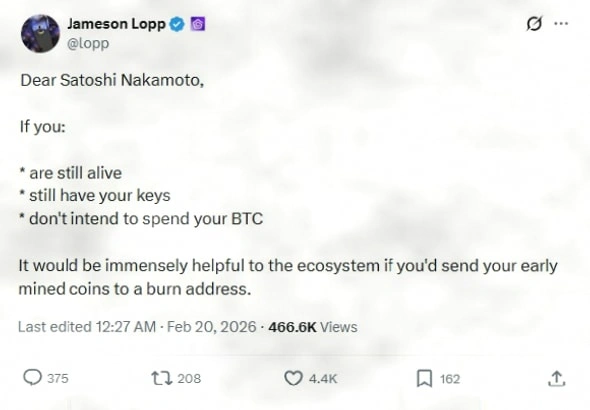
As quantum computing approaches practicality, the Bitcoin community is fiercely debating whether to freeze Satoshi Nakamoto's lost 1.3 million BTC. Supporters fear dilution of supply, while opponents insist on decentralized principles. A compromise proposal, Hourglass, is attempting to reconcile the contradictions, but a hard fork may be inevitable.
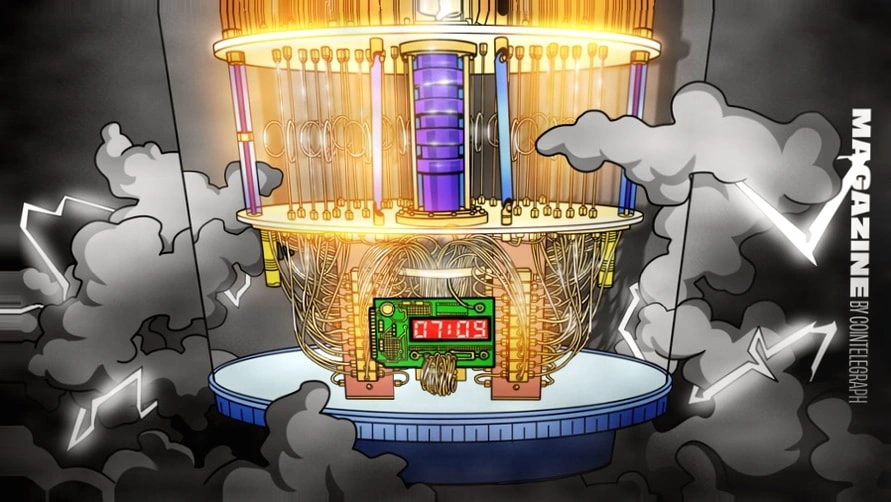
As quantum computing technology matures, the Bitcoin network faces an unprecedented ethical and technical challenge: how to handle the approximately 1.3 million Bitcoin lost by Satoshi Nakamoto and other early holders. These funds are stored in P2PK (Pay-to-Public-Key) format, with their public keys exposed on the blockchain, theoretically allowing quantum computers to reverse-engineer the private keys and steal them.
Some experts advocate proactive measures to prevent large-scale asset transfers from destabilizing the market in the future. The QBIP proposal, co-authored by Jameson Lopp, suggests that three years after BIP-360 is activated, transfers from quantum-vulnerable addresses should be prohibited; after five years, the funds in such addresses would be permanently locked. Supporters argue that if left unchecked, up to 20%-30% of the Bitcoin supply could be illegally released, severely undermining Bitcoin's core principles of a "fixed supply" and "censorship resistance."
"This would destroy user confidence in Bitcoin as hard money," said Charles Edwards, founder of Capriole. He also pointed out that if an orderly migration is implemented, 99.9% of active users would cooperate in transferring their assets, with only a very few special cases (such as those incarcerated) potentially unable to participate.
Historically, Satoshi Nakamoto likely knew about Shor's algorithm when designing Bitcoin—an algorithm proposed 20 years earlier that can use quantum computers to crack elliptic curve cryptography. Some analysts believe that this default use of P2PK was perhaps not an oversight, but a deliberate choice, reserving a channel for a possible "return of funds" in the future.
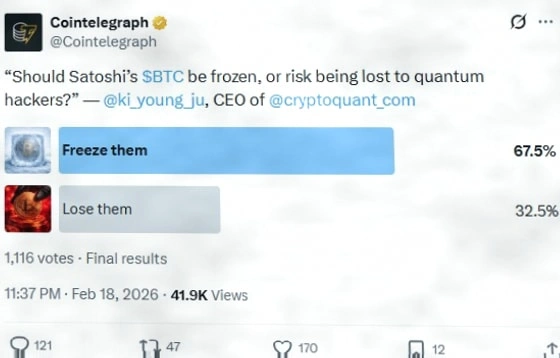
Opinions within the Bitcoin community are clearly divided on this issue. A Cointelegraph social media survey showed that approximately two-thirds of respondents supported freezing these coins, while one-third opposed it. Although the survey was not a scientific sample, it reflects the prevailing sentiment.
Bitcoin developer Pierre Rochard holds a completely different view: "These coins should be public loot. If someone can crack them, they should take them and use them. This is the embodiment of Bitcoin's free spirit." In his view, whether to sell immediately is entirely up to the thief.
Faced with polarization, the community is also exploring compromise solutions. A proposal called "Hourglass V2" suggests allowing quantum attackers to steal P2PK coins, but these coins would not flood the market all at once. Instead, they would be released at a steady rate of 1 BTC per block (approximately 144 BTC per day). This is intended to prevent the market from crashing due to a sudden massive supply—without restrictions, a single block could generate over 6,000 P2PK transactions, releasing more than 300,000 coins.
This mechanism attempts to strike a balance between "protecting scarcity" and "respecting decentralized principles." If a quantum attack does occur in the future, the Hourglass proposal may serve as a buffer to avoid network splits.
However, if no one promotes a consensus upgrade, the market may spontaneously diverge. A Bitcoin core developer pointed out, "Once a fork proposal emerges, the market will not hesitate to choose the chain that disables the unsafe spending path."
This debate goes far beyond the technical level, touching on the very foundations of Bitcoin's philosophy: whether to adhere to the absolute immutability of the original code, or to allow the community to make limited adjustments through consensus in the face of unforeseen threats? Regardless of the final outcome, Bitcoin's future stands at a critical crossroads.
0 comment A文章作者M管理员
No Comments Yet. Be the first to share what you think
❯
Profile
Search
Checking in, please wait...
Click for today's check-in bonus!
You have earned {{mission.data.mission.credit}} points today