

Decentralized oracle service provider RedStone has officially deployed its price data feed service on its blockchain, providing more reliable financial data support for DeFi News applications on the Stellar network. This move fills a critical infrastructure gap in Stellar's development of advanced financial functions, as the network previously focused primarily on payment and stablecoin transfer scenarios.
RedStone employs a deviation-based update mechanism and data freshness checks to ensure the accuracy and timeliness of price information. Its stablecoin price update threshold is typically controlled between 0.5% and 1%, and a minimum daily refresh frequency is set to effectively prevent price manipulation risks caused by low-liquidity markets.
The Stellar ecosystem has been gradually expanding its DeFi News capabilities in recent years, covering innovative applications such as lending and asset tokenization. However, a major DeFi News attack in February of this year exposed the network's vulnerability in price oracle mechanisms. At that time, relying on trading pairs with insufficient trading volume of less than $1 per hour as a pricing basis led to serious distortions in collateral valuation.
RedStone co-founder Marcin Kazmierczak pointed out that Stellar has natural advantages in real-world financial scenarios, and the introduction of enterprise-grade oracle services is a core step in promoting its move towards a more complex financial ecosystem.
According to DefiLlama data, internal protocol oracles account for 6% of the mainstream oracle market on the Stellar chain, while Pyth and RedStone account for 5.8% and 5.5% respectively, indicating that decentralized data sources are gradually becoming standard in the ecosystem.
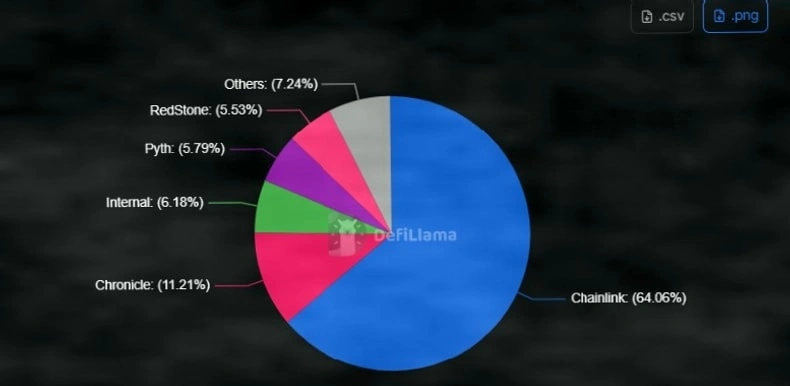
RedStone Integrates with Stellar Network to Enhance DeFi News Price Oracle Security
RedStone officially launched enterprise-grade price oracle services for the Stellar network, improving DeFi News security through deviation updates and data freshness checks, and making up for financial attack vulnerabilities previously caused by low-liquidity markets.