

The U.S. Department of Labor released the highly anticipated February Consumer Price Index (CPI) data, the last key inflation indicator before the Federal Reserve's next interest rate meeting. The data showed that the February CPI rose 0.3% month-over-month and 2.4% year-over-year, fully in line with market expectations. In comparison, the month-over-month increase in January was 0.2%, showing a slight rebound this month. Core CPI (excluding food and energy prices) rose 0.2% month-over-month, also in line with forecasts, while the January figure was 0.3%, showing a slight decline this month.
Within the CPI composition, housing costs remain the biggest influencing factor, rising 0.2% month-over-month and 3% year-over-year this month. Among them, rent only increased by 0.1% month-over-month, the smallest monthly increase in more than five years, indicating that housing inflation pressure is gradually easing.
Based on the fact that this data is highly consistent with expectations, the market generally expects the Federal Reserve to maintain interest rates unchanged at next week's FOMC meeting and continue to wait and see the subsequent performance of inflation trends and the job market.
Bitcoin's price experienced a brief fluctuation after the data was released, climbing slightly from around $69,000 to $69,800, before retreating to around $69,300 to consolidate. It is worth noting that Bitcoin's sensitivity to macro data has decreased recently, and the market's focus has shifted more to geopolitical risks, especially the evolution of the situation in the Middle East. In this context, the price trend of crypto assets is more driven by risk sentiment and safe-haven demand for funds, rather than purely by inflation data.
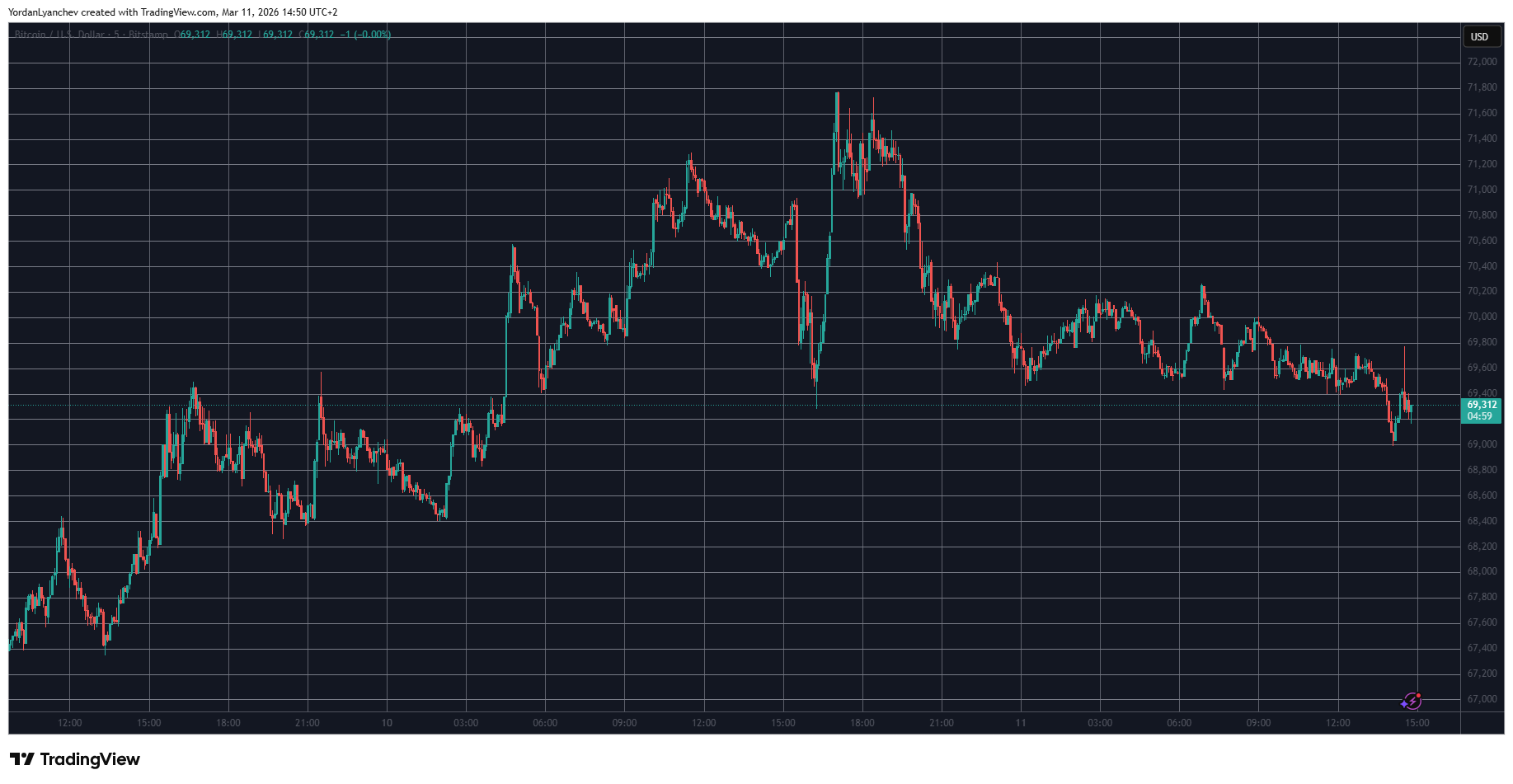
US February CPI Meets Expectations: How Did Bitcoin React?
US February CPI data met expectations, the market expects the Fed to remain on hold, and Bitcoin price briefly rose before falling back to $69,300, showing that its reaction to inflation data is becoming钝化, and geopolitical factors are becoming the new dominant variable.