

Due to ongoing adverse macroeconomic factors affecting investors' risk appetite, Bitcoin's price faces the risk of falling back to the $65,000 range.
Persistent Macroeconomic Headwinds Impacting Bitcoin
Currently, Bitcoin is facing a series of geopolitical and macroeconomic risks that could push its price towards $65,000, potentially dropping to $60,000 thereafter.
Through these measures, Iran aims to drive oil prices up to $200, a move that could ultimately exacerbate global inflation, with the United States being the most affected due to its sensitivity to energy price shocks. Escalating tensions in the Middle East have historically driven investors away from volatile assets like cryptocurrencies, opting instead for traditional safe-haven assets.
Meanwhile, if the war continues to push energy costs higher, it may further intensify inflation and weaken hopes for a shift in monetary policy this year. Higher interest rates typically diminish the liquidity necessary for speculative assets to thrive.
It is also worth noting that the inflation data from February did not fully account for the recent surge in oil prices, thus failing to reflect the tough stance the Federal Reserve will be forced to adopt in the coming weeks.
Thirdly, as the bond market reacts to these inflationary pressures, the yield on the U.S. 10-year Treasury bond has continued to rise. These yields have recently increased by several basis points, making the guaranteed returns on government debt far more attractive compared to the risks associated with digital currencies.
Bitcoin Price Analysis
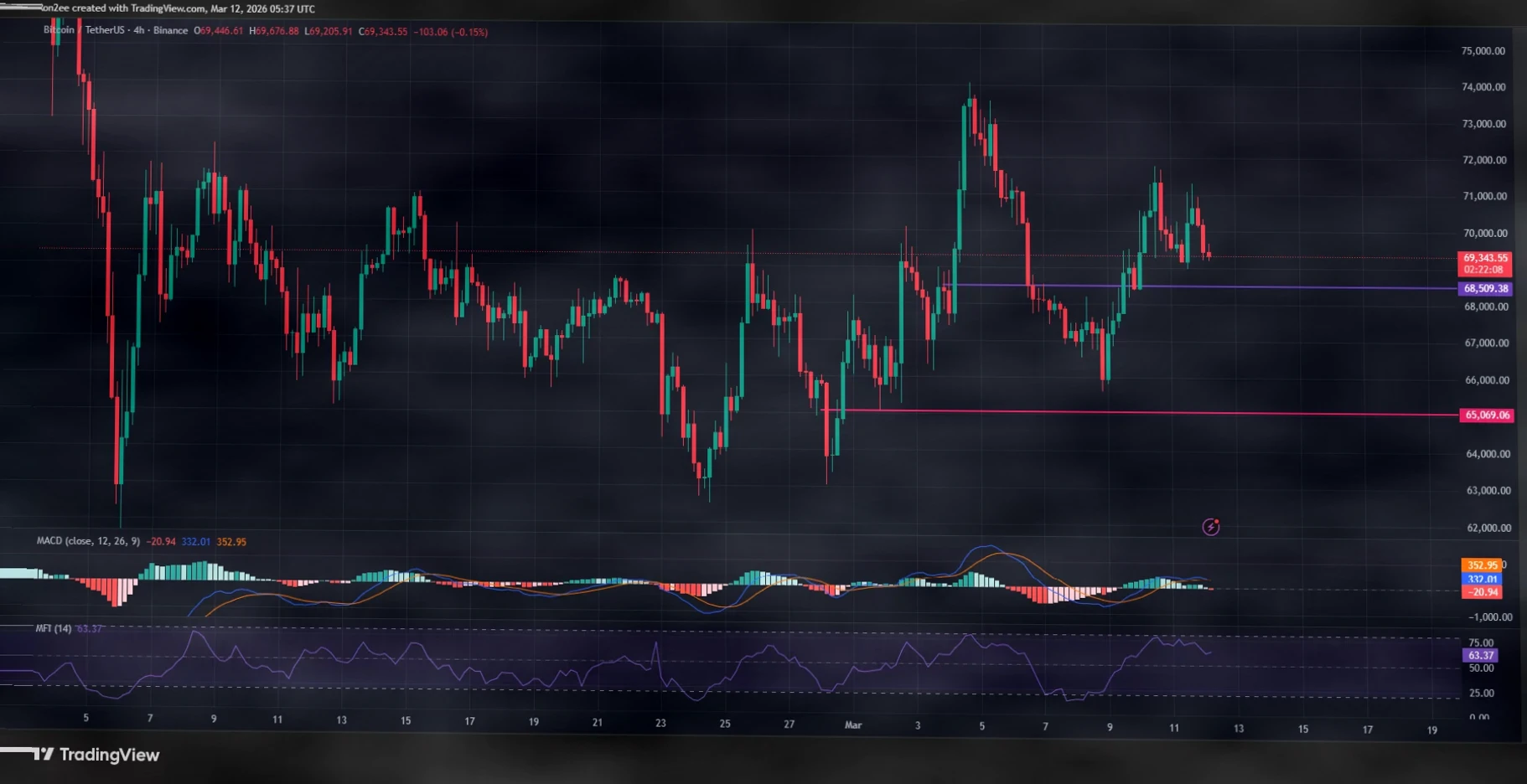
From a technical perspective, Bitcoin has once again fallen below the $70,000 mark. Traders are closely monitoring the support level at $68,500, but the ongoing selling pressure indicates that the path of least resistance remains downward, potentially retreating to the $65,000 support area.
On the 4-hour chart, momentum indicators suggest that a bearish structure has begun to form. The MACD line is nearing a confirmed bearish crossover, while the RSI is trending downward after reaching overbought levels.