

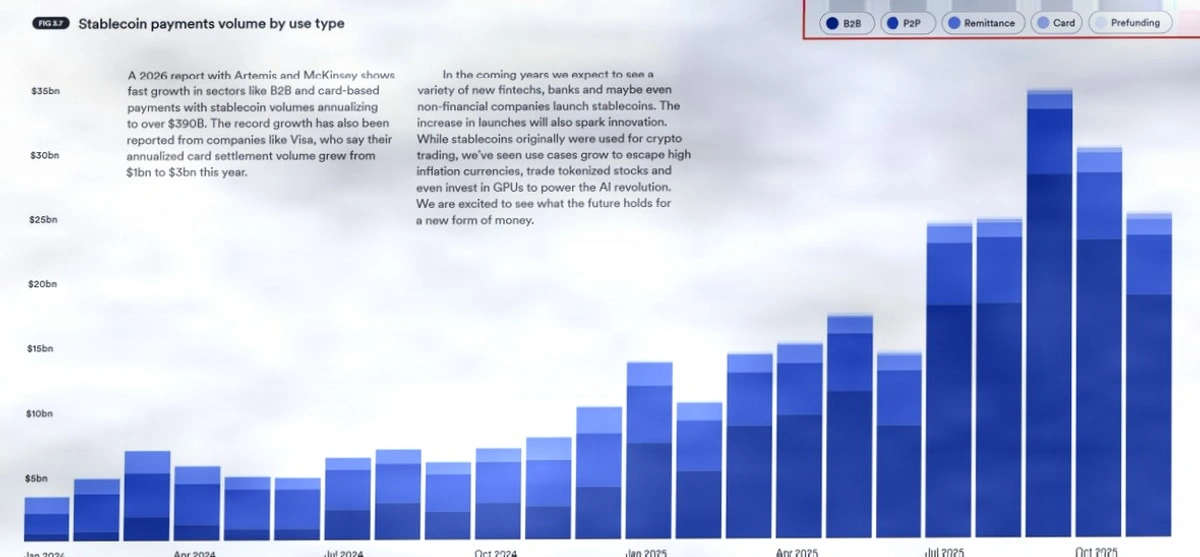
The payment volume of stablecoins has surged sixfold in just eighteen months, yet its primary use cases differ from industry expectations. According to new data released by payment infrastructure company BVNK, business-to-business (B2B) payments have quietly become the engine driving a significant shift in global capital flows.
BVNK cited a report jointly published by analytics platform Artemis and McKinsey, indicating that by early 2026, the monthly payment volume of stablecoins will exceed $30 billion, up from $5 billion in January 2024, with an annualized total exceeding $390 billion. In terms of usage types, B2B transactions account for the vast majority, far surpassing the combined total of peer-to-peer transfers, remittances, card payments, and prepayments. Charts in the report show that since mid-2024, the growth in B2B transaction volume has been particularly pronounced, especially reaching its steepest growth rate in the second half of 2025.
Why are businesses choosing stablecoins over traditional systems?
For corporate finance teams, the choice of stablecoins is not driven by ideology but by operational efficiency. The SWIFT network underpins most international bank transfers, with cross-border payment settlement times typically taking one to five business days. Each intermediary in traditional correspondent banking adds costs, especially in complex currency corridors. In contrast, stablecoin settlement times are within seconds and can operate around the clock, including weekends and holidays, completely independent of intermediary networks.
For companies engaged in substantial international transactions, these differences accumulate rapidly. Businesses needing to make payments to suppliers in multiple countries no longer have to manage currency exchange windows, correspondent banking relationships, or liquidity tied up due to settlement delays. Data from Artemis and McKinsey indicates that an increasing number of finance teams have calculated these factors and taken corresponding actions.
Use Cases Beyond Payments
BVNK notes that the initial assumptions regarding stablecoin adoption—that remittances and consumer transfers would be the primary drivers—have not materialized as expected. Instead, B2B transactions have gradually taken on this role. Card-based stablecoin payments have also seen growth, with Visa reporting that its annualized card settlement volume rose from $1 billion to $3 billion, but this category still falls short of B2B in absolute numbers.
The report from Artemis and McKinsey also highlights that the use cases for stablecoins are extending beyond simple payments. Stablecoins have been utilized for trading tokenized assets, serving as an alternative store of value in high-inflation currency environments, and recently have been used to fund GPU infrastructure for artificial intelligence computations. Each of these use cases represents a source of demand that did not exist two years ago and has increased transaction volumes beyond traditional payment categories that allow for data tracking.
Future Outlook
The report from Artemis and McKinsey...