

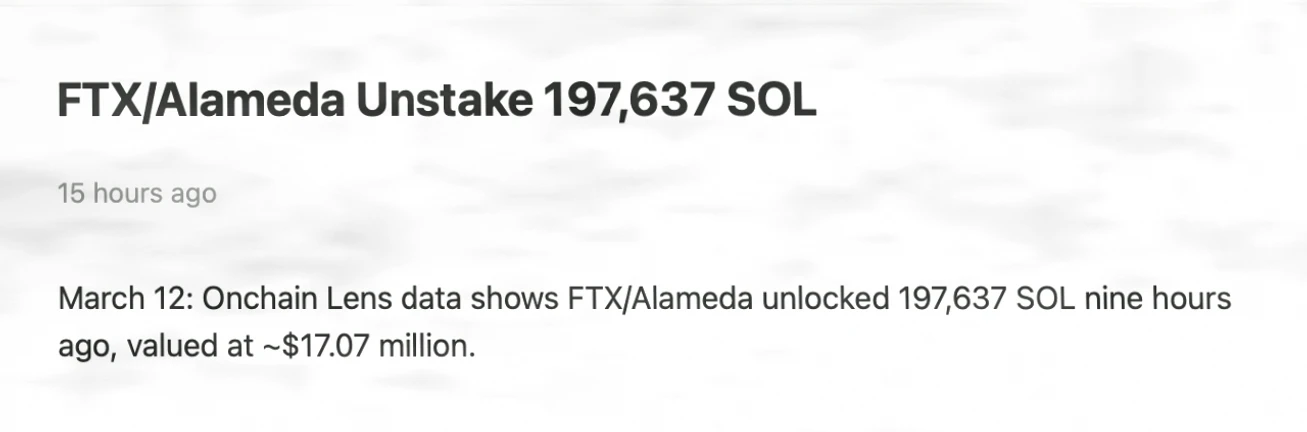
A wallet associated with the Alameda Research legacy unstacked a large batch of Solana (SOL) from staking contracts on March 12, marking the latest step in the court-supervised liquidation process aimed at quietly converting the remaining digital assets of the collapsed exchange into cash to repay creditors.
According to on-chain data monitored by Lookonchain, the transaction was flagged at the time it occurred.
The total amount of unstaked SOL was approximately 1.1 million, valued at around $17 million based on market prices at the time. These assets were transferred from designated cold staking contracts to a central settlement wallet operated by the FTX and Alameda debtor estate.
This transaction is part of a court-approved liquidation strategy that deliberately releases assets in batches rather than all at once, aiming to limit downward pressure on market prices. Nevertheless, the estate still retains over 18.4 million SOL in various locked and vested positions, representing an exposure of about $290 million in remaining assets.
Flow of Funds
The unstaked SOL directly enters the FTX distribution fund, which the estate uses to execute monthly payments to verified creditors through this fund. The repayment plan has now entered its second year, and progress for small claimants has been quite significant. As of March 2026, over 94% of customer claimants (those who held balances below $50,000 at the time of bankruptcy in November 2022) have been fully repaid the dollar value of their accounts at the time of collapse.
For larger creditors, the situation is more complex. Institutional claimants and disputed claimants are currently in the second phase of distribution, receiving payments proportionally as the estate manages its remaining altcoin holdings. SOL is the largest single position, but the estate is also converting SRM and MAPS into cash as part of the same process. Each conversion returns to the distribution pool on a monthly basis.
How to Avoid Market Volatility
This batch release strategy is not merely a legal formality. An indiscriminate sale of 18 million SOL on the open market would almost certainly depress prices significantly, thereby reducing the overall recovery for creditors. To manage this risk, the estate is liquidating through over-the-counter (OTC) trading platforms, which match large trades and avoid the slippage that comes with placing large orders on public order books.
This strategy appears to be effective. Following the news of the unstaking on March 12, the SOL price dropped by less than 1.2%, with analysts noting that this reaction indicates the market has largely priced in these periodic liquidations. Previous batch releases have also resulted in similarly mild reactions, suggesting that OTC trading and advance visibility have reduced the unexpected factors that typically exacerbate selling pressure.