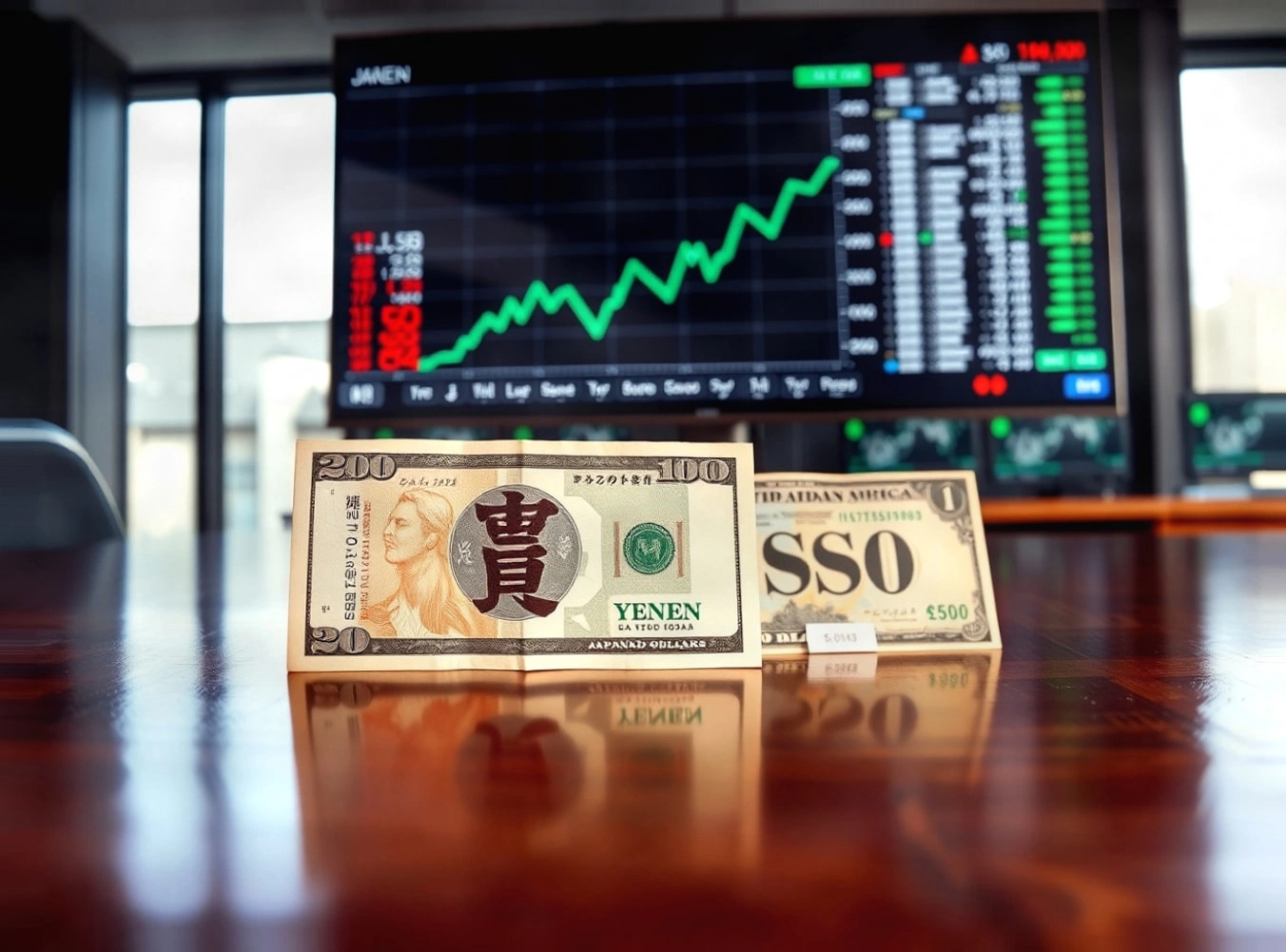
The yen has rebounded against the dollar recently, with the market focused on the possibility of Japanese government intervention. Analysts believe that verbal warnings and technical indicators are the main factors driving the yen's rise. At the same time, the market is closely watching the upcoming US PCE data, which could have a significant impact on global currency valuations.
The Japanese yen has recently rebounded against the US dollar from multi-decade highs, with the yen gaining approximately 0.8% on Thursday. Market analysts attribute this shift primarily to two factors. First, the verbal warnings issued by Japanese Ministry of Finance officials this week have been noticeably more forceful. Second, technical indicators suggested that the currency pair had entered a severely overbought territory, prompting speculative traders to take profits.
Nevertheless, the yen's recovery remains fragile against the backdrop of a stronger dollar. The Dollar Index (DXY) is holding near 105.00, driven by widespread expectations that US interest rates will remain elevated for an extended period. Consequently, the yen's rise appears more like a tactical bounce rather than a reversal of the underlying trend. Market participants are treating each yen rally with caution, acutely aware of the macroeconomic disparities between Japan and the United States.
**Foreign Exchange Market Shrouded in Intervention Shadow**
Japanese authorities have a proven track record of intervening in the foreign exchange market to stabilize the yen. The last time the Japanese Ministry of Finance (MOF) directly purchased yen was in October 2022, when it spent a record 9.2 trillion yen. Current market conditions are increasingly reminiscent of that period. In recent months, senior officials have used the strongest language, describing recent yen volatility as "excessive" and "speculation-driven," phrases historically used as direct precursors to action.
The mechanics of a potential intervention involve several key considerations:
Market sensitivity to intervention rhetoric has visibly increased. Options pricing analysis reveals a sharp rise in demand for contracts hedging against a sudden yen appreciation, a clear indication that the market is hedging against intervention risk.
**Expert Analysis: The Psychology of Currency Defense**
Dr. Kenji Watanabe, a former Bank of Japan official and senior research fellow at the Tokyo Institute for Monetary Affairs, provides crucial context. "The threshold for intervention is not a specific exchange rate level, but rather the speed and volatility of the movements," Watanabe explains. "The authorities will assess whether market functioning is impaired. Their recent statements aim to restore two-way risk and deter one-way speculative behavior." Historical data supports this view. Interventions typically occur after rapid, disorderly moves exceeding 2% in a single day, rather than gradual trends.
**US PCE Data: The Federal Reserve's Preferred Inflation Gauge**
Currently, all market participants' eyes are turning to the U.S. Bureau of Economic Analysis, which plans to release the latest PCE price index data. As the Federal Reserve's preferred inflation indicator, the report has significant implications for global currency valuations. Economists polled by Bloomberg generally predict that the core PCE index will grow by 0.3% month-on-month and 2.8% year-on-year.
Potential outcomes and their implications:
0 comment A文章作者M管理员
No Comments Yet. Be the first to share what you think
❯
Profile
Search
Checking in, please wait...
Click for today's check-in bonus!
You have earned {{mission.data.mission.credit}} points today