

BlackRock's Staked Ethereum ETF (ETHB) saw $15 million in trading volume on its first day, signaling growing institutional interest in Ethereum staking yields. 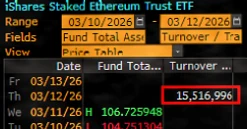
The fund's structural significance outweighs its debut performance. It marks the first time a mainstream asset manager has incorporated Ethereum staking rewards into a regulated brokerage account, opening it up to institutional investors.
ETHB shares closed at $24.82 on their first trading day, closely tracking the price of staked Ether throughout the day. Analysts observed steady institutional interest throughout the trading session, rather than a concentrated burst at the open, which is more consistent with prudent asset allocation than speculative trading. BlackRock is implementing a fee waiver on the fund, with a fee of 0.12% for the first 12 months or until the fund reaches $2.5 billion in assets, after which a standard fee of 0.25% will apply. This introductory mechanism is a common tactic used by the asset manager to attract early liquidity before the full fee takes effect.
The Importance of Yield
More importantly, it impacts a class of institutional investors that have previously had little involvement in cryptocurrencies. Pension funds and insurance companies typically need to allocate to assets with yield. A spot crypto ETF that only provides price exposure without yield does not meet these requirements, regardless of the underlying asset's performance. A staked Ethereum product that offers regulated, predictable yield removes this structural barrier. Whether a yield of 2.8% to 3.0% is sufficient to meet institutional requirements depends on the specific fund, but with the launch of this product, the investor base for Ethereum as a legitimate portfolio allocation choice has greatly expanded.
ETHB vs. IBIT
BlackRock's Bitcoin ETF set a standard on its debut that is difficult for subsequent products to surpass. IBIT launched in a very specific environment: years of anticipation, multiple rejected regulatory approvals, and long-standing anticipation from retail and institutional investors. ETHB faces a different environment. Spot Ethereum ETFs already exist, staking as a concept needs to be explained to investors unfamiliar with proof-of-stake mechanisms, and the overall cryptocurrency market is trading far below its late 2025 highs.
In this context, a trading volume of $15.58 million on the first day is a credible result. It reflects genuine institutional participation, rather than speculative spillover from Bitcoin ETF investors. Furthermore, the yield provides fund selectors with a rationale they can present to investment committees in language that traditional finance can understand. A yield-generating digital asset ETF from the world's largest asset manager is fundamentally different from a speculative product.