

Prediction markets hold immense potential, but their scalability is limited by the underlying solution infrastructure. Beyond regulation and custody, the key to trust lies in the problem-solving mechanisms.
Problem Resolution as a Bottleneck

Problem resolution architecture is crucial as the application scope of prediction markets expands into more contentious areas. Sports event markets often involve borderline cases related to rulings, timing, and data sources. Political markets depend on definitions, certification procedures, and legal interpretations. Macroeconomic markets are affected by methodological changes and release schedules.
As the scope of application broadens, disputed outcomes are becoming increasingly frequent.
When the problem-solving process is opaque or arbitrary, user engagement quietly declines. Conversely, when the problem-solving process is adversarial and backed by economic guarantees, users view it as financial infrastructure.
This is similar to the early development of cryptocurrencies. Custody, execution, and clearing were once product features, but over time, they have become predictable and auditable system attributes expected by institutions.
Problem-solving mechanisms are undergoing a similar transformation in prediction markets.
Problem Resolution as Infrastructure
Every prediction market makes the same promise: traders purchase conditional claims on future outcomes, and once the event occurs, the system must deterministically convert these claims into redeemable value. If the conversion process is slow, ambiguous, or arbitrary, traders will factor in problem resolution risk. When problem resolution risk becomes significant, large sums of capital will only concentrate in a few popular markets, avoiding others.
This is why problem resolution architecture is becoming a very important component of the modern prediction tech stack.
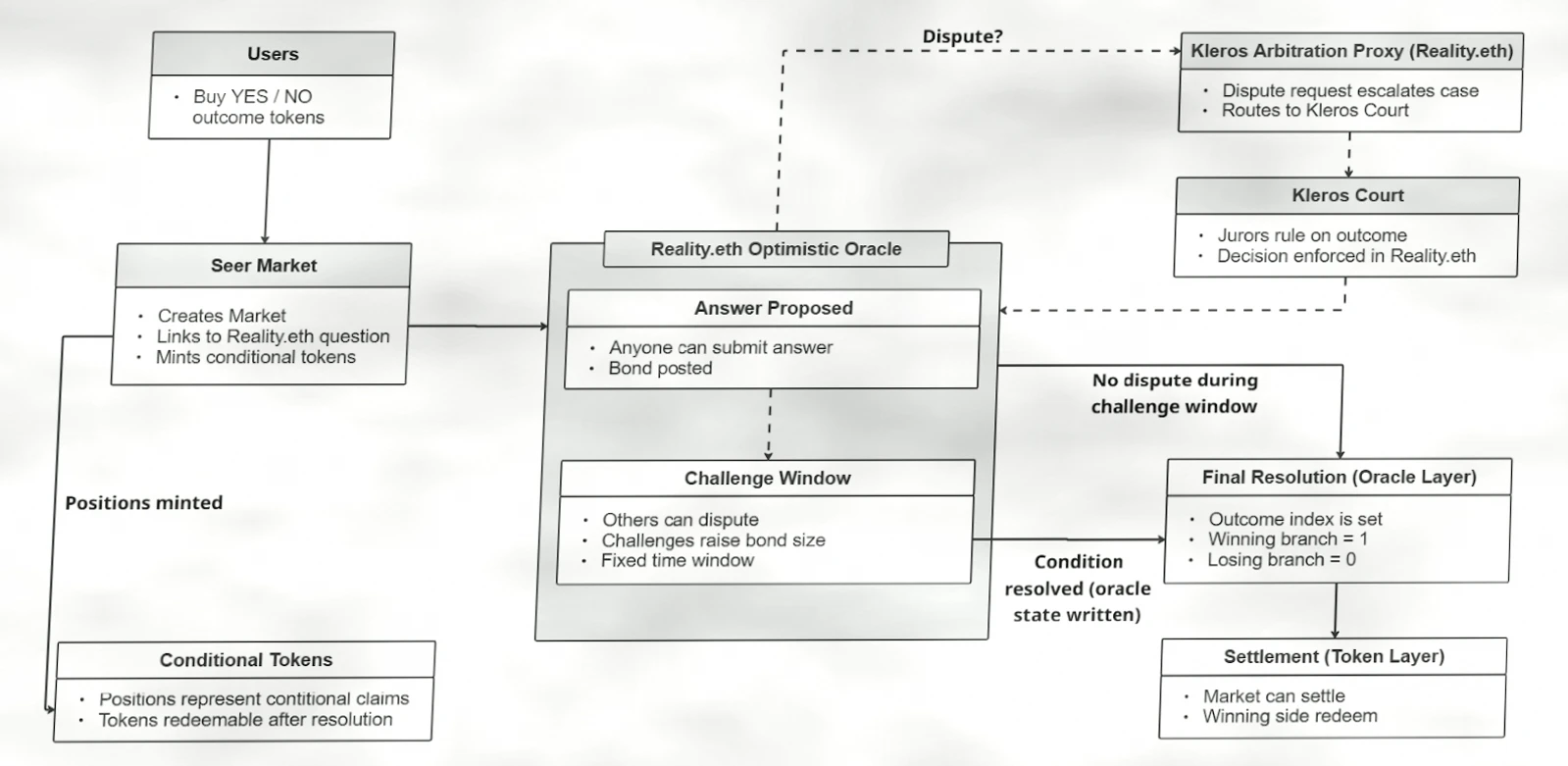
Once an event occurs, oracles propose an answer. Optimistic oracle designs default to the answer being correct but require proposers to submit a bond. Submitting an incorrect answer incurs an economic cost.
From Product Feature to Trust Foundation
As prediction markets evolve into information infrastructure, the focus of trust shifts from interfaces and incentives to the problem resolution mechanisms as architecture: a set of rules, bonds, challenge windows, and arbitrage paths that deterministically translate outcomes into enforceable settlements.
The winners of the next wave of growth will not be the platforms that acquire the most first-time traders in a single hot event, but those that build problem resolution infrastructure as reliable as execution.
For builders, this changes the priorities of core engineering and governance. Problem resolution rules must be clearly defined before a market goes live, rather than being retroactively modified after a dispute arises. Question design must minimize ambiguity at creation, rather than relying on discretion at settlement. Bond sizes and challenge windows must adjust as open interest grows, rather than remaining static as markets scale. Arbitrage paths must be predictable and enforceable. Problem resolution latency must be treated as a core performance metric.