XRP Ledger patched a major security flaw in its signature verification layer, potentially allowing attackers to bypass wallet authorization. The XRPL Foundation used AI-assisted tools to discover and fix the vulnerability, averting significant losses. XRP's technical analysis shows consolidation with upside potential.
XRP Ledger has patched its largest security vulnerability in years. The incident began on February 19, 2026, when security researcher Pranamya Keshkamat and Cantina AI's autonomous vulnerability hunting system, “Apex,” discovered a critical logic flaw hidden within the Batch amendment (XLS-56). The flaw was located in the signature verification layer – the mechanism used to confirm that transactions are authorized before they are executed.
If the vulnerability had gone unnoticed and the amendment activated, the consequences would have been dire: attackers would have been able to completely bypass wallet authorization and drain funds without ever touching private keys. With over $80 billion in network value at stake, the XRPL Foundation acted swiftly.
By February 23, Ripple and the XRPL community had rolled out v3.1.1 – an emergency release that explicitly marked the Batch and fixBatchInnerSigs amendments as unsupported, preventing activation. Version 3.1.2 followed shortly after, cleaning up residual instability introduced by the first patch. Neither release introduced new protocol features.
The response has earned praise from industry insiders. The XRPL Foundation's use of AI-assisted security tools to catch such a large-scale vulnerability, averting its exploitation, is noteworthy – and increasingly necessary as the network absorbs more institutional capital.
XRPL's Growing Pains
Timing is critical. XRPL is no longer the quiet, low-activity chain it was three years ago. As of early 2026, the total value of tokenized assets locked on the ledger has skyrocketed from $111 million to over $1.14 billion. The number of successful daily payments has climbed from approximately 1.5 million in late 2025 to around 2.5 million in Q1 2026. The network now carries real weight, and vulnerabilities that might have been theoretical risks in a calmer environment become real threats at this scale.
The Lending Protocol (XLS-66d) is currently in the voting phase, with validator consensus around 17% – well below the 80% threshold required for activation. Analysts expect it to accelerate XRPL's transition towards institutional DeFi News once passed. But that is a story for the future. For now, infrastructure build-out is the priority.
Technical Analysis: Consolidation with Upside Potential
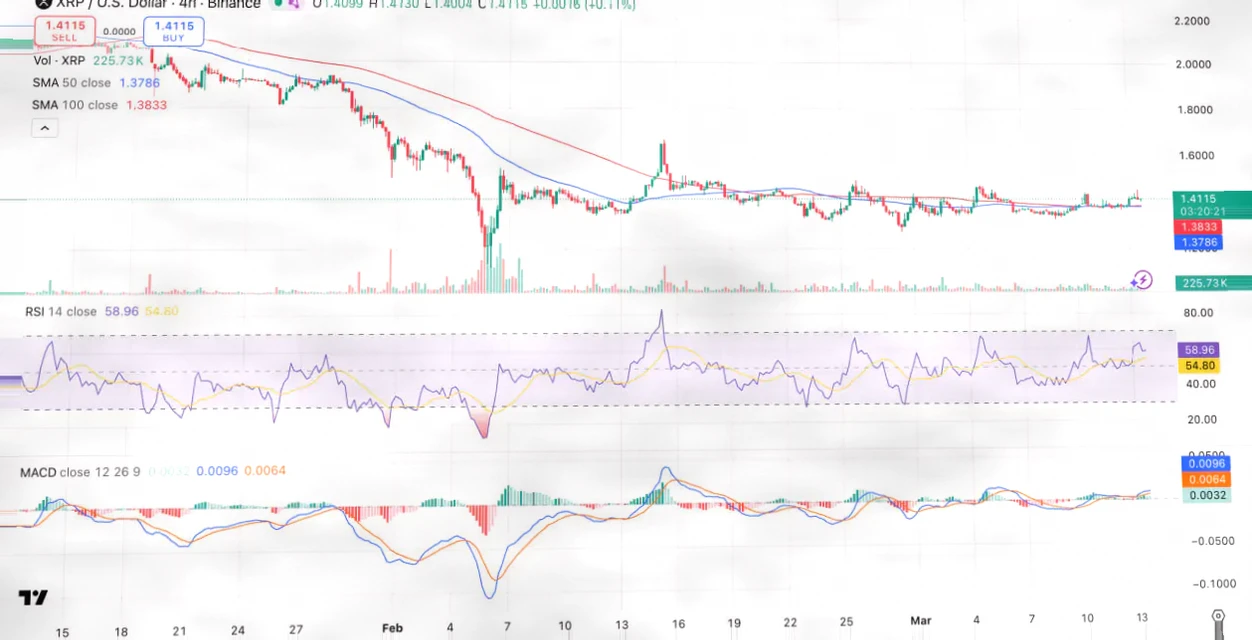
As of March 13, 2026, XRP is trading at $1.41, up 1.99% in the last 24 hours and 3.71% over the past week, with a market capitalization of $86.4 billion and $3.55 billion in 24-hour trading volume.
On the 4-hour chart, a measured consolidation is visible after a sharp sell-off from highs above $2.00 in January. The SMA 50 sits at $1.3786 and the SMA 100 at $1.3833 – both below the current price, a mildly bullish signal suggesting that price is reclaiming its short-term moving averages after weeks of compression.
The MACD confirms the cautious optimism. The histogram shows small positive bars, and the MACD line (0.0032) has crossed above the signal line (0.0096 vs 0.0064 histogram).
0 comment A文章作者M管理员
No Comments Yet. Be the first to share what you think
❯
Profile
Search
Checking in, please wait...
Click for today's check-in bonus!
You have earned {{mission.data.mission.credit}} points today