

According to Token Terminal data, stablecoin issuers unlocked roughly $5 billion in yield through deployments on the Ethereum network in 2025. This sum does not originate from Ethereum itself but reflects the share of interest earned by issuers after investing the USD reserves backing those coins into yield-bearing assets such as U.S. Treasuries, with the network merely serving as the settlement layer.
The profit model for stablecoins is straightforward: a user deposits $1, the issuer mints one stablecoin of equal value, and the issuer allocates that dollar to low-risk instruments like short-term Treasuries to collect interest. Users benefit from price stability, while issuers retain the full spread. At the current U.S. Treasury rate, that interest differential has become a substantial income stream.
Token Terminal apportions income based on proportional network deployment. If 70% of an issuer’s total stablecoin supply resides on Ethereum, then 70% of that issuer’s interest income is credited to Ethereum’s contribution. As a result, the $5 billion figure represents the “Ethereum-supported share of stablecoin yields,” not the network’s own revenues.
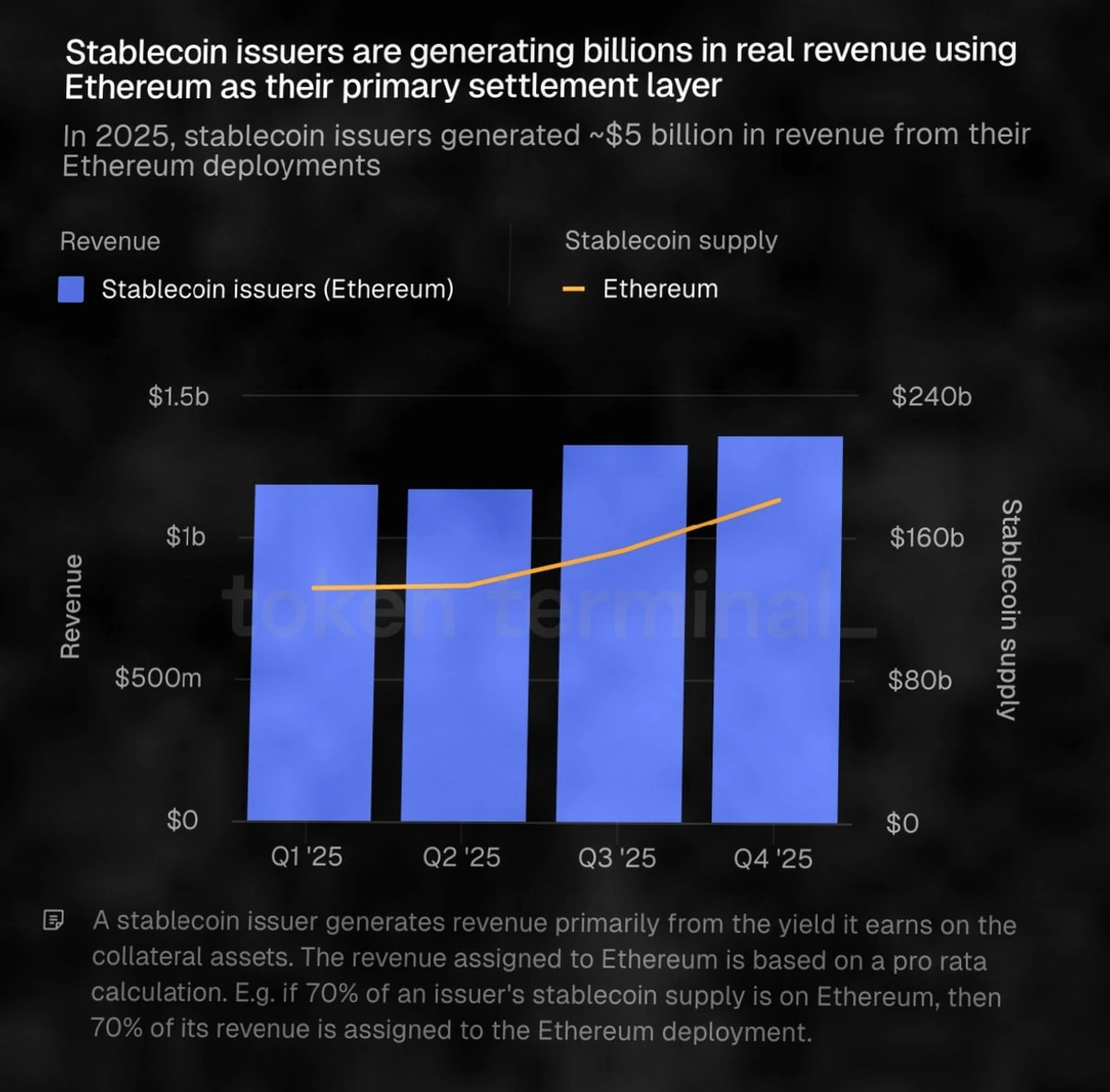
Quarterly trends show Ethereum-based stablecoins delivering steady $1.1 billion returns in Q1 and Q2 of 2025, rising to $1.3 billion in Q3 and edging up slightly in Q4, totaling around $5 billion for the year. Meanwhile, the total stablecoin supply on Ethereum was mostly flat in the first half but climbed sharply in the second half, surpassing $160 billion by year-end. That means total income is rising even as the yield per dollar invested falls, likely because new inflows are being placed into lower-yield instruments or because competition is compressing the spread.
This diminishing marginal return pattern is a hallmark of a maturing market and not a red flag; on the contrary, it reinforces Ethereum’s emerging role as the core infrastructure for stablecoins.
It’s worth noting that this massive revenue distribution structure has become a focal point in U.S. regulatory debates. Banks criticize the “license-free rate competition” where stablecoin holders earn no interest while issuers pocket all the gains. In contrast, firms like Coinbase argue that users should share in the returns and are promoting stablecoin yield programs offering roughly 3.5% annually. Donald Trump echoed that sentiment on Truth Social on March 4, stating “Americans should earn more on their money,” a line closely aligned with Coinbase’s position. Whether there is coordination between these political and corporate voices remains to be seen, but Token Terminal’s data make it clear: this is not theoretical—it’s a multi-billion-dollar annual yield reshaping the financial landscape.