

Key Highlights
The network now processes over 50 million transactions daily, with average fees below $0.001. These figures are not speculative indicators but reflect actual large-scale usage.
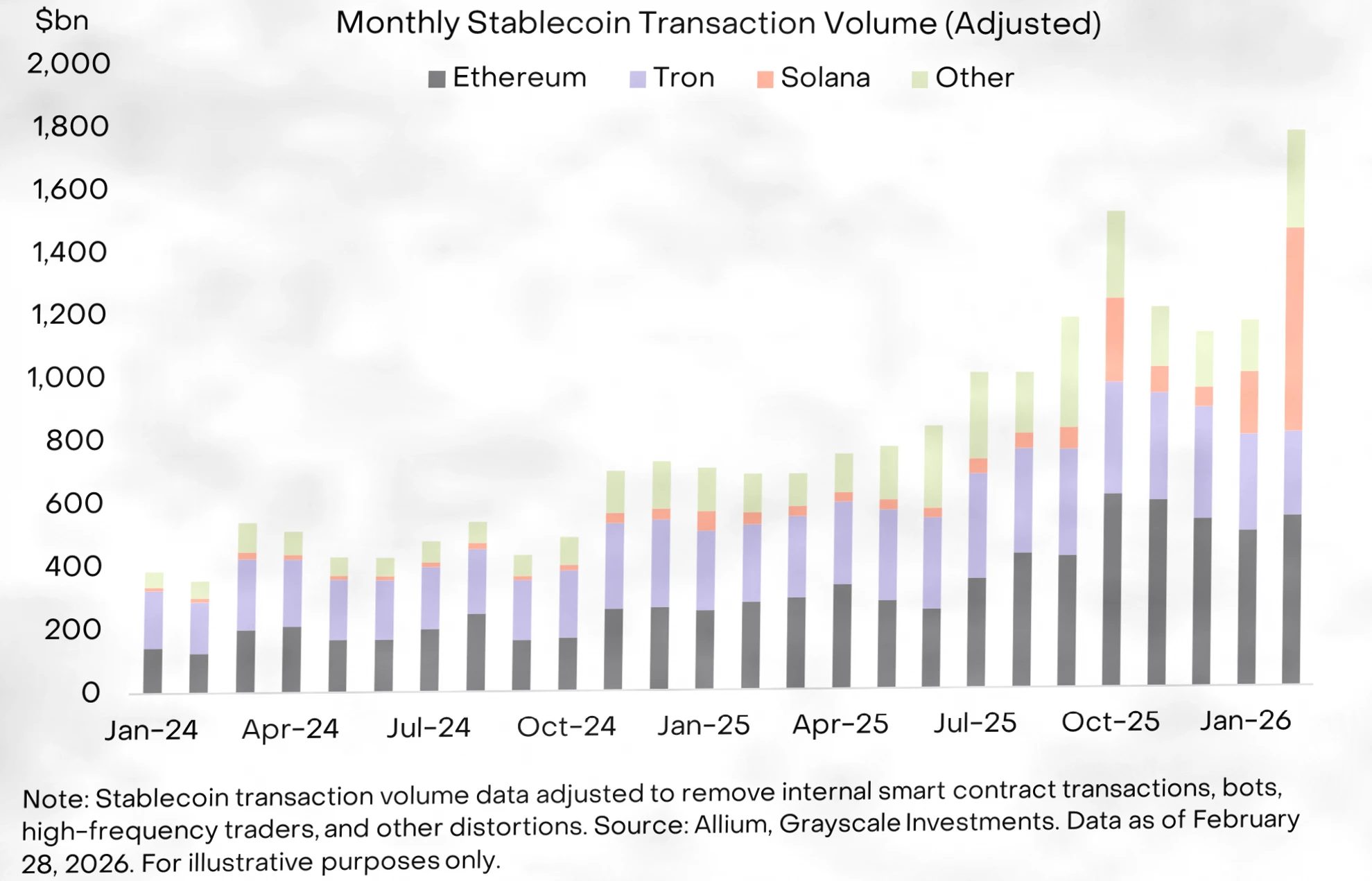
The Real Implications of Grayscale Data
In less than five months, trading volume has doubled, fees remain close to zero, and throughput is stable, which is not typical growth behavior. This indicates that Solana is absorbing demand that previously had no suitable home on-chain.
Analysts from Grayscale and Standard Chartered point out that the composition of this demand has undergone a substantial change. The Memecoin speculation that once dominated the narrative around Solana is gradually being replaced by payment infrastructure: retail stablecoin transfers, remittances, and micropayments. The network has the second-largest USDC circulation among all blockchains and ranks fourth in total stablecoin supply.
Two upcoming upgrades are key to this repositioning. Firedancer and Alpenglow are expected to launch in 2026, aiming to provide institutional-grade fault tolerance and push throughput to over one million transactions per second. Reliability is non-negotiable for any institution running payroll or settlement infrastructure on-chain. The real asset trading volume on Solana—including tokenized gold products like Tether's XAUTO—has already surpassed $280 million weekly.
Grayscale's 2026 Outlook: One-Way Development
Grayscale's broader 2026 digital asset outlook suggests that the industry is no longer reliant on speculative retail cycles. Regulatory clarity—especially with the anticipated CLARITY Act and bipartisan market structure legislation—is expected to provide the formal rules that institutional investors have been seeking. The GENIUS Act is anticipated to drive the adoption of stablecoins in corporate financial management and cross-border payments, with Solana, Ethereum, Tron, BNB Chain, and Chainlink identified as major beneficiaries.
Asset tokenization is seen as a turning point, with a potential 1000x growth expected by 2030. Decentralized finance (DeFi News) growth is led by on-chain lending protocols like Aave and Morpho, as well as perpetual exchanges like Hyperliquid. Grayscale expects protocols with verifiable fee revenue—such as Solana, Ethereum, and Tron—to become focal points for investors. Standard Chartered has set a base price target of $250 for SOL in 2026, with a bullish scenario estimating between $250 and $320, primarily driven by ETF inflows and the Firedancer upgrade. Bitcoin is expected to reach new highs by mid-year.

South Korea Deploys AI Tax Monitoring Tools, Tightens Regulations
Grayscale also highlights two noise narratives: the quantum computing threat—which is unlikely to materialize before 2030—and the digital asset treasury, viewed as a holding mechanism rather than driven by substantive demand.
USDC vs. USDT: A Quiet Shift of Power
As of February 2026, USDC accounted for about 70% of all stablecoin transfer volume—approximately $1.26 trillion out of a total of $1.8 trillion. Despite USDT having a larger market cap, its trading volume is around $514 billion.
2025 Annual Report