

In March 2026, the decentralized perpetual contract trading sector processed over $540 billion in monthly trading volume across its top ten platforms, with Hyperliquid holding a commanding lead at $178 billion, far surpassing any single competitor.
Data from the Top Platforms
In the subsequent positions, ApeX and GRVT processed $36.83 billion and $36.58 billion, respectively, with both volumes being about one-fifth of Hyperliquid's. Variational ranked fourth with $29.01 billion, while StandX, Pacifica, and Extended rounded out the top ten with $17.67 billion, $14.33 billion, and $11.85 billion, respectively.
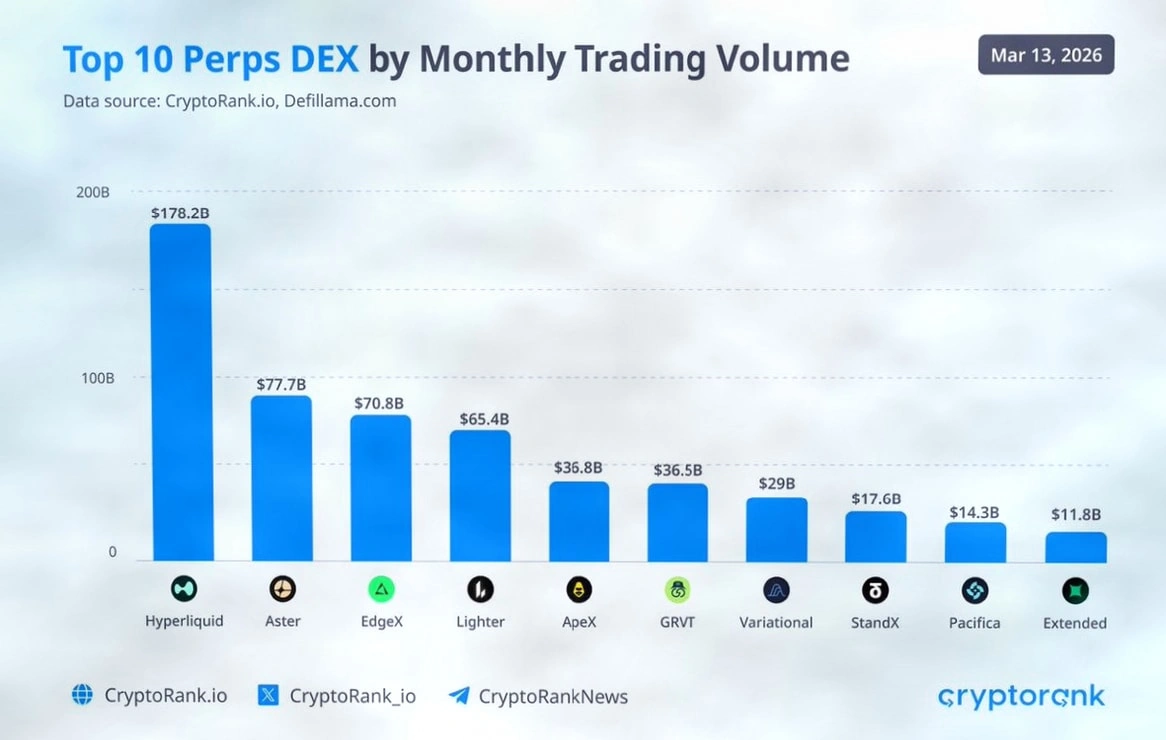
The total trading volume from platforms ranked fifth to tenth is approximately $146 billion, still lower than Hyperliquid's single-platform volume.
The True Significance of Hyperliquid's Lead
Hyperliquid's $178 billion monthly trading volume is not just a statistic of market share; it represents a structural shift in the way derivatives are traded. Perpetual futures contracts allow traders to leverage crypto assets without a set expiration date, a space historically dominated by centralized exchanges. Binance's perpetual contract trading desk has processed hundreds of billions in monthly trading volume for years.
The $178 billion monthly trading volume on decentralized platforms indicates that traders are increasingly willing to trade on-chain, no longer bearing the custodial risks associated with centralized exchanges. This shift accelerated after the FTX collapse in 2022, when counterparty risk became a major concern for serious traders.
Solana Payment Volume Surges 755%: Ecosystem Map Reveals Reasons
Broader Market Context
The total trading volume of $540 billion across these ten decentralized perpetual contract platforms represents a strong competition against the centralized derivatives market, although the largest centralized exchanges still handle significantly higher trading volumes, the gap is narrowing. Several platforms on the list, including Aster, EdgeX, and Lighter, as relatively new entrants, have processed billions in monthly trading volume in a short operational history.
The earlier mentioned discussions between Coinbase and Bybit further provide relevant context. Centralized exchanges are responding to the gradually encroaching decentralized space through acquisitions and partnerships. Hyperliquid's dominance in this decentralized arena positions it as the most direct competitive pressure on centralized derivatives venues.