

The Bitcoin 'Exchange Whale Ratio' has recently surged to its highest point in six years. This metric measures the proportion of trading volume attributed to 'whales' (individuals or institutions holding substantial amounts of cryptocurrency) relative to total exchange trading volume. Data indicates the current ratio stands at 0.62, marking a daily increase of 4.41%. This figure significantly surpasses the 72-period moving average of 0.5648 and is notably higher than any previous peak observed in the past six years.
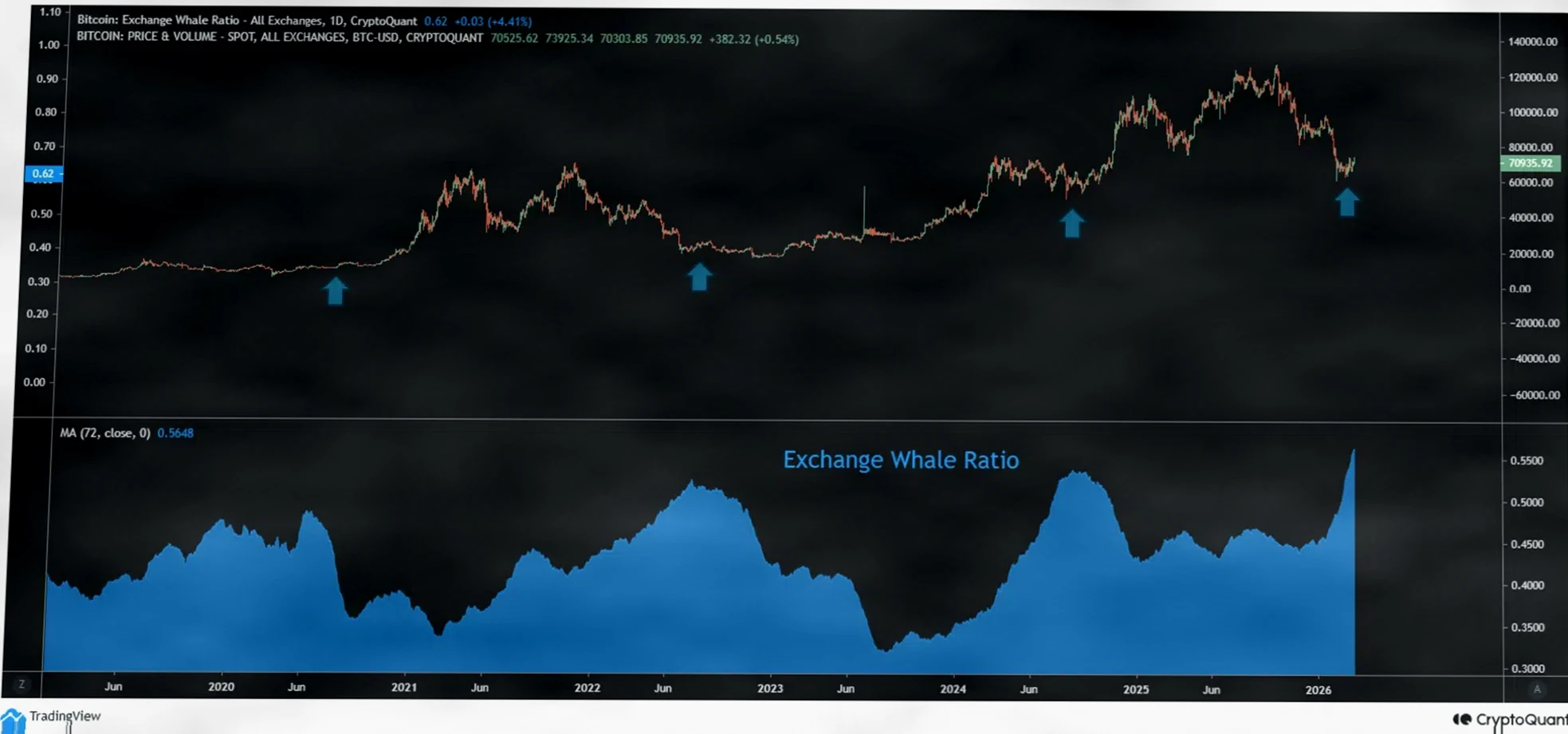
The rise in this indicator signifies that whales now account for a disproportionate share of exchange activity, while retail investor participation has fallen to a six-year low. Historical data suggests that whales tend to buy (accumulate) at low prices and sell (distribute) at high prices. Conversely, retail investors often buy during market euphoria and sell during panic. Therefore, when the whale trading ratio climbs at low price levels, it typically reflects whales absorbing supply from retail investors, a classic accumulation behavior.
Reviewing historical charts (spanning from June 2019 to March 2026), three significant surges in the whale trading ratio occurred after Bitcoin's price hit important bottoms, subsequently leading to strong rallies. The first took place from late 2019 to early 2020, after which Bitcoin experienced substantial growth. The second marked the bottom of the 2022-2023 bear market, with Bitcoin prices hovering between $15,000 and $20,000. The current third surge displays similar bottoming signals to the previous two instances.
This 'divergence' phenomenon, characterized by active whales and retreating retail investors, has been frequently observed at previous significant market bottoms. It reflects the distribution of market confidence: holders with the largest positions and longest investment horizons are buying as smaller participants exit or remain on the sidelines. This behavior is corroborated by other market data this week, such as Bitcoin's exchange supply dropping to its lowest point since November 2017, exponential growth in Ethereum's accumulation address balances, and the MVRV Z-Score falling to 0.38 – all of which have historically signaled cyclical lows.
In conclusion, the continuously rising Exchange Whale Ratio, combined with other positive market signals, provides strong behavioral support for a potential upcoming rally in Bitcoin's price.