

Bitcoin has been in a correction for nearly 160 days since hitting its all-time high in October 2025. While this period may feel lengthy for investors closely monitoring daily price fluctuations, it is insignificant when placed in the context of Bitcoin's historical cycles.
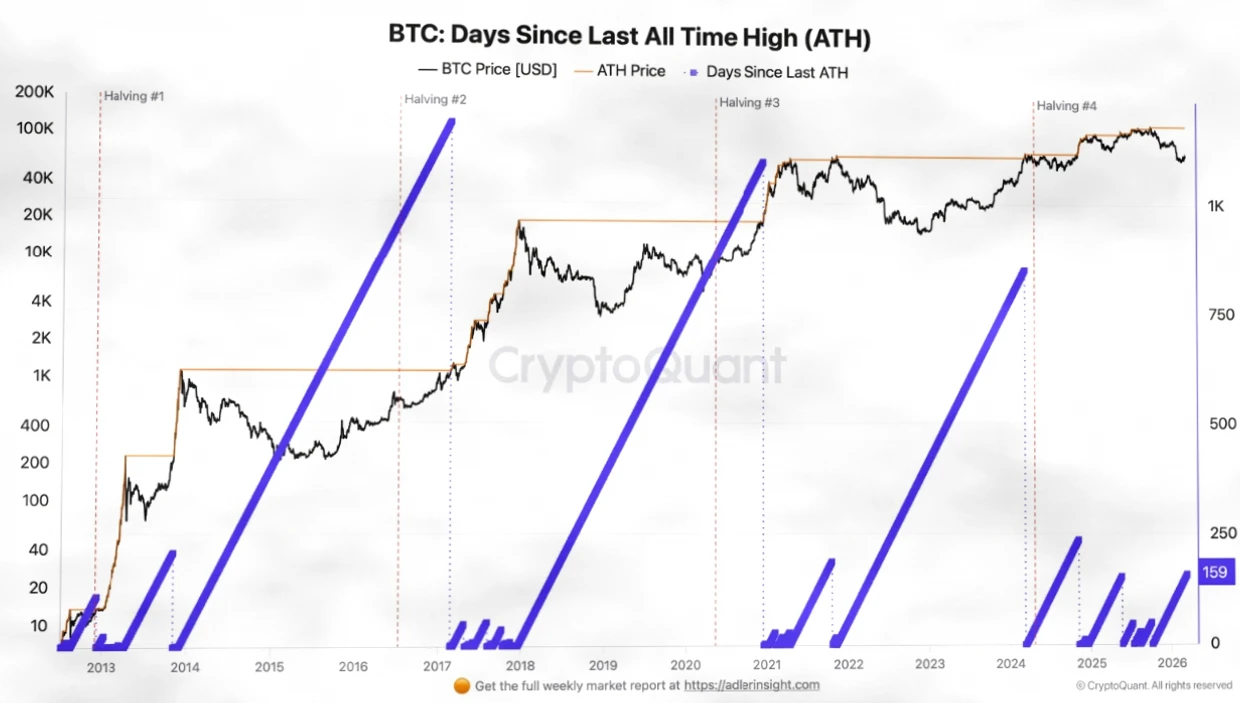
Historical charts clearly show a similar pattern across Bitcoin's four complete cycles. After each cyclical peak, the 'days to new all-time high' counter (marked in blue) experiences a significant growth period until Bitcoin eventually sets a new record and resets the count. For instance, after the 2017 peak, it took 1180 days to reach a new all-time high; the 2021 peak took 1093 days; and the 2025 cycle, due to its all-time high occurring earlier relative to the halving event than in previous cycles, took 849 days.
The blue line on the right side of the current chart shows 159 days. Compared to past cycles, the climb has just begun.
The Trend of Shortening Cycles
A constructive observation from the data is that the time intervals between different cycles are showing a trend of compression. From 1180 days to 1093 days, and then to 849 days, the time it takes for Bitcoin to recover from a low and reach a new high is shortening with each cycle. If this compression trend continues, the current cycle might end sooner than previous ones. However, the current duration of 159 days still has considerable time to fill compared to the shortest past duration of 849 days.
Notably, the 2025 cycle has already broken a historical pattern. Previous cycles typically saw new all-time highs occurring after the Bitcoin halving event, which is considered a key catalyst for stimulating new buying demand by reducing supply. However, the 2025 cycle peaked before the next halving. This was primarily due to the launch of spot Bitcoin ETFs in January 2024, which prematurely ignited institutional investor demand that historically manifested after the halving. This structural change is the fundamental reason behind the time compression in the current cycle.
The True Role of Halving
This analysis further clarifies the actual role of the halving event. Halving itself is not the primary driver for Bitcoin reaching new all-time highs. Typically, the bear market trend has already entered its later stages before the halving event, meaning market recovery momentum begins to build even before the supply reduction event occurs. The main function of halving is its long-term effect of reducing continuous selling pressure from miners, lowering Bitcoin's issuance rate, and further compressing the inflation rate, which has been declining since 2010, as shown by annual inflation data released by CryptoQuant earlier this week.
The disruption of the halving cycle pattern by the ETF launch is a one-time structural shift, not a repeatable variable. Institutional demand flowing through compliant products has generated a powerful buying force that the halving mechanism alone could not previously produce. This demand arrived ahead of the supply reduction.
What Does 159 Days Mean?
For long-term investors, a 159-day correction after a cyclical peak is more like market noise compared to the multi-year timelines that defined every past market recovery. Recall that investors who held on through the 1180 days after the 2017 peak were eventually rewarded with returns exceeding the new all-time high of over $69,000.