

Washington is currently experiencing a narrow legislative window that could provide tax exemptions for small Bitcoin transactions. Industry groups warn that Congress may only have a few months to act, or this year's opportunity will vanish. The Bitcoin Policy Institute (BPI) points out that lawmakers must pass meaningful legislation by August 2026 to introduce a minimum tax exemption for small digital asset payments. Without such an exemption, even minor Bitcoin transactions would trigger capital gains reporting under current U.S. tax law. The institute states that the timeline is constrained by political and legislative dynamics, which will soon limit Congress's ability to pass complex tax reforms.
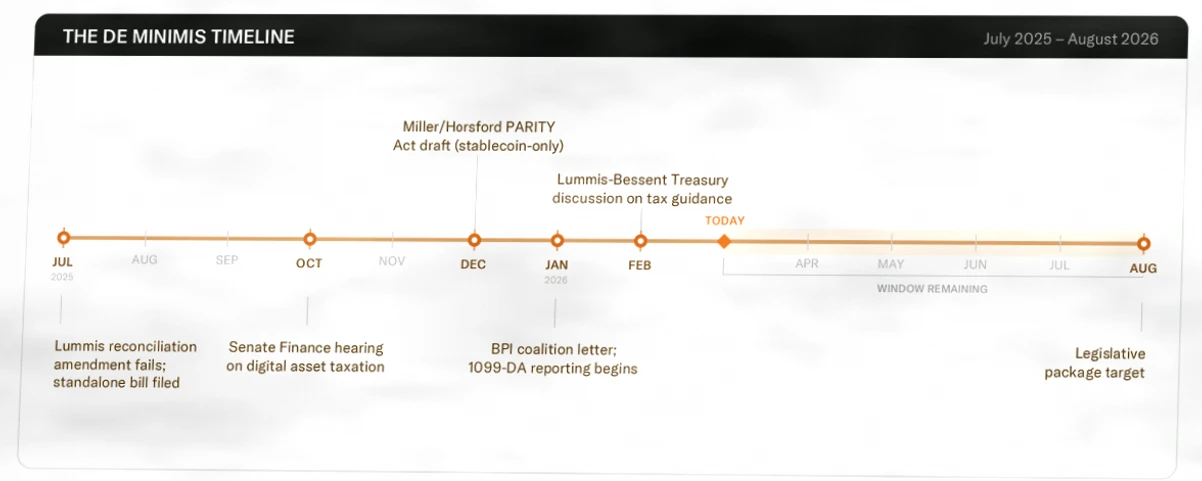
The pressure from the upcoming midterm elections is restricting the legislative window.
The main limiting factor comes from the approaching 2026 U.S. midterm elections, which will gradually dominate Congress's agenda as summer approaches. Historically, legislative activity significantly slows down before election cycles, especially for proposals involving complex tax frameworks. Lawmakers often shift their focus to campaign priorities, reducing the space for bipartisan policy negotiations.
For digital asset advocates, the coming months may represent the last realistic opportunity to secure a cryptocurrency payment tax exemption by 2026.
The departure of key Bitcoin advocates adds urgency to the situation.
Another factor affecting the timeline is the anticipated departure of Senator Cynthia Lummis, one of the most prominent advocates for Bitcoin legislation in the U.S. Senate. Lummis supports a proposal that suggests a minimum exemption of $300 per transaction, with an annual cap of $5,000. This measure aims to simplify everyday Bitcoin usage by eliminating the need to calculate capital gains for small purchases. However, Lummis is set to leave the Senate in January 2027, creating a sense of urgency among advocates to pass her proposal before her departure. Industry groups warn that if no action is taken before the current legislative window closes, similar proposals could stagnate for years.
Competing proposals focus on stablecoins.
Currently, advocacy for Bitcoin-related tax exemptions is competing with another legislative framework prioritizing stablecoins. The PARITY Act, introduced by Representatives Don Beyer, Mike Miller, and Steven Horsford, proposes a $200 tax exemption per transaction. However, this proposal is primarily aimed at regulated stablecoins rather than the broader cryptocurrency market. The bipartisan discussion draft of the PARITY Act was released on December 20, 2025, and currently appears to have more political momentum than proposals focusing solely on Bitcoin.
Debate arises over the “stablecoin-only” relief.
This distinction has raised concerns among Bitcoin advocacy groups.