

Globally, the use of stablecoins exhibits significant national variations. Among these, Tether (USDT) continues to maintain a leading position in the global market, while the share of USD Coin (USDC) is steadily increasing in several major economies.
A newly released dataset comparing national USDT and USDC holdings reveals how stablecoin prevalence is influenced by economic conditions, regulatory environments, and the stability of local currencies.
Nigeria Leads the World in Global Stablecoin Holdings
Data shows that Nigeria ranks first globally by a significant margin, with its stablecoin engagement far exceeding other regions.
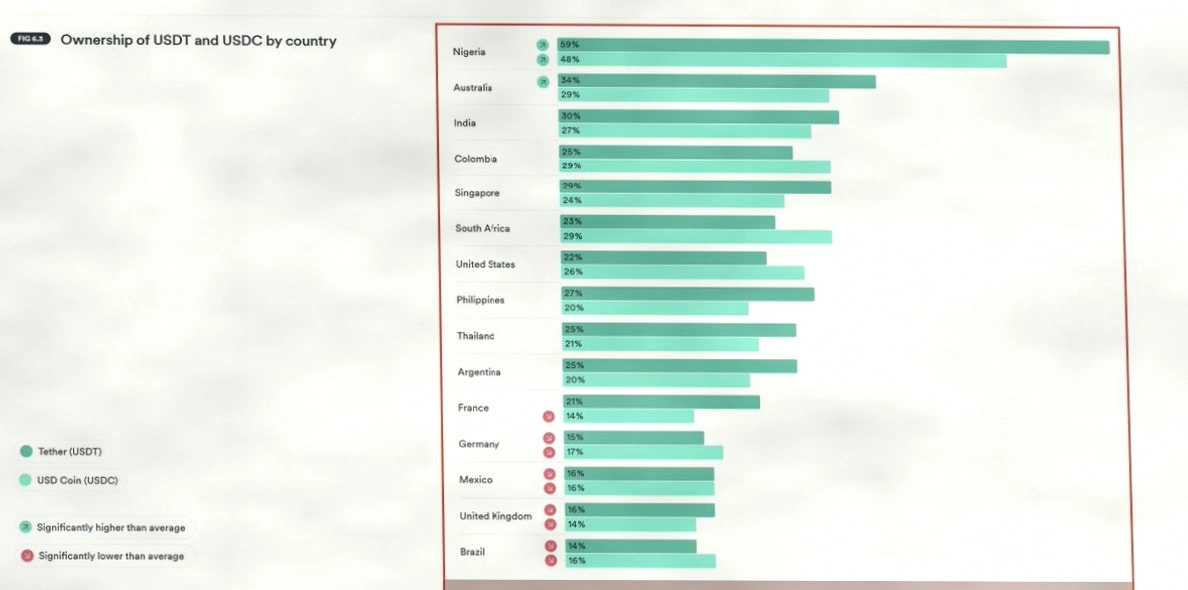
Nigeria's strong stablecoin adoption rate highlights how stablecoins serve as a crucial digital alternative savings tool when economies face widespread pressure from currency devaluation. In economic environments with high inflation or significant currency depreciation, dollar-denominated digital assets can effectively hedge against extreme fluctuations in the local currency.
Emerging Markets Show Strong Demand for Stablecoins
Several emerging economies also stand out in terms of stablecoin holdings, including:
In these regions, stablecoins are frequently used for cross-border remittances, international payments, and as a store of value, offering a faster way to access dollar value compared to traditional banking systems.
USDC Gains Traction in Developed Markets
Although USDT still holds the largest global market share, data indicates that USDC is gradually expanding its influence across various countries and regions. In some instances, USDC holdings have surpassed those of USDT.
This trend may reflect a growing demand for compliant stablecoin structures, particularly in areas where financial institutions and regulated platforms increasingly favor assets with clear regulatory frameworks.
European Stablecoin Penetration Remains Relatively Low
Looking at the dataset, European countries show relatively low overall stablecoin holdings. For example:
The lower adoption levels in this region might be linked to its mature banking systems and a more stringent regulatory environment.
Stablecoin Competition Intensifies
Data suggests that while USDT maintains global dominance, the competitive landscape is evolving as USDC expands in both developed and emerging markets. As stablecoins become increasingly integrated into payment systems, remittance processes, and digital asset trading, the regional preferences between USDT and USDC could become a key indicator for observing global stablecoin market trends.