

The market performance of Bitcoin at the start of 2026 has marked one of its weakest quarters on record.
According to historical return data, Bitcoin experienced a decline of approximately 18.3% in the first quarter of 2026, making it the fourth worst Q1 performance in its recorded history.
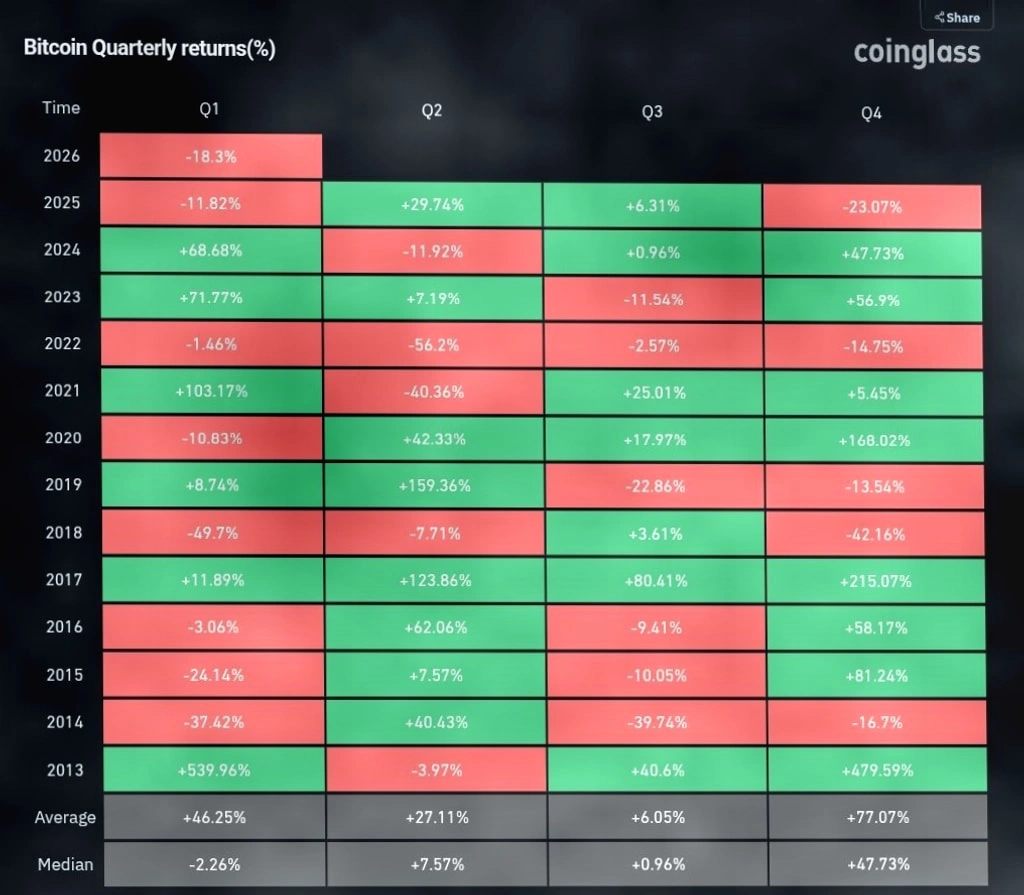
Q1 2026 Performance Ranks Among Weakest Starts
This 18.3% drop in the first quarter of this year is surpassed only by three more severe quarterly declines in its history.
Despite the current downturn, data indicates that a weak first quarter is not unprecedented in Bitcoin's history.
Notably, in many years where this occurred, Bitcoin achieved strong rebounds in subsequent quarters.
Bitcoin Historical Quarterly Volatility Overview
Relevant charts highlight the significant variations in Bitcoin's performance across different quarters of the year. For instance:
- The first quarter of 2018 saw a decline of 49.74%.
- The first quarter of 2022 saw a decline of 17.93%.
- The first quarter of 2014 saw a decline of 57.35%.
These cases suggest that the performance at the beginning of the year does not necessarily dictate the final outcome of the entire cycle.
Bitcoin has been 'declared dead' 471 times, and buying each time would have turned $47,100 into $74 million.
Average Quarterly Returns Remain Positive
Historical averages also indicate that Bitcoin's strongest performances often occur in the second half of the year.
According to available datasets:
- The average return for Q2 is 17.75%.
- The average return for Q3 is 5.17%.
- The average return for Q4 is 20.79%.
However, the median return for Q1 shows -2.26%, suggesting that volatility at the start of the year is relatively common, even in bull market environments.
Market Focus on Potential Recovery
While Bitcoin's performance this quarter ranks among its weakest starts historically, past data suggests that negative Q1 performance does not always hinder a strong rebound in the latter half of the year.
The coming quarters will be crucial in determining whether 2026 follows a similar pattern or continues to deviate from historical market cycles.