

How the market is judging.
The rules of the prediction contract are clear: if, based on CoinGecko data, Ethereum (ETH) falls to second place in market capitalization at any point between January 1 and December 31, 2026, the contract will resolve to "Yes." Even a brief intraday fluctuation in rankings counts. If ETH remains in second place for the entire year, it will resolve to "No" on January 1, 2027.
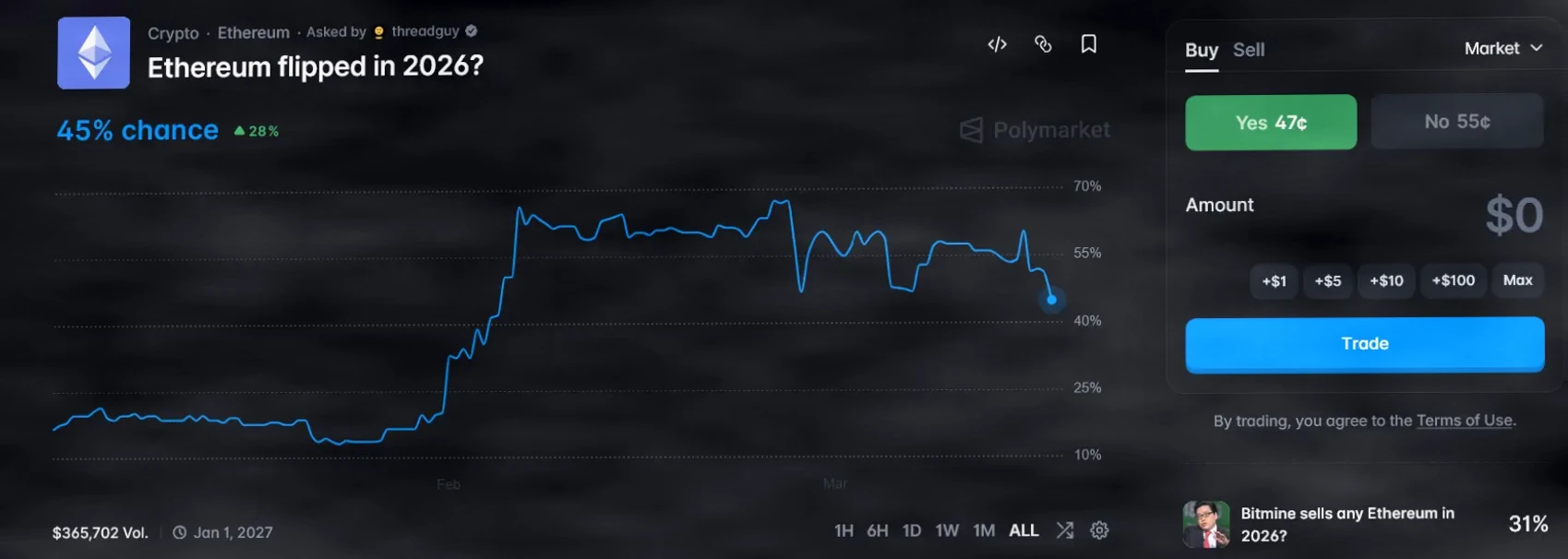
The market launched on January 2, and trading volume has steadily increased. In recent months, the probability of a bullish outcome (resolving to "Yes") has fluctuated between 10% and 70%. Notably, there was a significant surge in February, with the bullish probability reaching over 50% and peaking at 68% before a slight pullback.
Who could overtake Ethereum?
Currently, the market cap gap between Ethereum and its closest competitor offers a significant reference point. Ethereum's market cap stands at approximately $273 billion, while the second-ranked non-Bitcoin asset, stablecoin Tether (USDT), has a market cap of around $184 billion. This leaves a gap of approximately $89 billion between them.
After this, the market cap gap widens further:
For an overtake to occur, any competing asset's market cap would need to grow two to three times, while Ethereum's market cap remains flat or declines. This is a tall order, and thus, much of the market's focus is on USDT as the most likely contender.
Unlike more volatile tokens, USDT's growth stems primarily from real-world utility and new issuances, rather than speculative price appreciation. Its market cap is directly tied to its circulating supply. If stablecoin use cases continue to expand, USDT could theoretically close the $89 billion gap without a massive price surge.
Why the large gap, yet rising bullish odds?
Several factors can explain traders pushing the prediction market's bullish odds from 14% to nearly 50% in less than three months:
First, Ethereum's recent performance has lagged the broader market. It trades around $2,264, far below its previous all-time high of nearly $4,950. This means its market cap is compressed compared to previous cycles.
Second, USDT's market cap had been steadily growing until a recent pullback. It approached a peak of nearly $187 billion in January before settling around $184 billion. This was partly influenced by the EU's MiCA regulations, which prompted exchanges to restrict European users' access to USDT. While regulatory pressure has slowed Tether's growth, the market cap gap remains narrow enough for an overtake to be plausible.
Third, market sentiment surrounding Ethereum is largely bearish. In another Ethereum price prediction market on Polymarket, 61% of participants expect ETH to remain below $1,500 this year. On competitive prediction platform Kalshi, some traders are even betting on ETH falling to $1,250. This cross-platform pessimism further fuels the possibility of a "flip."
Can Ethereum hold its ground?
There is, of course, a possibility. Ethereum's roadmap for 2026 includes two major upgrades: the Glamsterdam upgrade in the first half of the year and the Hegotá upgrade in the second half. Both aim to enhance scalability and user experience, potentially driving application growth and transaction fee revenue.
On the institutional front, BlackRock recently launched its iShares Staked Ethereum Trust ETF (ETHB) on Nasdaq, providing traditional investors with exposure to Ethereum and the ability to earn staking yields.