

According to a report from CryptoQuant, on March 4th, the net outflow of Bitcoin from major exchanges reached 28,700 BTC, marking the largest single-day outflow since November 2025. This figure is superficially interpreted as a bullish signal for the market—investors transferring coins from trading platforms to private wallets indicates a stronger long-term holding sentiment and reduced market supply. However, a deeper analysis reveals that there is more to this phenomenon.
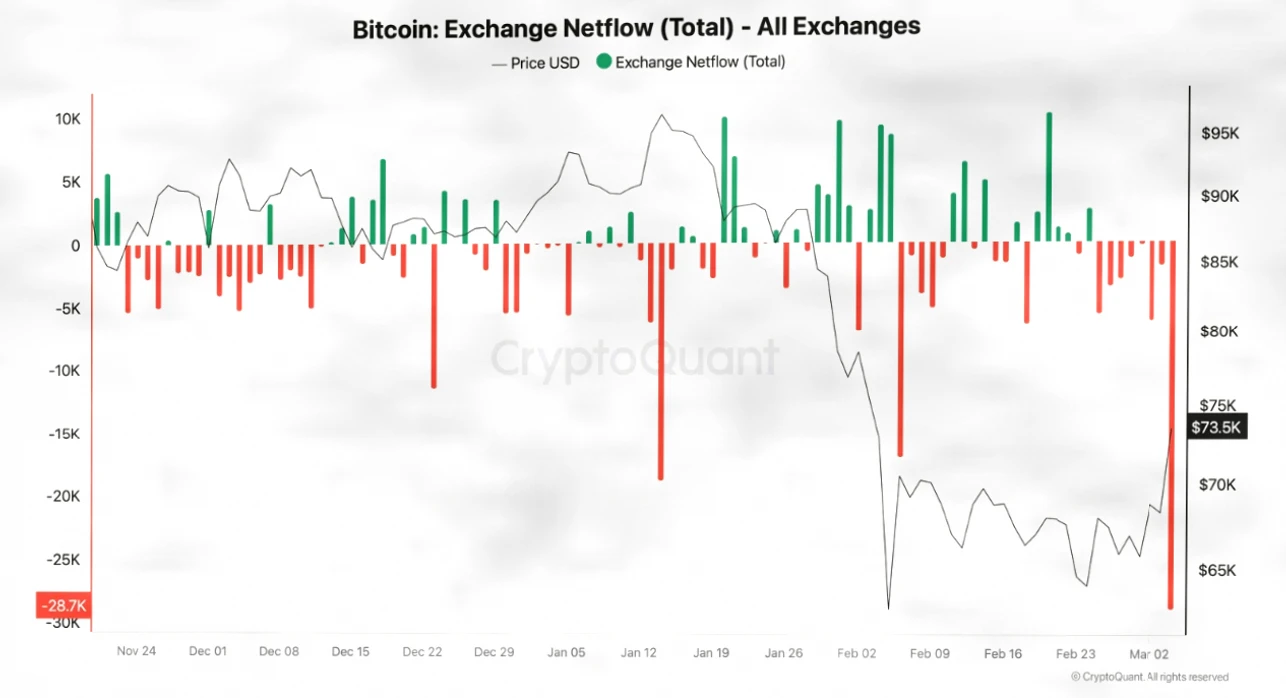
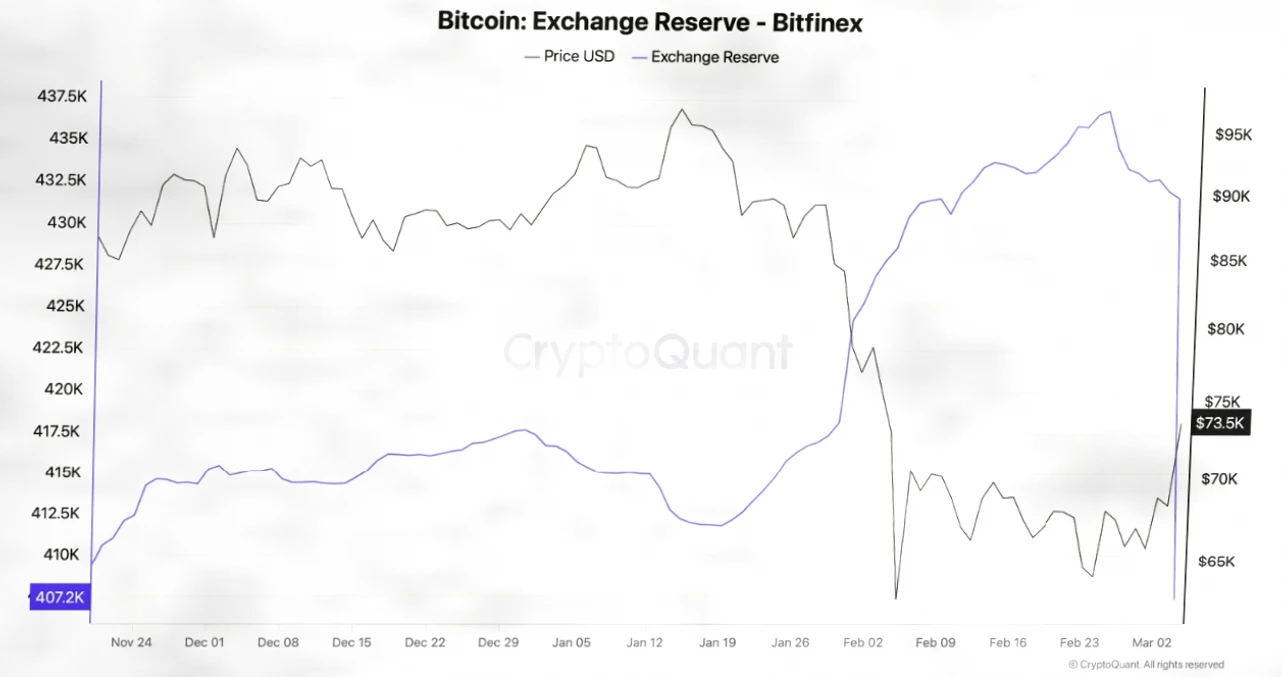
It is noteworthy that this massive outflow was almost entirely concentrated in one exchange: Bitfinex. Its reserves plummeted from 431,767 BTC to 407,140 BTC, with a net outflow of approximately 24,627 BTC in a single day, accounting for 86% of the total outflow across the network. Excluding Bitfinex, the total outflow from all other exchanges was only 4,073 BTC, which falls within the normal range of fluctuations and shows no abnormalities.
The more critical detail is that of the 24,627 BTC from Bitfinex, 23,588 BTC was transferred in a single transaction to a brand new wallet address. This operational pattern is starkly different from the behavior of ordinary users who typically withdraw funds in hundreds or even thousands of transactions, sending them to existing personal wallets. The single transaction to a new address is characteristic of internal fund management at exchanges—such as cold wallet reorganization, reserve migration, or asset consolidation.
Currently, Bitfinex has not issued an official statement regarding this fund movement. However, this does not imply any risk or anomaly. In the crypto industry, it is standard practice for exchanges to periodically adjust their reserve structures and optimize security configurations, and for security reasons, such internal operations are usually not disclosed in advance. No announcement does not equal something suspicious; it is more likely a discreet handling under compliance and risk control.
Therefore, categorizing this event simply as a “boost in market confidence” or a bullish signal of “large-scale accumulation” is a misinterpretation of the data. The real driving factor is not retail behavior but rather the asset management processes of centralized exchanges. Investors who base their judgments solely on total volume data may misinterpret the true market sentiment.
It is worth mentioning that according to Bitwise data, investors holding Bitcoin for over three years have a loss probability of only 0.7%. This indicates that long-term holders still dominate the market, and short-term flow fluctuations should not overly interfere with trend judgments.